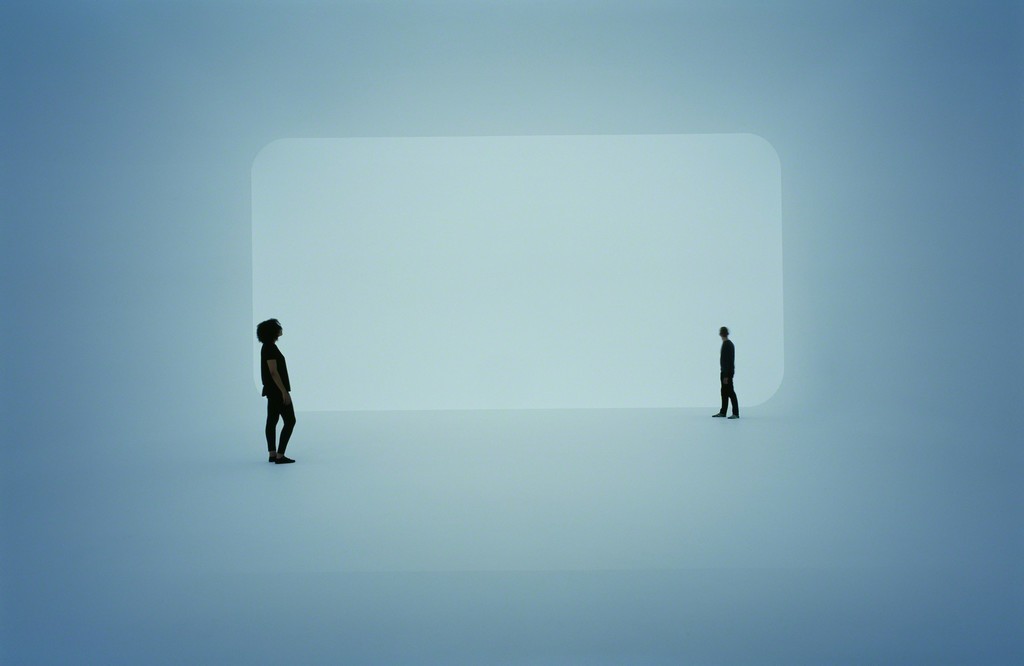
James Turrell’s Into the Light exhibition at MASS MoCA is a must-see exhibition. The artwork on display is jaw-dropping both visually and intellectually. James Turrell doesn’t just deconstruct light, but the very nature of seeing. While slightly hindered by the labyrinth-like venue, the mind-numbing wait to see certain works, and the lack of educational value, Into the Light is an extraordinary exhibition that must not be missed.
Turrell is a world famous artist and architect who applies his psychology and mathematics background to his work. He has been prominently featured in many solo exhibitions in reputable venues such as the Museum of Modern Art in New York City, National Gallery of Art in Washington D.C., Centre Georges Pompidou in France, National Gallery of Australia in Canberra, among many more. He even received the coveted ‘Genius’ award from John D. and Catherine T. MacArthur Foundation in 1984, as well as the National Medal of Arts in 2013.
His exhibition Into the Light at MASS MoCA features a collection of sculptures, interior spaces, and optical illusions that focus on manipulating the viewer’s perception. Some of his most interesting optical illusions are in his “Reflective Hologram” series, which use a flat surface to reflect light to create the illusion of a three-dimensional chromatic shape. The illusion breaches the surface and invades the viewer’s space, warping and shifting as the one moves around it. This subtle spatial intrusion and warping of the viewer’s perception creates a deeply subconscious reaction. The sculptures are of interesting yet mind-boggling architectural models of strange buildings and interior spaces, and feel almost alien in the way they manipulate the viewer’s sense of space, especially at such a tangibly small scale. The layout of the interior of these sculptures are reminiscent of M.C. Escher’s work, specifically the famous lithograph Relatively. In it, Escher creates an optical illusion of infinite descending staircases, which seem to have directly inspired some of Turrell’s architectural models. But the sculptures and minor illusions are mere mental chewing gum in comparison to his larger, more involved architectural spaces.
These rooms of pure light are gorgeous yet sublime. In Pink Mist (Space Division), the viewer must walk down a winding darkened hallway, into an almost pitch black room. The only light source to be found are two stage lights emitting subtle pink light onto what appears it be a white wall. After closer inspection, it turns out not to be a flat wall, but instead a perfectly rectangular hole in the wall that leads into another chamber. This extra chamber is not accessible, with only a square-shaped gap through which to view it. The piece creates an awe-inspiring illusion of endless space; both nothingness and everything at the same time. This absolute deconstruction of the way we humans perceive the space that immediately surrounds us has a very sublime effect, both beautiful and frightening. It highlights the imperfectness of the human eye, and allows the viewer to understand how easily our most trusted sensory organs can be tricked and manipulated, with nothing more than light and a room. Turrell himself perfectly explains the motivation driving these spaces when he said “I want to use light as this wonderful magic elixir that we drink as Vitamin D through the skin—and I mean, we are literally light eaters—to then affect the way that we see.” There are many more experiences like Pink Mist (Space Division) on view, such as Perfectly Clear and Hind Sight, but it would be a disservice to spoil the experience any further. They are best experienced by viewers having as little pretext as possible before viewing the works.
While Turrell’s work is beautiful and engaging, a glaring complaint about the exhibition is its lack of educational value. To start with, some of Turrell’s pieces appeared to not have didactics. There was an accompanying pamphlet detailing the exhibition, and in it there is plenty of information on the artist and his accomplishments. However, it does not discuss anything beyond this, leaving out any mention of his contemporaries, how he fits into the broader context of art history, or any additional context on his design philosophy or details on the works themselves. Only surface level descriptions and bios are made available during this exhibition. This leaves artists and other curious parties wanting for more information. This also makes it difficult to fully utilize the experience of these works from an educational perspective. This is unfortunately not the only issue with this exhibition.
The Massachusetts Museum of Modern Art as a whole, for all its strengths, fails in the minutest yet most noticeable ways. The buildings themselves are not intuitively laid out, which is the nature of the renovated mill in which it is located. The signage and maps do little to help an eager art viewer to find their way to their chosen exhibition in a timely manner. Once you do manage to find your way to the Turrell exhibition, you’re met with long waits to see the more important pieces. Viewers are supposed to register online for thirty-minute time slots to see both Perfectly Clear and Hind Sight, which are arguably the most impactful pieces on display. This information about the necessity to sign up is very well hidden, only appearing vaguely on the MASS MoCA website or by speaking to the numerous exhibition attendants. Once signed up, one must continue to wait as only a handful of people are allowed to see each piece at a time, compounding the waiting problem to an almost infuriating degree. This is not a fully damning issue, but it will make even the most patient of people slightly miffed at this uncooperative system. On top of this, the venue does not do a good job at making an accessible environment for disabled people with its hard to navigate floor plan and lack of brail didactics and elevators.
Over all, James Turrell’s exhibition Into the Light at the MASS MoCA is an excellent exhibition that offers anyone who has the patience to see it have a visual feast. The exhibition has its problems, but if these can be overlooked, a unique visual experience is bound to be had.
Header image:
James Turrell, Perfectly Clear (Ganzfeld), 1991. MASS MoCA, 1040 MASS MoCA WAY North Adams, MA.
Sources
Esher, M.C. Relativity. 1953. Lithograph 294mm x 282mm. M.C. Esher Foundation. Accessed March 2019. https://www.mcescher.com/gallery/back-in-holland/relativity/.
Into the Light: James Turrell. Exhibition Pamphlet. North Adams, MA: Mass Moca, 2018.
James Turrell: Into the Light. Mass Moca. Accessed March 6, 2019. https://massmoca.org/event/james-turrell/.
MASS MoCA. Mass Moca. Accessed March 6, 2019. https://massmoca.org/.
Turrell, James. Biography, James Turrell Personal Website, 2019. Accessed March 2019. http://jamesturrell.com/about/biography/.
Turrell, James. “Interview.” Guggenheim Museum, 1071 5th Ave, New York, NY. Interview by Michael Govan, June 20, 2011.
 Issues in Contemporary Art