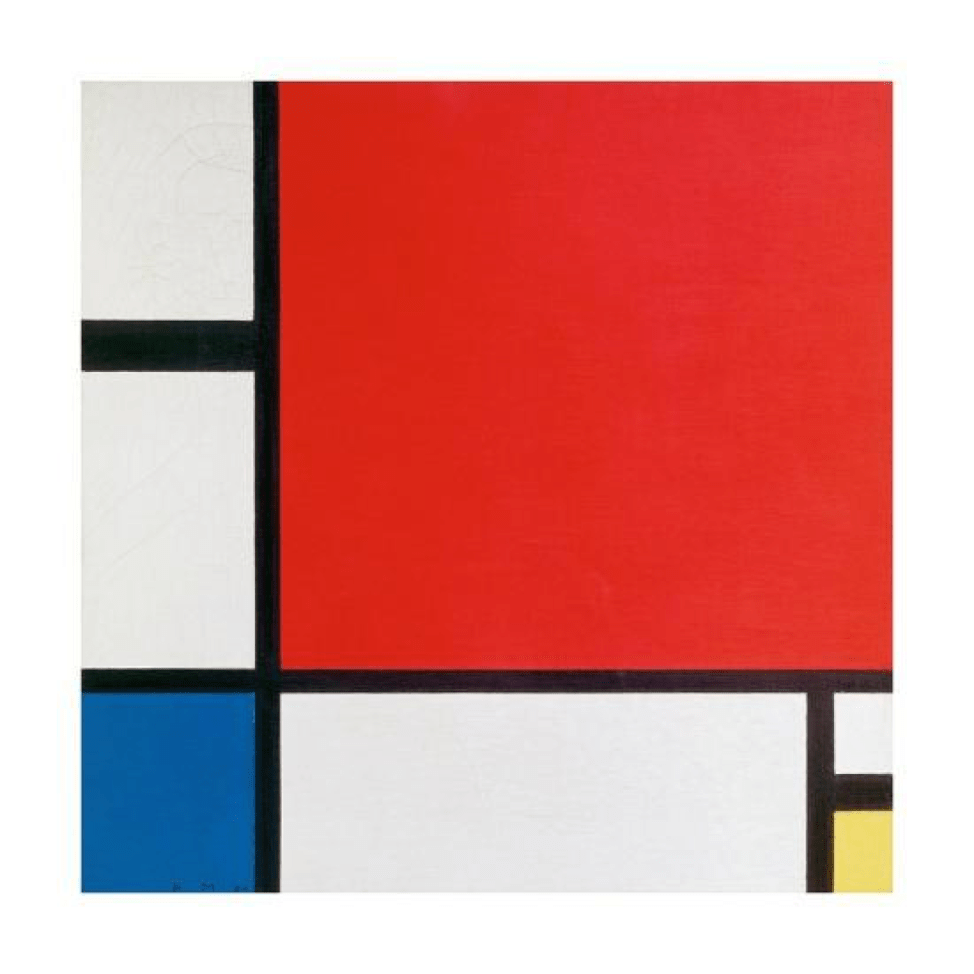
De Stijl remerges almost half a century later in the Minimalist art movement, stripped from its fundamental depths and classic red, blue and yellow palate. Instead, Minimalism takes on the classic shapes and lines to redefine the purest abstraction. The attempt to remove all recognizable aspects in our life is displayed through Minimalism’s clarity, much like De Stijl’s harmony: “I wish to approach truth as closely as is possible, and therefore I abstract everything until I arrive at the fundamental quality of objects,” Piet Mondrian once said.
The art movement De Stijl, otherwise known as Neo-Plasticism, was an art movement that launched in 1917s. With only geometric shapes, primary colors, and vertical and horizontal lines, these painting achieved perfect harmony. This purified abstraction presents the fundamentals of art in an aesthetically stunning light. Great conceptual depth lays behind each line, from which simplistic unity of this classic style emerges. “Abstract-Real painting reveals the abstract vitality of full and complete life, by intensifying the naturalism of its plastic to the really abstract, i.e., by the making it determinate, and by establishing equilibrated composition (or proportion); its vitality becomes real through the rhythm of the composition and through the relativity in which abstractness appears”– Hans L Jaffe.
Abstraction composed of simple geometric shapes and lines reappeared with the art movement of Minimalism in 1960s. This abstract style has similarities with De Stijl for the commonly used shapes and lines, but the conceptual thread differs.
“Minimalism or minimalist art can be seen as extending the abstract idea that art should have its own reality and not be an imitation of some other thing. With minimalism, no attempt is made to represent an outside reality, the artist wants the viewer to respond only to what is in front of them. The medium, (or material) from which it is made, and the form of the work is the reality. Minimalist painter Frank Stella famously said about his paintings ‘What you see is what you see.’”
Furthermore, De Stijl and Minimalism hold parallels to one another through their interest in to creating a pure, aesthetic beauty for the viewer. De Stijl is comprehensiveness focuses on only the purest objects to express a symbolic internal connection. Where Minimalism’s goal is to allow viewers to only see what’s right in front of them, and nothing else. The differences between these two are small, but greatly change the way we view them. De Stijl’s red, blue, and yellow colors balance themselves on a white canvas and connect with black vertical and horizontal lines. This combination represents an internal balance of the fundamentals, where Minimalism abandons the balance and meaning behind the primary colors and vertical and horizontal lines. In its place, we see this abstraction loses the claim of any fundamental quality, and becomes complete openness with no internal connection or symbolic depth, but a pure moment of clarity.
With small shifts from harmony to clarity, these two movement hold close ties. These similarities display the shared rebellion against lavish designs by abstracting purity, which allows the viewer to open their mind in a moment of aesthetic pleasure in their hectic lives.
Header image:
Piet Mondrian, Composition with Red, Blue, and Yellow, 1930, oil on canvas, 46 x 46 cm Museum: Kunsthaus Zürich
Photo Credit: Piet Mondrian [Public domain], via Wikimedia Commons
Sources
Jaffe, Hans L, C De Stijl, New York: Abrams, 1971.
“Piet Mondrian Paintings, Bio, Ideas,” The Art Story, Accessed February 12, 2019.
Tate, “Minimalism – Art Term,” Tate, Accessed February 12, 2019.
 Issues in Contemporary Art