Surrealism is an art movement that took Europe by storm in the 1920s. The intriguing yet controversial subject matter would influence art styles to come. One art movement that greatly influenced by Surrealism was Abstract Expressionism, a movement that was founded twenty years after Surrealism. Abstract Expressionism was an American art movement that focused on applying automatic drawing and painting as a form of expression. Although both art movements have vastly different appearances, the fundamental core of both are identical.
In the early twentieth century, artists began to explore the unconscious mind as a source of inspiration. Surrealist paintings were often composed in a hyper-realistic style of nonsensical subject matter. This style emerged from Surrealist artist’s desire to create dream-like paintings. However, surrealism was also an art form based on automatism: “Pure psychic automatism, by which one proposes to express, either verbally or in writing or otherwise, the actual functioning of thought. Dictation of the thought, in the absence of any control exercised by reason, apart from any aesthetic or moral concern.” This quote from Andre Breton’s Surrealist Manifesto showcases the intentions and methods of the Surrealist artists. Although, this quote can also apply to Abstract Expressionism.
Abstract Expressionism, in a way, is a critique of the Surrealist methods. According to Robert Hobbs in his novel titled, Surrealism and Abstract Expressionism: From Pyschic to Plastic Automatism: “Matta hoped to challenge Surrealism by focusing on his idea of a truer, more authentic approach, based on the definition of psychic automatism found in Breton’s 1924 manifesto.” This group of American artists that consisted of Robert Motherwell, William Baziotes, Peter Busa, Gerome Kamrowski, and Jackson Pollock, would form Abstract Expressionism. Unlike Surrealism, Abstract Expressionist displayed automatism in its purest form. Abstract expressionism stripped away the hyper-realist style of Surrealism, in order to showcase the unconscious mind in its most raw state.
Automatism is to act without conscious thought:“When I am in my painting, I’m not aware of what I’m doing.” This quote by Jackson Pollock perfectly illustrates his pure automatist approach to painting. Abstract Expressionists took a core value of Surrealism and turned it into something new. Instead of defining the unconscious mind with detailed renderings, Abstract Expressionist let the unconscious mind express itself.
Art is everchanging, ever evolving, and ever defining. Art movements are influenced by their predecessors, taking old ideals and turning them into something new. Abstract Expressionism is no exception.
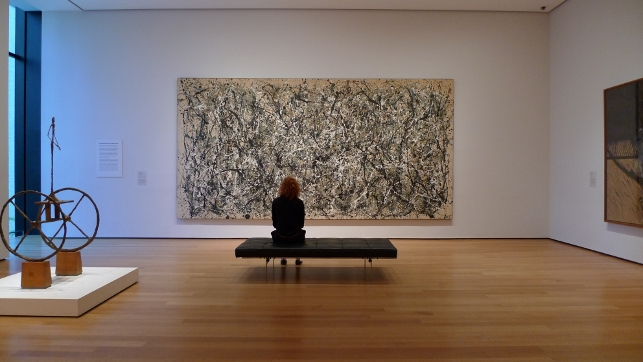
Header image:
Jackson Pollock, One: Number 31,1950. Oil and enamel paint on canvas 8′ 10″ x 17′ 5 5/8″. Collection of the Museum of Modern Art, New York. Sidney and Harriet Janis Collection Fund (by exchange).
Sources
Breton, Andre, First Manifesto of Surrealism, 1924, n.p., (A. S. Kline), n.d., http://self.gutenberg.org/eBooks/WPLBN0002171411-First-Manifesto-of-Surrealism–1924-by-Breton-Andr-.aspx
Bontecou, Lee, Untitled, 1959, (MoMA), Accessed February 12, 2019, Web, https://www.moma.org/interactives/exhibitions/1998/pollock/website100/txt_possibilities_drip.html
Hobbs, Robert, Surrealism and Abstract Expressionism: From Psychic to Plastic Automatism, In Isabelle Dervaux, Surrealism USA, (New York: National Academy Museum in conjunction with Hatje Cantz Publishers), 2005, pp, 56-65, http://www.roberthobbs.net/essay_files/Surrealism_and_Abstract_Expressionism.pdf
 Issues in Contemporary Art