Artificial Intelligence is an emerging medium in the contemporary art world. Only recently has technology improved enough to allow the creation of algorithms capable of preforming complex tasks like generating an original image. AI art is pivotal within the history of contemporary art because it gives artists a new medium by which to create unique works, and a new framework through which they can explore and extrapolate upon on the role of the artist in the creation of a work. The Bauhaus idea of the artist as an engineer is invoked, as to code AI one must be intensely familiar with computer science and coding. It also allows artists to further explore ideas of randomness, iteration, and artistic authorship that the Abstract Expressionists and Surrealists experimented with before them.
In the last few years, artificially intelligent technology has improved at an exponential rate. Computer algorithms have gone from only being able to perform basic sorting tasks to being capable of self-learning entire languages. This technology is primarily developed and used to solve extremely large and complicated data processing tasks that would take humans far too long to preform manually. Artists are beginning to experiment with a technology that was developed to help automate computing processes is now being explored as a means of creative expression. As AI art is a relatively new medium by which artists can express themselves, it is a fertile field ripe for exploration and invention. This is unfortunately hindered by the fact that coding for AI is an incredibly difficult thing to do. Not only is computer logic and the actual building the code difficult in itself, but finding ways to implement AI within the fine art context alone presents a seemingly insurmountable endeavor. These perceived barriers can be conquered however, proven by the many artists who use AI to create their work, such as Harm van den Dorpel, the duo of Shantell Martin and Sarah Schwettmann, and many others.
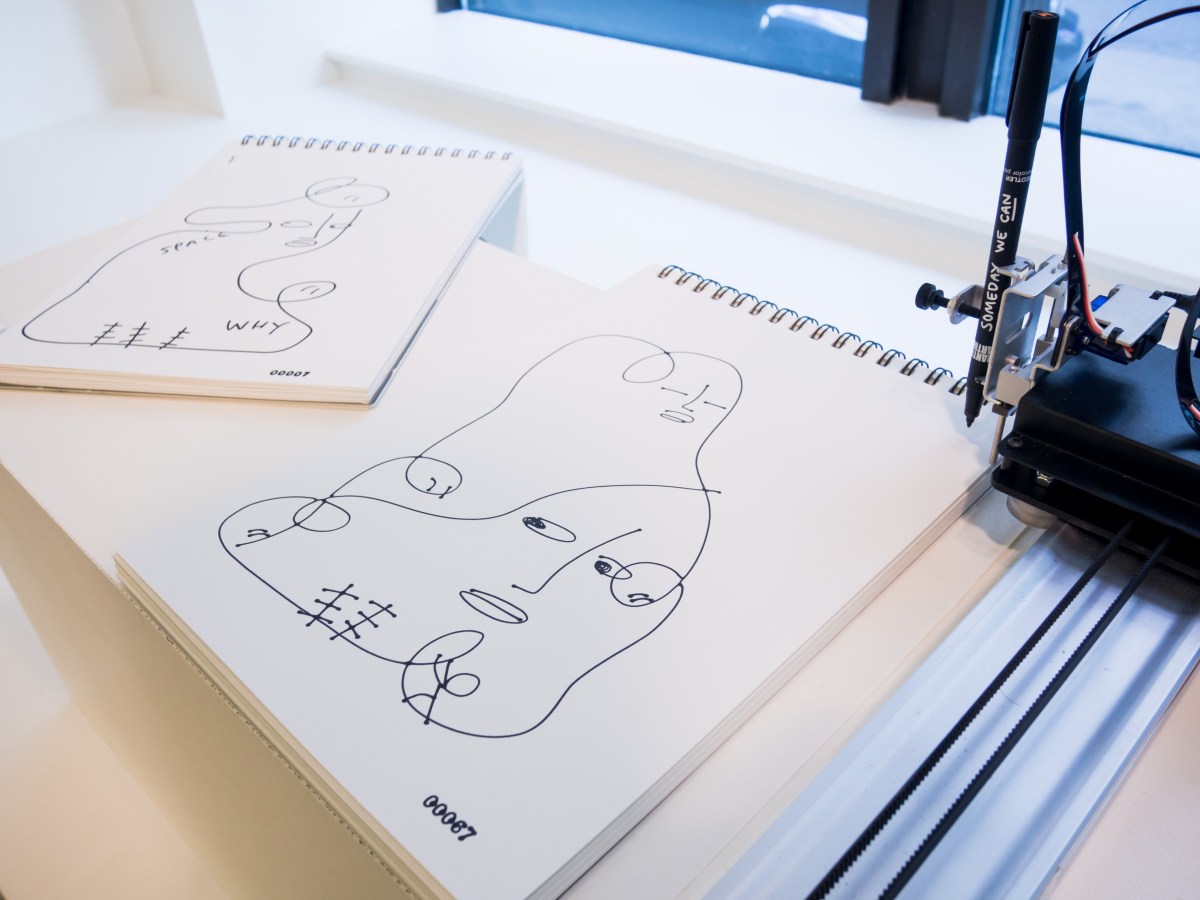
While these artist may vary in the specific projects they engage in, there are a few overarching ideas presented purely by the medium itself. The first being how AI art, by its very nature, toys with the idea of what it means to be an artist. To create AI one must develop technical skills to code as well as to understand machine logic, which are not easy concepts to master. This is reminiscent of the Bauhaus ideology that the “artist” is a skilled craftsman/engineer whose work should be as functional as it is artistic. But rather than physical craftsmanship, AI artists delve into the newest technology of our era; computers and robotics. While at the same time, AI art calls into the question the very nature of being an “artist.” AI artists create machine learning algorithms that in some cases can create its own original artwork. In these instances, whom would the true artist be? The original creator, or the AI itself? The previously mentioned Sarah Schwettmann developed the artificial intelligence that was capable of replicating Shantell Martin’s specific artistic style after being shown over three hundred examples in their collaborative project called Mind the Machine in 2017. This shows that there are some aspects of the creation of art that is not specific to humans, and can be replicated by non-human entities such as AI. There are however, limitations to what the artificial intelligence could do. The Ai was not capable of creating original art without a prompt. These findings begin to lessen the importance or gravitas of the human artist as the sole creative force in the context of art. The questioning of artistic authorship as well as the importance of the artist have been hotly debated topics historically, and AI art serves to further the discussion, as well to present many more interesting and divisive questions to consider.
AI artists also explore concepts of randomness and spontaneity in their work. In many ways, this is an extension of the attempts to explore the subconscious human mind during creation of automatic art by both the Surrealist and Abstract Expressionist art movements. This concept is taken to a whole new level in attempts to create artificial intelligence that can be programmed to generate original work. In essence, the art is literally creating itself! This goes far beyond the subconscious, it almost entirely removes the human from the picture. Of course, the AI can only act within the parameters set by its human creators, a note that is important to address when discussing artificial intelligence. From this logic, it could be posited that the algorithm itself is the ultimate reflection of the creator’s subconscious. AI can not only generate original work (if programmed to do so), but they can also be used to replicate artwork on both small and large scales, as well as create an iterative series of work. These robotic artists may eventually begin to explore their own unique aesthetic ideas in the near future.
Artificial Intelligence in art is a very important new medium in the context of art history. It is a new frontier of endless creativity ripe for artistic experimentation. AI art works explores the concepts of what it means to be an artist, as well as the potentials for randomization and iteration. This intellectually stimulating newcomer to contemporary art is one to keep a close eye on for many interesting developments.
Header image:
Shantell Martin and Sarah Schwettmann, Mind the Machine, June 9th – July 21st, 2017. OPEN Gallery, 201 South St, Boston, MA.
Sources
Abstract Impressionism. The Tate UK. Accessed April 10, 2019. https://www.tate.org.uk/art/art-terms/a/abstract-expressionism.
Anyoha, Rockwell. The History of Artificial Intelligence. Harvard University Blog. Published August 28, 2017. Accessed April 10, 2019. http://sitn.hms.harvard.edu/flash/2017/history-artificial-intelligence/
Mateas, Michael. Expressive AI: A Hybrid Art and Science Practice. Leonardo, Volume 34, Issue 2, Pages 147-153. April 2001. The MIT Press Journals. Posted Online March 13, 2006. Accessed April 10, 2019. https://www.mitpressjournals.org/doi/abs/10.1162/002409401750184717.
Martin, Shantell and Schwettmann, Sarah. Mind the Machine. Open Gallery, 2017. Accessed April 10, 2019. http://galleryopen.org/mind-the-machine/.
Surrealism. MoMA Learning. Accessed April 10, 2019. https://www.moma.org/learn/moma_learning/themes/surrealism/tapping-the-subconscious-automatism-and-dreams/.
Winton, Alexandra Griffith. The Bauhaus, 1919-1933. The Met, Heilbrunn Timeline of Art History. Published August 2007, Last Editted October 2016. Accessed April 10, 2019. https://www.metmuseum.org/toah/hd/bauh/hd_bauh.htm.
 Issues in Contemporary Art