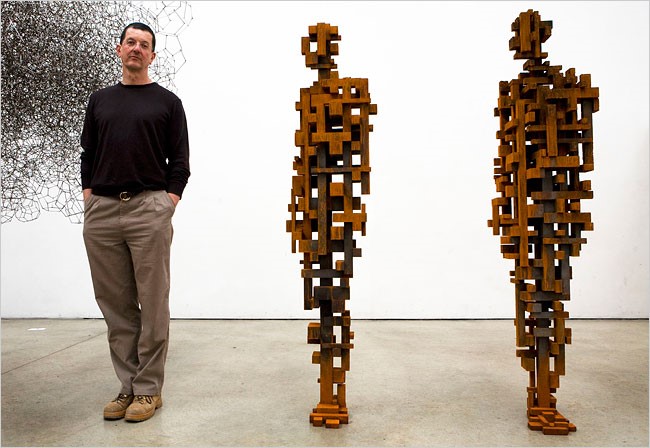
Antony Gormley is a sculptor who is widely acclaimed for his installations that investigate the human body and condition. Throughout his artistic career, Gormley has been awarded many prizes, including the Turner Prize in 1994, the South Bank Prize for Visual Art in 1999, and the Bernhard Heiliger Award for Sculpture in 2007, among many more. Gormley critiques the human-centric beliefs of Catholicism, with the beliefs of cosmology where the human presence is seen as irrelevant to the greater whole.
Born in London in 1950, Gormley was raised in a Catholic home and was the youngest of seven children. Gormley’s father was an art-lover who would often take his family to the British Museum or National Gallery after church on Sundays. These museum visits had a lasting impression on young Gormley, as he still holds vivid memories of them. After Gormley fostered an aptitude for art, as a boy, he travelled to India where he studied Buddhism, spirituality, and cosmology. After three years in India, he decided to try his hand at becoming a professional artist. With his newfound enlightenment, Gormley began to portray the human body in relation to both cosmology and the Catholic beliefs of his upbringing.
Antony Gormley’s work titled Bed is a sculpture created out of sliced white bread and wax on aluminum panels. The bread is uniformly stacked to create the shape of a bed, with a human shaped void cut into it. The pose of the absent form resembles common depictions of Christ’s burial. “Bed suggest the Catholic ritual of consuming the body and spirit of Christ, dually symbolized by bread, through the taking of sacrament.” The void created by the absent figure, represents “both infinity and absence: ‘the infinity of space within the body’, which is the locus for man’s spiritual potential.” Antony Gormley would continue to foster this obsession with the human form and our inherent spirituality in works like Sound II, created in 1986, and Angel of the North, created in 1998.
Being exposed to the arts at a young age played a significant role in Gormley’s decision to become an artist. However, Gormley wouldn’t develop his artistic voice until after his travels to India, where he would learn about spirituality and cosmology and how it related to his catholic upbringing. It was only then that Gormley would become an artist investigating man’s physical and spiritual relationship to the natural and elemental world. In order to evoke thoughts and feelings in viewers, Gormley began to cast his own body with the hopes of conveying his own emotions through his physical form. By taking inspiration from his own experiences -and body- Antony Gormley has become a widely acclaimed sculptor, whose work is on view around the world.
Header image:
Antony Gormley in his London studio. Photo credit to Hazel Thompson, The New York Times.
Sources
- Gormley, Antony, Biography, Accessed March 15, 2019, http://antonygormley.com/biography
- La Spina, Salvatore, Izzo, Barbara and Diana, Arianna, ANTONY GORMLEY HUMAN, (Comune di Firenze), Accessed March 15,2019, http://www.antonygormley.com/uploads/files/HUMAN%20Press%20Release.pdf
- Wroe, Nicholas, Profile: Antony Gormley, (The Guardian), June 24, 2005, Accessed March 15, 2019, https://www.theguardian.com/artanddesign/2005/jun/25/art
- Tate, ‘Bed’, Antony Gormley, 1980-1, (Tate), Accessed March 15, 2019, https://www.tate.org.uk/art/artworks/gormley-bed-t06984.
 Issues in Contemporary Art