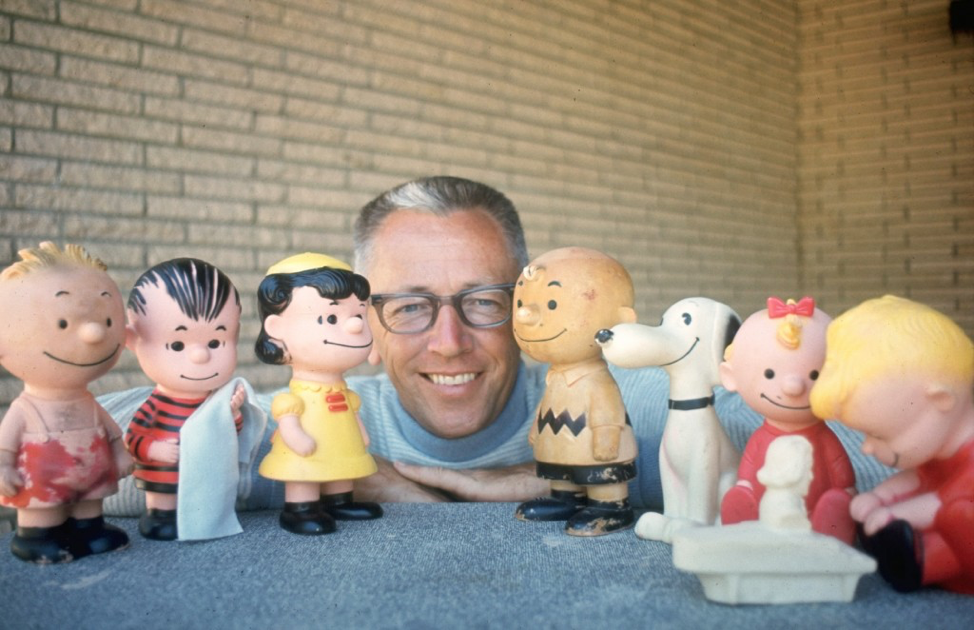
Charles Schulz is the cartoonist behind the iconic Charlie Brown and Snoopy from the comic strip Peanuts. From his childhood spent reading the funnies with this father every Sunday morning, Schulz’s love for comics remained steady throughout every hardship in his life, including death and war. From the miserable critter we know as Charlie Brown, who echoes a little bit of what we all have in us, and characters who were inspired from his own life; Schulz’s accomplished his childhood dream while leaving an unforgettable mark as a cartoonist on the world of illustration.
The American cartoonist Charles Monroe Schulz, born in Minneapolis, Minnesota, on November 26, 1922 is the son of Carl and Dena Halverson Schulz. Growing up in Twin Cities, outside of Needles, California, Schulz and his father’s tradition of reading the funnies every Sunday morning together formed his life goal of becoming a cartoonist. However, his plan of pursuing a career as a cartoonist was halted by two monumental events in 1943 that profoundly affected the rest of Schulz’s life. Shultz’s mother, whom he was very close to, passed away from cervical cancer at age fifty and the beginning of his army career in Camp Campbell, Kentucky.
Remarkably, the reality of death and war did not deter him from his goal, but shaped his cartoons to embraced the less glamorous side to life. After leaving the army in 1945, he returned to Minneapolis, where he took a job as an art teacher at Art Instruction, Inc. Here, he found employment at his alma mater, and sold intermittent one-panel cartoons to The Saturday Evening Post, and enjoyed a three-year run of his weekly panel comic, Li’l Folks, in the local St. Paul Pioneer Press. After Li’l Folks, an interview from 1961 addressing the famous Peanuts, Schulz explains how the “miserable critter” we know as Charlie Brown“is just a little bit of what we all have inside us”, then continues to explain that he undoubtedly sees his own reflection within Charlie Brown, for if you write only about winners, you are addressing only the minority, because most of us lose. Schulz also drew inspiration for his work from individuals in his life; for example, Lucy was inspired by Joyce Halverson, his first wife, and represented the manner of how young girls mature faster than boys. Additionally, Snoopy was based on a black and white pointer named Spike that Schulz owned as a child, and the name came from Schulz’s mother, who had suggested the family name their next dog “Snoopy”.
From his childhood Sunday mornings reading the funnies with this father, Schulz wanted to becoming a cartoonist. He kept this goal alive through his mother’s death and his service in World War II, where he would then reflect the majority rather than the minority. His success came full circle when the Peanuts comic strip was syndicated in over 2,600 newspapers worldwide, with book collections translated in over twenty-five languages. He has been awarded with the highest honors from his fellow cartoonists, received Emmy Awards for his animated specials, been recognized and lauded by the U.S. and foreign governments, had a NASA spacecraft named after his characters, and inspired a concert performance at Carnegie Hall. By the end of his life, Schulz childhood dream lead to an enormous career that left an unforgettable mark on American culture, far exceeding the Sunday newspaper funnies that started it all.
Header image:
Charles Schulz, Jan. 1, 1962 in Los Angeles. Photo by CBS via Getty Images
Sources
- Charles M, Schulz Biography, (Charles M. Schulz Museum), Accessed March 18, 2019, https://schulzmuseum.org/about-schulz/schulz-biography/
- Charles Schulz, (New World Encyclopedia), Accessed April 14, 2019, http://www.newworldencyclopedia.org/entry/Charles_Schulz
- CBC, The True Meaning Behind Charlie Brown and the Peanuts Gang, Charles Schulz, 1961, (YouTube), January 16, 2018, Accessed March 18, 2019, https://www.youtube.com/watch?v=IC5-zQCgjVI
- Hall, Alexandra, and Eric Osman, 8 Things You Didn’t Know about Charles Schulz and ‘Peanuts’, (PBS), November 11, 2015, Accessed April 14, 2019, https://www.pbs.org/newshour/arts/8-things-didnt-know-peanuts
 Issues in Contemporary Art