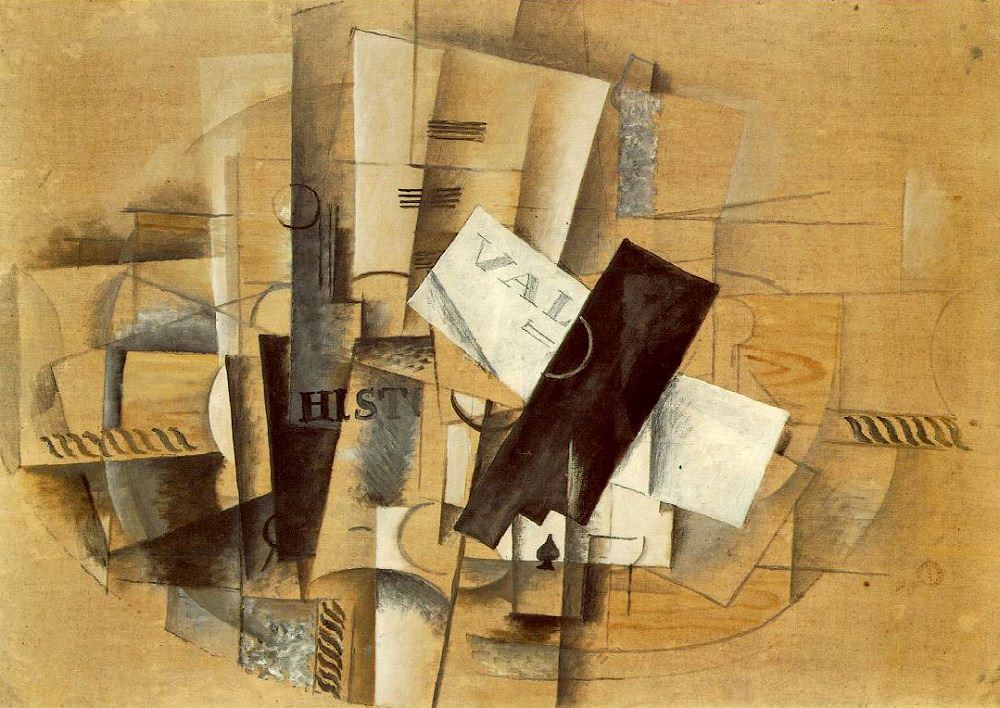
Cubism is a very important artistic style, and one of the most impactful art movements of the early twentieth century. Its unique visual style and abstract ideas inspired a plethora of future art movements such as Constructivism, Dadaism, De Stijl, Futurism, and many more. De Stijl artists in particular drew from Cubism’s adoption of pure abstraction, removal of any and all identifiable subject matter, and its mysticism about ideal geometric shapes.
The story of cubism begins with Pablo Picasso and Georges Braque in 1907. The term cubism was coined by an art critic by the name of Louis Vauxcelles when he underhandedly remarked that one of Braque’s cubist paintings looked like a bunch of “cubes.” Picasso and Braque created the stylistic basis of Cubism, and other artists began to join in. Artist like Robert and Sonia Delaunay, Fernand Leger, and Jean Metzinger came under the Cubist fold to further the movement. As art movements go, Cubism was very against the grain of the current contemporary art of the time, and as such is considered a paradigm shift for art as a whole. Cubism opened the door for more abstract and unrealistic art to become valued and important. It was also one of the first major stepping stones in the evolution of mainstream abstract art, which is a large part of modern art. By the end of Cubism’s reign around 1920, Cubist ideas of rejecting realism, the abstraction of form, and a love of the geometric shape began to permeate throughout the rest of the art world.
De Stijl is a prime example of a later art movement taking inspiration from Cubism. The rejection of realism and the deconstruction of the physical form are Cubist ideas that the De Stijl artists used and expanded upon in their own art. They believed that absolute abstraction was the only way to produce a pure artistic style. The level to which the De Stijl artists abstracted their work would have been seen as extreme by some of the Cubist, as they used only lines and shape as forms, and employed black, white, and the primary colors. Like the Cubist that came before them, the De Stijl artists adored simple geometric forms and favored them above all else. Absolute abstraction was also seen as the freeing of visual arts from any restrictions, and as such would be much more possible to democratize. De Stijl artists hoped to use this universal and pure style to heal the world, which was desperately needed after the destruction wrought by the Great War.
De Stijl and Cubism have much in common. They both attempt to break visual form into its basic elements, reject realism, and fetishize geometric shapes. This seems like almost a natural transition, seeing as the former is a reaction of the later.
Header image:
Georges Braque, Gueridon, Painting, 1913.
Sources
Art Term: De Stijl, Tate Gallery, Accessed February 2019. https://www.tate.org.uk/about-us.
De Stijl, Museum of Modern Art, Accessed February 2019. https://www.moma.org/collection/terms/29
Eskilson, Stephen J. Graphic Design: A New History, 2ndEdition, Yale University Press, 2014.
Rewald, Sabine. Cubism, Heilbrunn Timeline of Art History, The Metropolitan Museum of Art, October 2004. http://www.metmuseum.org/toah/hd/cube/hd_cube.htm
Vauxcelles, Louis. Gil Blas / dir. A. Dumont, BnF Gallica, 1908. https://gallica.bnf.fr/ark:/12148/bpt6k7521008s/f2.item
Van Doesburg, Theo. De Stijl, Vol. 1, no. 1, Delft, October 1917.https://arthistoryproject.com/artists/theo-van-doesburg/de-stijl-manifesto/
 Issues in Contemporary Art