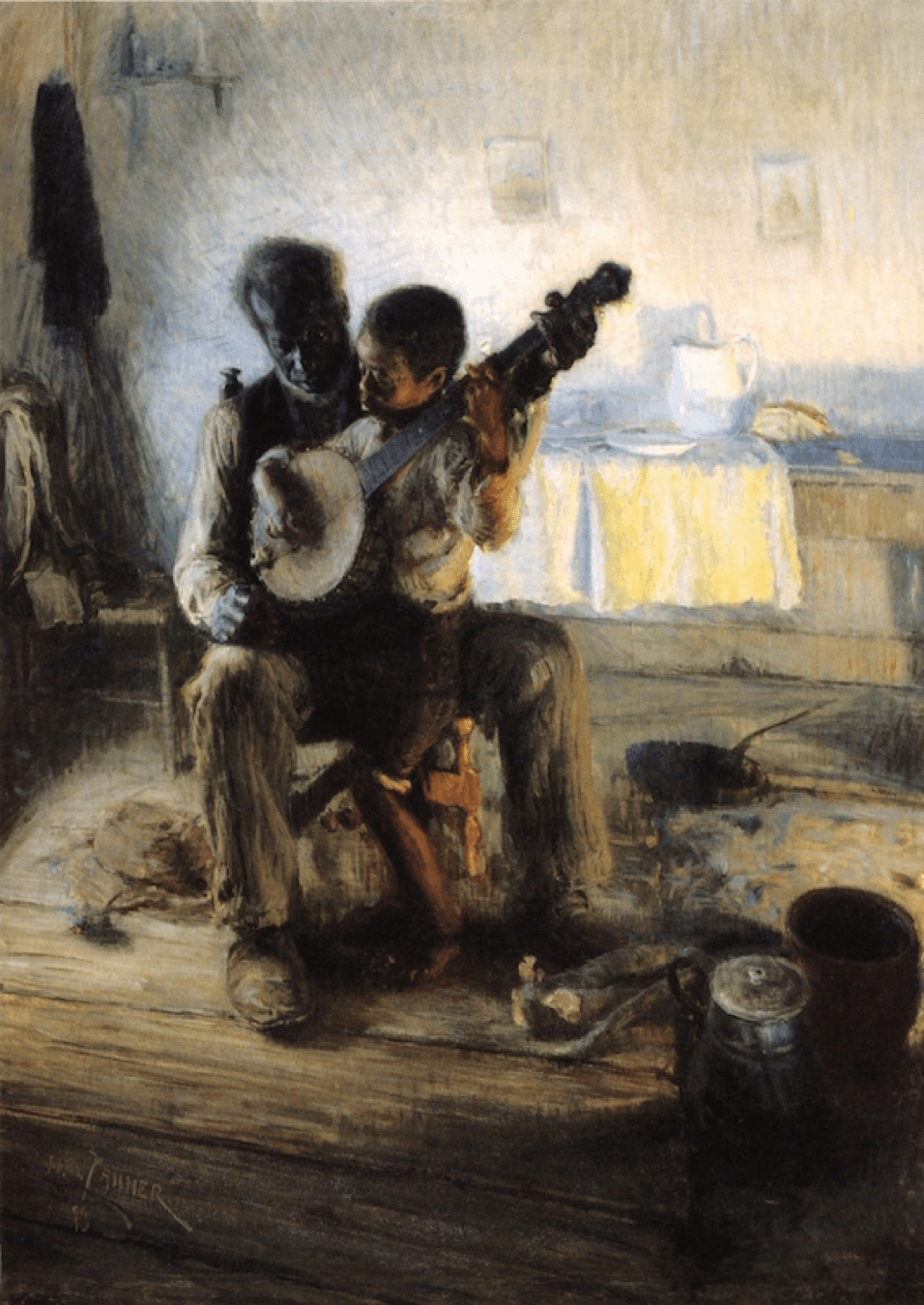
Henry Ossawa Tanner’s The Banjo Lesson and The Thankful Poor combat the dominant narratives of Western art history by depicting an African-American grandfather and grandson in humane, ordinary moments. The warm depiction of the grandfather reflects the hardships suffered by older generation: slavery, the Civil War, oppression, and racism. While the young grandchild reflects the new America, full of opportunities and advancements, education and a new beginning for all African Americans.
Tanner’sThe Banjo Lesson represents resilience, spiritual grace, and the creative intellectual promise of the post-civil war becoming fully realized for African-Americans.[2]Staged in a log cabin, there are two light sources that symbolize each generation’s role in history. Natural light enters the room from the left-hand side, illuminating the top section of the young grandson’s head, that represents the center of knowledge. The grandson’s downward gaze expresses his concentration on his grandfather’s instruction, while he is guided through the banjo lesson. Bathed in muted cool tones of grays and blues, the grandfather is the past, the old America of slavery and The Civil War, of oppression, racism, and poverty, while the boy, caught in the warm glow of the fire’s light, is the new America, of renewed opportunities, advancement, education, and new beginnings. The banjo reflects the long-lived stereotype of African Americans as entertainers in American culture, however here, the banjo is leading the young boy to the new America without the previous shadows his grandfather faced.
The Thankful Poor depicts another ordinary moment of a grandfather and his grandson giving thanks before a meal. This painting reflects the resilience of faith throughout generations. Expressing the purpose and power of faith, Tanner does not depict a biblical moment, but rather a spiritual one that expresses how grace can be embraced in ordinary moments, as the grandfather is role modeling faith. The adjective brush strokes and warm light help enhance the overall spiritual quality, similar to The Banjo Lesson. Again, light sources illustrate the boy’s concentration, devotion, and thankfulness. The Banjo Lesson and The Thankful Poor are composed of the same symbolic light sources and positioning of the grandfather and the grandson in their roles in Black history.
Henry Ossawa Tanner’s The Banjo Lesson and the Thankful Poor share similarities that address private, domestic senses between family members. Tanner’s powerful depictions in these works combat Western history by depicting African – Americans participating in a humane, loving family. Tanner usurps the dominant narratives by comparing the old America’s past, which lies in the shadows, to the new light of America’s opportunities, education, and beginnings.
Header image:
Henry Ossawa Tanner, The Banjo Lesson, 1893, oil on canvas, 49 × 35.5 inches
(Hampton University Museum, Hampton, VA)
Photo credit: Khan Academy
Sources
1. Henry Ossawa Tanner, The Banjo Lesson,” Smarthistory, accessed March 24, 2019, https://smarthistory.org/tanner-banjo/
2. College, Sinclair. “The Banjo Lesson: Black History Moment.” YouTube. March 04, 2017. Accessed March 24, 2019. https://www.youtube.com/watch?v=38uu6QxiWiM
3. 17green, “Henry Ossawa Tanner: The Thankful Poor,” Art History & the Art of History, May 26, 2014, accessed March 24, 2019, https://17green.wordpress.com/2014/05/25/henry-ossawa-tanner-the-thankful-poor/
4. Seeing Art History, “1 Henry Ossawa Tanner: The Thankful Poor, 1894,” YouTube, April 03, 2018, accessed March 24, 2019, https://www.youtube.com/watch?v=FKTtUkp86BY
5. Wilson, Judith (1992) “Lifting “The Veil”: Henry O. Tanner’s The Banjo Lesson and The Thankful Poor” Contributions in Black Studies: Vol, 9, Article 4, Available at: https://scholarworks.umass.edu/cibs/vol9/iss1/4
 Issues in Contemporary Art