The goal of the exhibition is to display the human condition through figurative sculpture in order to elicit thought and emotion in viewers. Each artist displayed in this exhibition will touch upon an aspect of the human condition. Anthony Gormley’s sculptures are based around the theme of spirituality and growth, they are very reserved in their message, making them very thought provoking. Whereas Sarah Lucas’s sculptures are based around the imperfections of the human body and psyche, with a very aggressive approach to her intended message, drawing forth an emotional response in viewers. On the other hand, Robert Morris’s sculptures end the exhibition the same way life ends, with the themes of death and decay, ending the exhibition on a somber note and reminding viewers the life is short and impermanent.
The first artist displayed in the exhibition is Anthony Gormley, he was born in London, 1950 and was raised in a Catholic household. Gormley’s father was an art enthusiast who often took his family to art museums after church on Sunday’s, where young Gormley would foster an aptitude for art. After graduating high school, Gormley travelled to India where he studied spirituality, Buddhism, and cosmology. After three years in India, Gormley found his perspective as an artist and began his professional career.[2] By taking inspiration from his enlightenment in India and his Catholic upbringing, Gormley would portray the human body in relation to Catholicism and cosmology.[3] Anthony Gormley then became a sculptor who is widely acclaimed for his installations that investigate the human condition.[4] Throughout his artistic career, Gormley has been awarded many prizes, including the Turner Prize in 1994, the South Bank Prize for Visual Art in 1999, and the Bernhard Heiliger Award for Sculpture in 2007, among many others.[5] Gormley would continue to investigate the human condition and our inherent spirituality in works like Sound II, 1986, and Angel of the North,1998.
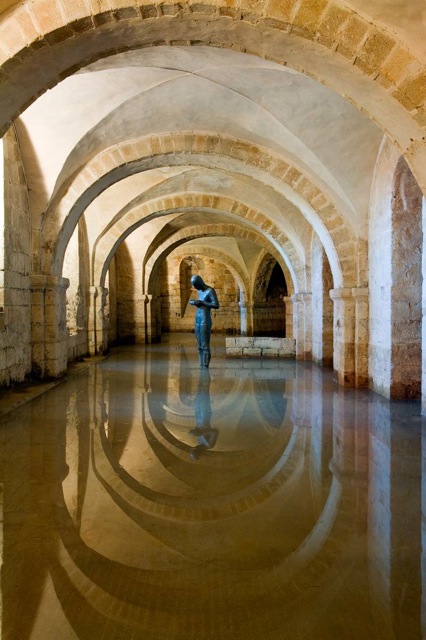
The first sculpture exhibited by Gormley is Sound II, it is on view in the Crypts of Winchester Cathedral. Sound II, like many of Gormley’s work, is a lead cast of the artists own body (Figure 1). The figure stands alone within a Crypt filled with water, as high archways contain the space and reflect within the water below. The dark shimmering color of the illuminated lead form contrasts the pale walls as the golden sun light fills the space. The figure appears solid and steady as its legs anchor it into the water. The figure’s head is gazing downwards at its hands that are cupping water by its chest. When the Crypts floods, water rises through the sculpture and pores into the hands from a void in the chest. Most of Gormley’s sculptures have an indescribable presence that provokes thought and enlightenment, Sound II is no exception. The sculptures placement in the center of the space allows it to dominate it surrounding with an intangible aura. As the sculpture stands in contemplation, the viewer begins to contemplate at well, thus becoming engulfed by Sound II’s spiritual presence. Sound II represents man’s contemplation of the restrictions and limitations of the physical world and body. By describing the body as a place, Gormley presents the human form as a container for the human spirit. This sculpture treats the body not as an object but a place that we will eventually leave. In creating works that enclose the space of an individual’s body, Gormley identifies a condition common to all human beings.[6] Like the water in the hands, man’s physical body will eventually vanish with time, and thus allow the human spirit to transcend the physical world. The aspiration to transcend the physical world is a distinctly human concept that can be traced back throughout history. This notion is a building-block for the foundations of many religions. The promise of an afterlife gives people hope and courage that death isn’t the end. Therefore, Sound II was chosen for the exhibition because of its basis in the human desire to transcend the physical body to find purpose in one’s life.
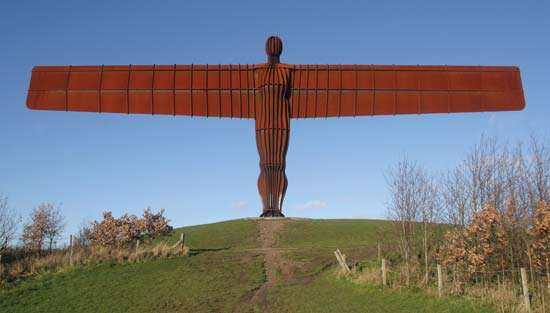
Antony Gormley, Angel of the North,1998,
Corten steel, copper, and Concrete, Credit: Gordon Ball
The second sculpture by Gormley is Angel of the North, located in Durham Road, Low Eighton, England (Figure 2). The sculpture is twenty meters tall with a wingspan of fifty-four-meter-wide. The figure is standing vertically as both legs are connecting, which creates a strong outline of the from. The wingspan contrasts the vertical body with a horizontal plane. The sculpture is twenty meters tall with a wingspan of fifty-four-meter-wide, towering over its surroundings. The figure is standing vertically as both legs are connected, which creates a strong silhouette of the from. Wings, that connect the sides of the torso, contrasts the vertical body with a horizontal plane. As the angel’s wide wingspan stretch outwards, they dominate the surround space. While The complementary orange-red tones of the angel contrast the green landscape below. The stiff angel is crafted from corten steel, copper, and a concrete base. With harsh angles, sharp edges, and featherless wings, Angel of the North subverts the typical light and airy depictions of angels.[7] The monumental scale of the sculpture is awe inspiring and larger than life, and so is its message. Angel of the North represents a new age, where humans are leaving behind the energy resource of coal. Gormley alludes to the regions successful transition from the abruptly ending coal industry to a service-driven economy. Making the aegis of this rigid angel a poignant statement indeed.[8] Angel of the North represents a sustainable future in which humans strive for the betterment of the planet, rather than themselves. This sculpture is not just a contribution to art, but one of the most popular contemporary sculptures on Earth, seen by more than one person every second, which equates to ninety thousand every day or thirty-three million every year.[9] This sculpture also fits into the exhibitions, as one of the criteria for being human is growth. Unlike other themes portrayed in The Human Condition, Angel of the North’s ‘growth’ is an optimistic message about humanities potential to change for the better. Within all the imperfections and mistakes, humanity has and will always strive to do better.
The second artist on display is Sarah Lucas, this contemporary British artist known for her kinesthetic photographs, performances, and sculpture. Lucas creates crude and often inflammatory comments on sexuality, death, and gender by appropriating common place materials. Born in 1962 in London, United Kingdom, she studied at the Working Men’s College, the London College of Printing, and Goldsmith’s College where she received her BFA in 1987. The artist rose to prominence and critical acclaim during the late 1980s. Lucas is now recognized among the most prominent members of the Young British Artists (YBA). Her work has been exhibited at the Walker Art Center in Minneapolis and the Tate Liverpool. In 2015, Lucas represented the United Kingdom at the Venice Biennale. Her works are in the collections of the Museum of Contemporary Art in Chicago, The Museum of Modern Art in New York, and the Centre Georges Pompidou in Paris.[10] Lucas’s controversial artworks, NUD CYCLADIC 9 and Bunnies have been chosen for this digital exhibition.
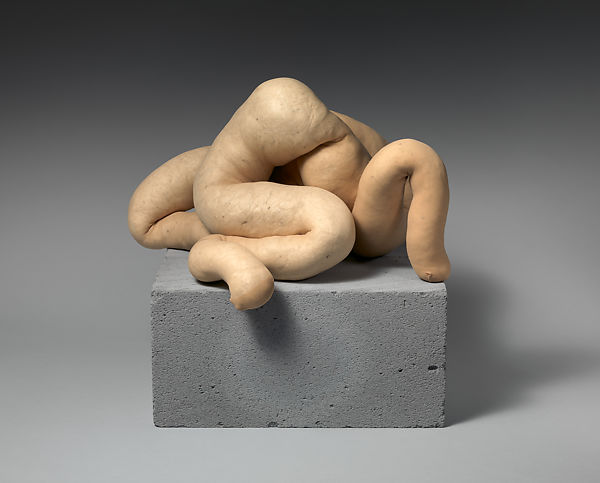
Sarah Lucas, NUD CYCLADIC 9, 2010,
Stuffed Stockings, synthetic fiber, concrete, steel wire,
Credit: Lila Acheson Wallace
Sarah Lucas’s NUD CYCLADIC 9, created in 2010 and exhibited in the Metropolitan Museum of Art, is part of a larger series composed of stuffed hosiery that resumes flesh (Figure 3). NUD CYCLAD 9 gives the illusion of biomorphic tentacles that have the appearance of intestines or intertwined limbs. [11] Lucas is commenting on the imperfections of the human body, as she mocks idealized classical paintings and sculptures of the human form. ‘Nude’ paintings and sculptures classically referred to idealized renderings of the human form that were stripped of all imperfections, whereas Sarah Lucas’s ‘NUD’ displays the opposite. The writhing mass resembles an abstracted version of the Hellenistic Greek statuary group Laocoön and His Sons. By playfully referencing the smooth and stylized female forms of ancient Cycladic figurines, Lucas’s transformation of nylon stockings into twisted bodily contortions displays a feminist response to such a canonical sculpture.[12] The thick fleshy tubes, wrapped and intertwining into contained mass on a pedestal. The unnatural state of the twisted tube of flesh represents human fragility and its physically contorted state. This perversion of one’s physical state is commonplace in the human condition. Lucas’s NUD CYCLAD 9’s disturbing appearance reminds viewers of the imperfect state of human flesh.
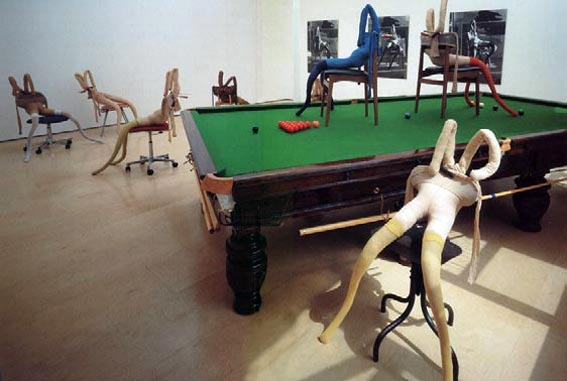
Sarah Lucas, Bunnies, 1997, Stuffed Stockings,
Credit: Lauren McGahey
Bunnies, by Sarah Lucas, is the fourth sculpture on view and is another biomorphic sculpture is created out of stuffed stockings (Figure 4). Bunnies was exhibited in the New Museum located in, Manhattan, New York, along with over 150 other Sarah Lucas works. Composed of multiple stuffed stockings sitting in chairs around and on a pool table, Bunnies challenges social norms of gender, sexuality, and identity.[13] Each stuffed stocking has a pair of legs, and in place of a torso and head, there are two stuffed tubes that resemble bunny ears hanging over the chairs. The semi figures are slouched in their chairs, on the edge of falling off. The biomorphic soft shapes of the bunnies contrast the strong geometry of the pool table. Each figure has its own color and set of leg warmers, all of which are different skin tones except for a blue bunny on the table. By removing all recognizable features besides legs, viewers cannot associate Bunnies with any human traits, addressing the crucial debates about gender and power. From her clever transformations of everyday objects to her exploration of sexual ambiguity, Lucas demonstrates the tension between the familiar and the absurd. [14] Bunnies represents the perversions and imperfections of the human mind, in order to make viewers see the flaws in themselves. Bunnies was chosen for this exhibition because of its confrontational nature and subject matter. Sarah Lucas’s work helps the viewer confront the human body with a level of discomfort. The Human Condition is an extremely confrontational topic; therefore, the exhibition cannot be successful without displaying the imperfections and comfortability that make us human.
Robert Morris, The Human Condition’s third and final artist was born in 1931 in Kansas City, Missouri. After studying engineering at the University of Kansas, Morris turned to art and art criticism; where he began to write influential and critical essays, which served as a thumbnail for future art movements he would play a role in. During the 1960s and 1970s, Morris played a central role in defining three principal artistic movements: Minimalist sculpture, Process Art, and Earthworks. In the 1960s, Morris explored more elaborate industrial processes for his Minimalist sculpture, using materials such as aluminum and steel mesh. In the late 1960s and 1970s the rigid plywood and steel sculptures of Morris’s Minimalist style gave way to soft materials in his experiments with Process Art.[15] In his later years, Morris would investigate other processes and styles, like in his 2017 solo exhibition Boustrophedons at Castelli Gallery, New York. With old age, Morris’s style had drastically diverged from his previous works. However, the change in style aided in portraying the themes relevant to Morris’s own life, old age and death, as Morris passed away in 2018, only a year after Boustrophedons.
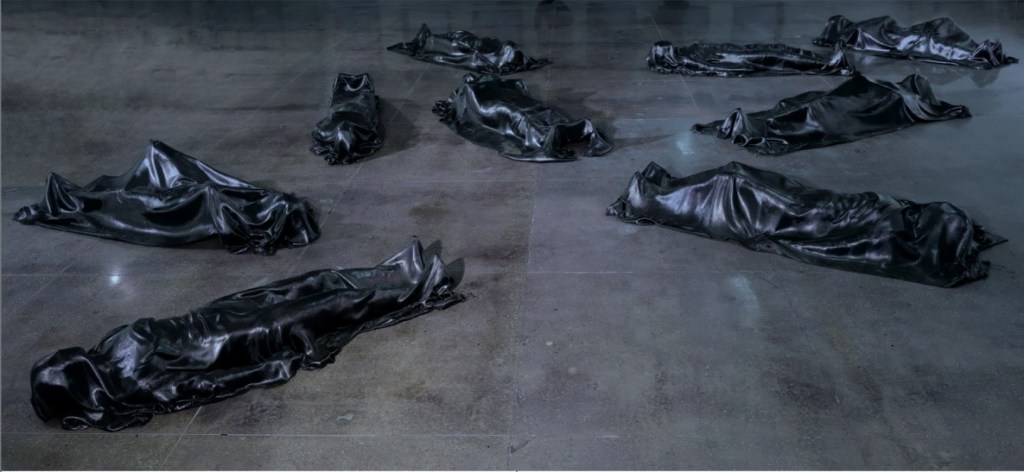
Robert Morris, The Big Sleep, 2016,
Epoxy Resin, Carbon Fiber
Credit: Kevin Ryan
In Robert Morris’s solo exhibition Boustrophedons, he displays free-standing cloth that creates the illusion of a form. Morris creates these sculptures by draping carbon fiber over manikins and soaking the material in epoxy resin. The manikin is removed once the carbon fiber has hardened, leaving behind a free-standing fabric that eludes to an invisible human form. In this exhibition, Morris explores themes of human mortality, in works like The Big Sleep. The Big Sleep is composed of nine figures that appear to be lying on the ground, draped in a black fabric, as if they were victims of a mass shooting (Figure 5). Light bounces off the dark fabric, creating high contrast and definition in each crease and fold. The high contrast makes it easy to see what appears to be real forms under the fabric, raising fear and intrigue in viewers. All nine figures are seemingly placed at random, displaying the uncontrollable nature of death. Each individual figure recalls traditional images of the entombed Christ, whether seen in profile, as in Hans Holbein’s Dead Christ in the Basel Kunstmuseum, or foreshortened, as in Andrea Mantegna’s Dead Christ in the Pinacoteca di Brera.[16] The number of figures and the black drapery work together to add a level of depersonalization to the figures, making it easier for viewers to see themselves under the black cloth. This element of The Big Sleep is what makes it an extremely relevant piece in The Human Condition. Human beings are the only species burdened with the knowledge that they will one day face death. Morris’s The Big Sleep forces viewers to confront their own mortality, displaying one of the characteristics that make us human, the fear of death. This is what makes The Big Sleep an exceptional work to be included in The Human Condition’s digital exhibition.
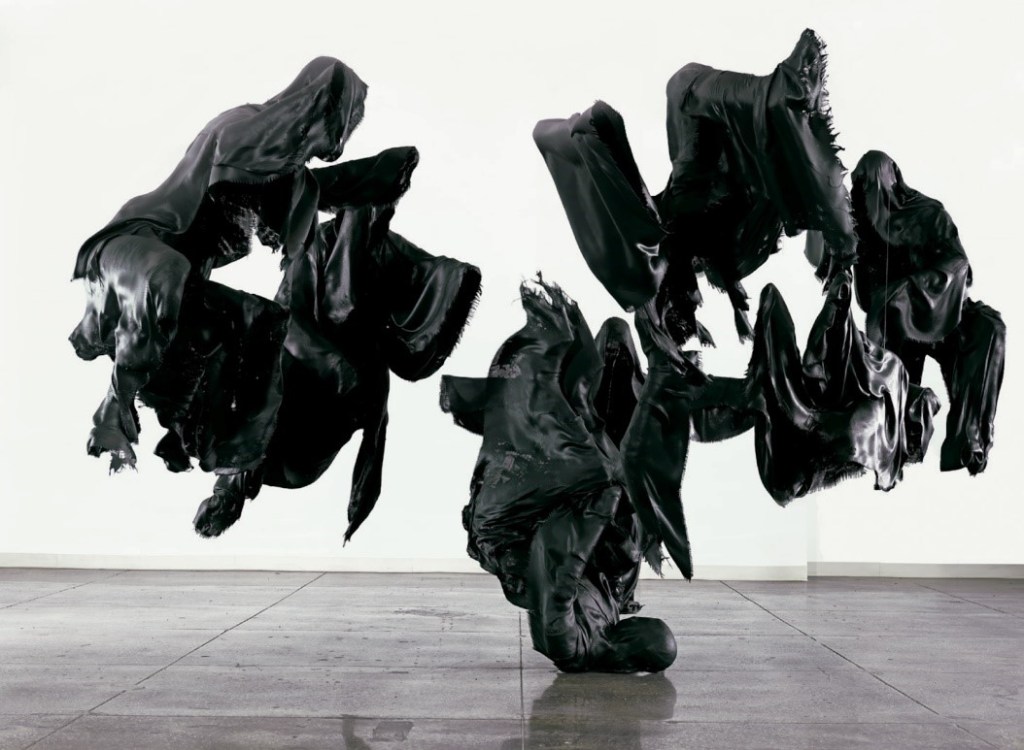
Robert Morris, Out of the Past, 2016,
Epoxy Resin, Carbon Fiber,
Credit: Kevin Ryan
Another Morris work from Boustrophedons, Out of the Past, (figure 6) represents human fantasies, cruelties, and perversions. Created in the same style as The Big Sleep, Morris’s work depicts hovering black draperies that were inspired by Goya’s drawings of Witches and Old Women. The first sheet of Goya’s album shows an aged witch hovering in space, yanking the hair of a younger maidservant while two other witches float behind them.[17] Out of the Past takes inspiration from Goya, bringing forth “the Vanities, follies, cruelties, superstitions, fantasies, disgusts, and perversions of old age.”[18] Out of the Pasts’s nightmare-like appearance conjures up unsettling images of the unconscious, adding a surreal quality to the sculpture. Created in the same style as The Big Sleep, the high contrast fabric helps display the movement of each figure. While one form balances on the floor by its head and neck, the other five figures dance around it in mid-air, held up by transparent string. Unlike The Big Sleep, the forms aren’t fully covered, as one can see the missing void of a figure underneath the fabric, creating the illusion of an invisible form. The dynamic and unique poses of each form create a flowing movement throughout the dancing figures. Out of the Past is an ideal work to be viewed in The Human Condition because it represents the repressed conflicts of the human psyche and the deterioration of the human mind. Like our bodies, the human mind deteriorates with time and old age. As Morris entered old age, death and mental deterioration were becoming more relevant themes in his life, as they are relevant to anyone of old age. Therefore, the exhibition ends the way life does, with the deterioration of old age, and death.
The Human Condition is composed of artists that craft their works with an abundance of conceptual depth and artistic technique. Effectively combating some of the discourse that often surrounds contemporary artists who lake traditional skill, conceptual depth, or create artworks that don’t serve a purpose by creating art for art’s sake. The six works directly display how these contemporary artists do not fall victim to this claim. Rather, they explore the multiple elements of the human form through spirituality, growth, physical and mental imperfections, death, and decay, through a vast range of mediums. Anthony Gormley’s Sound II, although one can argue that casting a body takes little skill, it has immense conceptual depth on the theme of spirituality. Whereas, Angel of the North has the conceptual depth of growth and likely took more craftsmanship to produce than any of the other works chosen for this exhibition. While Lucas embraces every flaw of the human body within a culture that only desires the ideal form. With her disturbing take on flesh and lifeless bunnies, Lucas shocks and disturbs the viewer. In addition, Morris used his medium and craft to portray the death and decay he faced near the end of his own life. Although the artworks chosen for this exhibition are drastically different in appearance, they all conceptually fit into the themes of The Human Condition.
Header image:
(Figure 1) Antony Gormley, Sound II, 1986, Lead Cast. Credit: Art and Christianity
Sources
[1] Human-condition, (Your Dictionary), Accessed May 02, 2019, https://www.yourdictionary.com/human-condition
[2] Wroe, Nicholas, Profile: Antony Gormley, (The Guardian), June 24, 2005, Accessed March 15, 2019, https://www.theguardian.com/artanddesign/2005/jun/25/art
[3] Wroe, Nicholas, Profile: Antony Gormley, (The Guardian), June 24, 2005, Accessed March 15, 2019, https://www.theguardian.com/artanddesign/2005/jun/25/art
[4] Gormley, Antony, Biography, Accessed March 15, 2019, http://antonygormley.com/biography
[5] La Spina, Salvatore, Izzo, Barbara and Diana, Arianna, ANTONY GORMLEY HUMAN, (Comune di Firenze), Accessed March 15,2019, http://www.antonygormley.com/uploads/files/HUMAN%20Press%20Release.pdf
[6] Antony Gormley: Sound II, (Art Christianity), Accessed April 28, 2019, https://www.artandchristianity.org/antony-gormley-sound-ii/
[7] Sculpture Angel of the North in Gateshead by Antony Gormley, (Xamou Art), Published October 18, 2014, Accessed April 28, 2019, https://www.xamou-art.com/angel-of-the-north/
[8] Sculpture Angel of the North in Gateshead by Antony Gormley, (Xamou Art), Published October 18, 2014, Accessed April 28, 2019, https://www.xamou-art.com/angel-of-the-north/
[9] Sculpture Angel of the North in Gateshead by Antony Gormley, (Xamou Art), Published October 18, 2014, Accessed April 28, 2019, https://www.xamou-art.com/angel-of-the-north/
[10] Sarah Lucas, (Artnet), Accessed May 02, 2019, http://www.artnet.com/artists/sarah-lucas/
[11] NUD CYCLADIC 9,2010, (MET Museum), Accessed May 03, 2019, https://www.metmuseum.org/art/collection/search/667860?exhibitionId={dd4a4389-0bcb-41df-a512-d517572f3d05}&oid=667860&pkgids=482&pg=0&rpp=20&pos=44&ft=*&offset=20
[12] NUD CYCLADIC 9,2010, (MET Museum), Accessed May 03, 2019, https://www.metmuseum.org/art/collection/search/667860?exhibitionId={dd4a4389-0bcb-41df-a512-d517572f3d05}&oid=667860&pkgids=482&pg=0&rpp=20&pos=44&ft=*&offset=20
[13] Sarah Lucas: Au Naturel, (New Museum), Accessed May 04, 2019, https://www.newmuseum.org/exhibitions/view/sarah-lucas
[14] Sarah Lucas: Au Naturel, (New Museum), Accessed May 04, 2019, https://www.newmuseum.org/exhibitions/view/sarah-lucas
[15] Robert Morris, (Guggenheim), Accessed April 26, 2019, https://www.guggenheim.org/artwork/artist/robert-morris
[16] Karmel, Pepe, Robert Morris Boustrophedons, (Castelli), Published 2017, Accessed April 26, 2019, https://castelligallery.com/images/publications/publications_PDF/RM_2017_spreads_web.pdf
[17] Karmel, Pepe, Robert Morris Boustrophedons, (Castelli), Published 2017, Accessed April 26, 2019, https://castelligallery.com/images/publications/publications_PDF/RM_2017_spreads_web.pdf
[18] Karmel, Pepe, Robert Morris Boustrophedons, (Castelli), Published 2017, Accessed April 26, 2019, https://castelligallery.com/images/publications/publications_PDF/RM_2017_spreads_web.pdf
 Issues in Contemporary Art