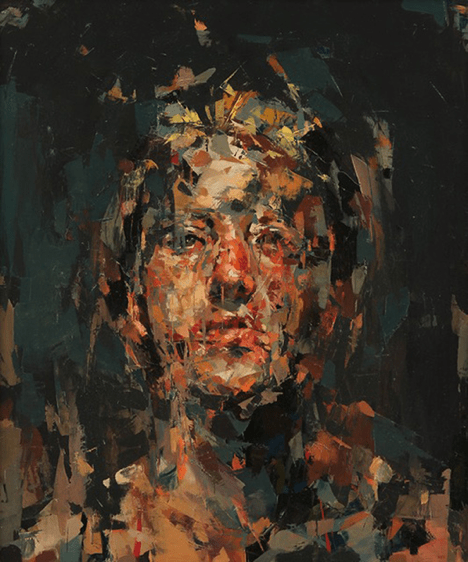
The Fragmented Portrait is a digital exhibition composed of large scale oil paintings that capture and express the ever-changing fragments that accumulate and compose an individual’s identity and personality. The term fragmented has been selected to express the symbolic pieces we carry and accumulate as we age. From birth, we are subjected to influential factors that shape and define who we are today, with works from Kai Samuels-Davis, Ann Gale, and Andrew Salgado, this theme is portrayed through their unique artistic perspectives and concepts. They depict the common man, woman, and minority groups through styles reminiscent of Abstraction, Impressionism, and Expressionism. Each artist contributes two works of art, creating a six-piece collection that uncovers and visualizes how one can be shaped by time, emotion and events. By documenting the accumulations of fragments one gathers throughout their lives, rather than recording one’s solid appearance, The Fragmented Portrait exhibits the multitudes of perceptions, psychology, and emotions of the human race.
The first artist is Kai Samuels-Davis, an American contemporary artist born in Catskills, New York in 1980. Samuels-Davis studied at the Woodstock School of Art and NY Art Students league before earning his Bachelors in Fine Art from SUNY Purchase College in 2002. He continued on to earn his Masters in Fine Art from Art Center College of Design, Pasadena, CA in 2006. [1] Painting primarily with oil paints on wood canvas, his abstract style is built from a combination of brushes, and metal and rubber scrapers. The linear paint strokes and large washes of color form shapes that are recognizable as faces, but without all of the visual information seen in traditional portraiture. In addition to his untraditional twist on portraiture, his creative process of composing one portrait from multiple photo or images offers multiple points of view which crafts a lose scattered style that transcends time. His style is indicative of abstract art, which is often seen as carrying a moral dimension, in that it can be seen to stand for virtues such as order, purity, simplicity and spirituality. Each stoke displays the distant and independent scattered distractions and clarity of daily thought within a space between the representational and expressive. [2]Samuel-Davis’s was chosen for this exhibition because he directly addresses the human’s relationship with space and time. This fragmented, expressive style shows the distortion of our perspectives and perceptions of our daily lives.
The aesthetically stunning result displays the numerous textures that overlap one another while highlighting the history and relationship of each gesture before it, as see in the two-chosen portrait from Samuel-Davis, The Darkness Apparent and The Question. Both Samuel-Davis works featured in The Fragmented Portraitare from his second solo exhibition, titled Wilderness,exhibited at San Francisco’s Dolby Chadwick Gallery.Wildernesscinematic aesthetics were inspired by his pervious education in film, the artworks explore “wilderness” as both a metaphorical and realistic place, a space often oozing in solitude, yearning, anguish that all human beings come to experience sooner or later. The narrative that offers multiple points of view, but apparently one understanding of the scenery before us; which will, however, resonate differently with each viewer. [3]
In Darkness Apparent, 2016(Figure 1) has been selected to be the first portrait within the exhibition for its impact on the viewer. The full-fontal gaze directly addresses the viewer while embodying the title and or theme gracefully and accurately. With abstract gestures and colorful brush strokes, this 36 by 30-inch oil depicts a full-frontal Caucasian woman emerging headfirst from the dark background as she meets her own reflection. [4] The abstract patches of skin tones mixed with oranges, reds, yellows, yellow ochre, and blue-greens, unify the composition as they lay and overlap one another. The accumulation of colorful fragments depicts her identity with limited information. The central composition is balanced by the light source that highlights her forehead, cheek and some small details around her eyes. The buildup of lighter tones within the focal point guide the viewer’s attention to the most defined section where the marks are smaller, brighter and hold the most vivid colors within the composition. The lighter hues that encompass the portrait contrast the black background, pushing the woman forwards. The darker hues that encapsulate the right side of the portrait fade into the background, creating depth and suggesting the figures structure. The swaths of color become larger and more gestural as they drift father away from the central figure, becoming more impressionistic. The shoulder and the base of her neck are undefined and more expressive then the structured tight marks of the face. The degradation of marks transitions the figure into the background, which enhances the illusion that she is appearing out of the darkness, meeting her own fractured refection. This portrait was selected to begin the exhibition for it directly reshape the traditional portraits throughout history. portraits, which historically recorded one’s wealth, power, status, and staged persona, are transformed into a recording of an individual meeting their own reflection without these additional distractions.
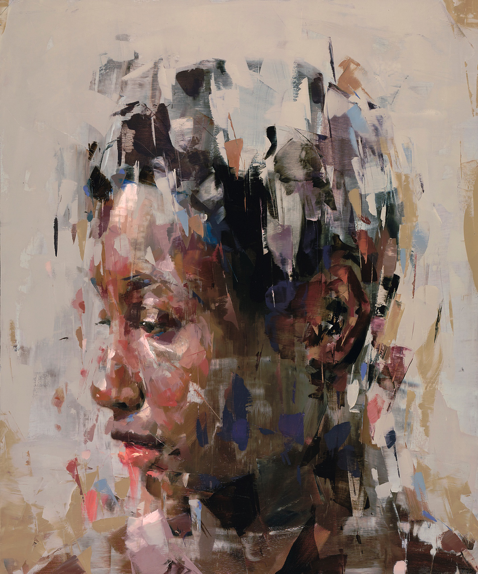
Kai Samuels-Davis, The Question, 2016. Oil on wood canvas 36 × 30 in
Photo Credit: Artsy
Samuel-Davis ability to captures one’s contemplations and thoughts allows his work to become relatable to almost any viewer. The second portrait from Samuel-Davis is titled The Question. (Figure 2) Depicting an African-American woman, this portrait contrasts the pervious with light hues and tints of pink, red, brunt umber, white, and purple, alongside darker values of blue, yellow ochre, and black. As a part of the Wildernessexhibition, The Question captures a woman in throughout, the three quarters pose disconnects the woman from the viewer while she is trapped within heavy contemplation. The natural light source enters the frame from the left-hand side, creating a clear focus on her eye, nose, and lips. Within deep through, her eyes seem to be in a tired gaze, her bottom lip is full with color. Here the abstract marks transition into an impressionist-like style with larger, single stokes obtaining their own space, rather than overplaying and creating a mass. The marks only start overplaying heavily on the head, almost masking her hair while blending it into the background. In contrast to the illuminated face, the shadows balance the overall composition. The dark hair and the shadows on the side of her face, neck, and the beginning of her shoulder contract the background. The Questionwas chosen for this exhibition because it contrasts the previous portrait with its disengaged pose and opposing ethnicity and color. In addition, the heavy contemplation of embodies the daily thoughts and question we all become lost in.

Ann Gale, Rachel with white Robe, 2011. Oil on canvas, 14 x 11 inches
Photo Credit: Widewalls
The second artist is Ann Gale, an American figure painter who was born in 1966. She earned her BFA from Rhode Island College and her MFA from Yale University. She is best known for her portraits composed of accumulations of numerous, detailed color patches that powerfully express the changes in light and the movement of the human figure in time. Her addition to this exhibition inserts a great deal of psychologically and reminiscent of impressionism. With a series of three-hour sessions over a total time period that can last from four months to two years, Gale is the only artist within The Fragmented Portrait who works from a live model. By painting from the live model, Gale is able to address the psychological depths behind the individual. In addition to the long spans of time spent with her models, Gale incorporates an impressionistic flair. When viewing a work from Gale, remanence of impressionism can be identified within something she refers to as “color environment”. By viewing the composition in sections of colored triangles, the portrait is broken down into patches, which often embody their own light. Gale captures the atmosphere of her sitter’s surroundings in brush stokes that subsequently approach and moves away from her sitters in harmony. This harmony transforms visually into a style one can compare to impressionist treatment of the fleeting effects of sunlight; with smooth and careful carvings of space around the figure, she in highlighting some parts of the body while hiding others. The result accumulates into a technique of building particles and patches on a molecular level, to remind us that we are all made from particles and motion of energy. [5]Gale’s style reflects the impressionists, who captured the momentary and transient effects of sunlight by working quickly, in front of their subjects, in the open air (en plein air) rather than in a studio. Resulting in a greater awareness of light and color and the shifting pattern of the natural scene.[6]However, Gale’s creative process remains indoors and does not race against time, rather she embraces it. As we view Gales soft and warm stokes, the movement and size of the marks hold some similarity to Claude Monet’s Sunrise, 1872. In both, the brush stokes are all similar in size, shape and movements as they compose the composition with fluid gestures. Comparing Gale’s work to impressionism revels art history’s impact on contemporary artists. Now that Gale’s artistic perspective has been addressed, the selected portrait can be revealed.
The third portrait within the exhibition is titled Rachel with white Robe, 2011.(Figure 3)The model Rachel is painted in a frontal pose, turned slightly to left and dressed in a white robe. The portrait obtains approximately half of the composition, while the balance between light and dark can be split up into thirds, each contrasting the next while remaining the focus on the Rachel. This portrait has been selected for it embodies the psychological depth clearly; Gale captures Rachel’s demeanor in detail, emotional distress is illustrated through her tighten and wrinkled eye brows paired with somber and sunken eyes with bags underneath. Additional wrinkles around her nose and mouth display clear frown lines that express a level of unhappiness and aging. Here Gale’s color environments and color triangles can be found as they craft a unity throughout the composition. Her brush strokes are soft and warm as they pull hidden colors of skin to the surface, with small highlights of color, such as oranges, yellows, and green create the illusion of a natural glow within the face and chest. These smaller strokes also blend Rachel’s outline naturally into the background and the atmosphere.
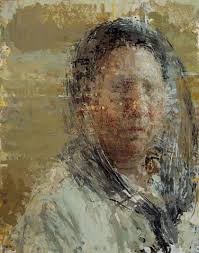
Ann Gale, Self Portrait with Thread, 2019. Oil on canvas, 14 × 11 in.
Photo Credit: Widewalls
Moving along to the forth portrait within the exhibition by Gale, titled Self Portrait with Thread, 2019. (Figure 4) Here, a depiction of an older Caucasian woman wearing a light weight scarf draped around her head gently tied around her chest, she obtains half of the frame and is turned in three quarters view as she meets the viewer with eyes showered in haze. One shoulder is visible which creates diagonal movement from the lower left corner to the right upper side. Smudges of browns and yellow ochre passively fill the background, allowing the woman to remain the focal point, which is vital for a portrait with such little definition in the face. However, this is not necessarily a negative aspect, because this portrait displays how Gale’s ability to portray the models’ psychological state without defining the eyes: which are in most cases one’s greatest window into a person’s emotions. The viewers’ can only see lips and a fleshy nose, hinting at a sensuality countered by filmy, unfocused eyes. The comparison of Rachel with white RobeandSelf Portrait with Thread allows the viewer to study how one’s emotional state can be depicted with or without eyes.
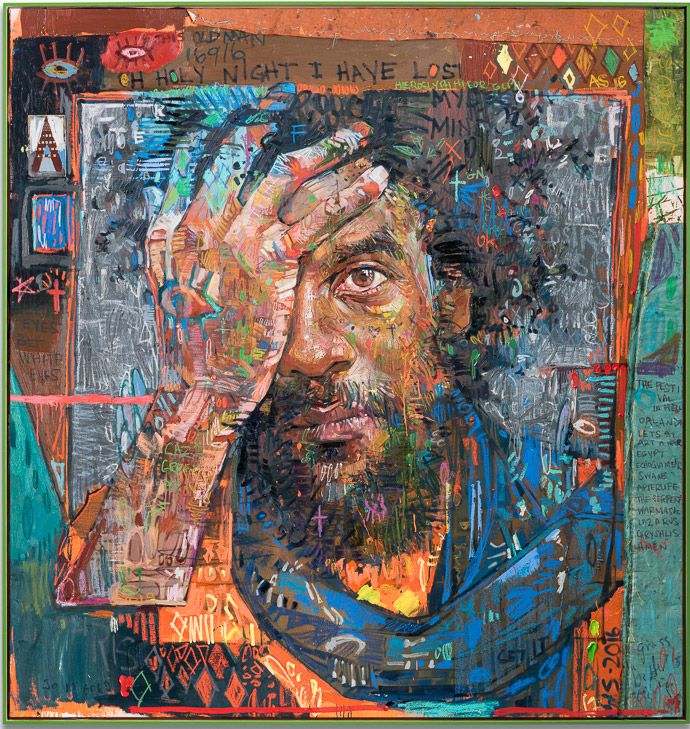
Andrew Salgado, Osiris, 2016. Oil, Oil Pastel, Hand Dyed linen on canvas 200 × 170 cm
Photo credit: Wall Street International
The third and final artist exhibited in The Fragmented Portraitis Andrew Salgado. Born in 1982, Regina, Canada this UK artist earned his MA of Fine Art from Chelsea College of Art and Design in 2009. Today he lives and works in London, England where he is building an enormous career: with 13 sold-out solo exhibitions held all over the world, and is widely regarded as one of the UK’s leading young figurative painters. In 2017, Salgado was the youngest artist to ever receive a survey-exhibition at The Canadian High Commission in London, accompanied by a 300-page monograph, both of which were entitled TEN.[7]
Salgado is a powerful addition to this digital exhibition, for he injects a political stance as well as a personal one. Before Salgado gain such massive success as an artist, he was victimized from his home in Canada for his sexual orientation in 2008. Salgado revels how his life of victimization has impacted his work in an interview from Gridmindless. Here he freely shares how his perspective as a homosexual man has opened a window of opportunity into the art world, for he has something to say. His work is fueled from a personal place as well as a sinister one; an element of darkness formed from his personal pain can creates a misconception that he himself is a dark person. However, this is incorrect, as Salgado states the darkness only lies within the topic, whereas his happiness and joy as an individual is expressed through his technique.[8]
Salgado’s expressive color swathes dance in-between the lines of abstraction and portraiture. By depicting men in a medium that is stereotypically connected to softness and feminism, Salgado challenges the preconceptions of masculinity. His painting style is comprised of quick brushstrokes, patchwork forms, and technicolor tones, his portraits offer a contemporary twist on the traditional standards of portraiture. Foregoing traditional postures and forward-facing stares for unique poses and distant gazes, Salgado presents figures who are not easily defined. Often looking away from or past the viewer, his subjects maintain a mysterious disconnect, juxtaposing the kaleidoscopic colors of the canvas with the somber expressions of its characters. Bold contrasts between light and shadow emphasize this disparity; colliding brushstrokes distinguish surfaces. [9]
Thus, the fifth addition to the exhibition is titled Osiris, (Figure 5) Salgado painted twelve vibrant works as a tribute to the victims of the 2016 Orlando massacre in Florida, which killed forty-nine people, making it the largest shooting by a single gunman in American history. As a result, Salgado finds himself once again revisiting themes of brutality and masculinity in his paintings. Recognized for his somewhat aggressive, textured brushstrokes and the raw emotion that bleeds from his works, Salgado’s paintings often reference broad ideas around hatred, destruction and re-birth. [10]
As the most colorful portrait within The Fragmented Portrait, Osiris depictsan African-American meeting the viewer head on with a single brown eye emerging from a vastly complex composition. The right side of the man’s face is covered by his hand, that is tightly holding his head. Composed of colorful cross hatches, and symbols, the prominent symbol is an illustration of an evil eye, which is widely known as a protective mark. The eye lies on the back of his hand, placing it in a similar location of where his hidden eye would be. As much as this hand plays a large role within the composition, it is not the main focal point. Rather, the hand guides the viewers eye to the man’s face and hair. With a soft, almost sad expression, the emotion is clear within the sitter’s visible eye. In addition, the man’s chaotic hair and facial blends into the expressive marks that surround him contained in one of two frames. The first frame is a slim orange one that contains the grey and white marks overlapping into the figures hair, where the second frame creates a border of collaged colors, shapes, text, and symbols. The colorful and chaotic portrait symbolizes all of those who were victimized on a severe level, and in this cause to death. This portrait acts a memorial for the lost individuals and each life had has been effected from their sexual orientation.
Andrew Salgado, Decade, 2013 Oil on canvas 130 x 95-inch
Photo Credit: Galerieflash.de
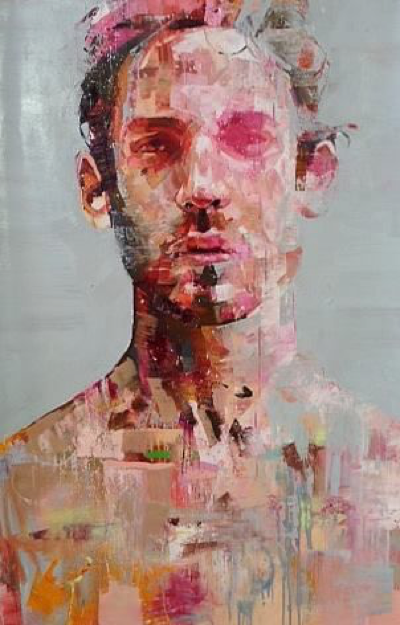
The sixth and final portrait ends the exhibition on a poetic note, titled Decadeby Andrew Salgado (Figure 6). Unlike the pervious one, this portrait is not one of the twelve tributes, rather it is a 2013 piece. By ending the exhibition with a symbolic note of the passing years, this 130 x 95-inch portrait of a Caucasian male in a full-frontal pose is depicted in a monochromatic pallet. However, on closer analyzation of the abstract painting, skin tones, browns, oranges and some blue are uncovered. The blue-grey is found primarily in the background, peeking through the right side of the portrait, as the figure fades way with time. As a symmetrical piece, Salgado has created balance and contrast in the fading right and defined left sides. Overlapping tints of red, pink, and white create the illusion of transparency. With this transition, the focal point is clear, especially compared to his chest, which is undefined and only consists of pallet marks overlapping one another. Decade represents how we all fade away with the passage of time, by framing a decade within a single moment, viewers can relate to the notion that throughout our lives, parts of us fade away while others remain the same.
Kai Samuels-Davis’s indicative abstract portraits reveal obvious brush stokes building one’s identity through a cinematic inspired aesthetic, that welcomes the viewer to study multiple points of view within a single frame. His works captures the titled in literal manner while visually explaining to the viewer what this exhibition has in store. Next, Anne Gale’s honest relationship with her models directly connects to the viewer on a personal and historic level. The lights dim to a political twist with Andrew Salgado’s stance against homosexual brutality. Salgado plays a vital role within the exhibition for he challenges the traditional standards of portraiture. By painting homosexual men, Salgado shines a modern light on an ancient practice, portraying the minority rather than the elite.
The Fragmented Portrait displays a collection of artist who directly combat some of the discourse around contemporary art and artist who lack conceptual depth and technique. By crafting artworks that hold inspiration of fine art movements like Impressionism, Expressionism and Abstraction, these artists displaying how the contemporary era can and still hold traditional techniques and depth. In addition, their modern voice rebels and redefines the history of portraiture by painting ordinary man, woman and minority groups. Which amounts to an enormous combination that breaks the physical form to free our ever-changing fragments that accumulate and compose, who we are.
Header image:
(Figure 1) Kai Samuels-Davis, In Darkness Apparent, 2016. Oil on wood canvas 36 × 30 in. Photo Credit: Artsy
Sources
[1]Salgado, Andrew, BIO, Accessed May 15, 2019, https://www.andrewsalgado.com/info
[2]Gridmindless, An Interview with Artist Andrew Salgado – Video Dailymotion,(Dailymotion), June 12, 2015, Accessed May 05, 2019, https://www.dailymotion.com/video/x2tmac6
[3]Cantaba, La Danta,The Pioneering Portraits of Andrew Salgado, (Medium), Published May 10, 2016, Accessed May 15, 2019,https://medium.com/@ladantacantaba/andrew-salgado-s-pioneering-portraiture-in-nyc-bca74e3da6d4
[4]Andrew Salgado, The Snake, (Wall Street International), Published, December 12, 2016, Accessed May 15, 2019, https://wsimag.com/art/21892-andrew-salgado-the-snake
[5]Ann Gale,(Widewalls), Accessed May 05, 2019, https://www.widewalls.ch/artist/ann-gale/
[6]Impressionism – Art Term,(Tate), Accessed May 15, 2019, https://www.tate.org.uk/art/art-terms/i/impressionism
[7]Kai Samuels-Davis, (Widewalls), Accessed May 15, 2019, www.widewalls.ch/artist/kai-samuels-davis/
[8]Abstract Art – Art Term, (Tate), Accessed May 15, 2019, www.tate.org.uk/art/art-terms/a/abstract-art
[9]Samuel-Davis, Kai, ABOUT – Kai Samuels-Davis, Accessed May 15, 2019, https://www.kaisamuelsdavis.com/new-page
[10]Kai Samuels Davis Art Evokes Wilderness, (Widewalls), Accessed May 15, 2019, https://www.widewalls.ch/kai-samuels-davis-art-dolby-chadwick-gallery/
[11]LaSane, Andrew, Paint Smudges and Smears Form Abstract Portraits by Kai Samuels-Davis, (Colossal), Published April 04, 2019, Accessed May 15, 2019, https://www.thisiscolossal.com/2019/03/abstracted-portraits-by-kai-samuels-davis/
 Issues in Contemporary Art