“Beyond a beauty cream, Mother is a Woman invites you to rethink kinship through the pores of your skin” – Jes Fan
When the body and binary are taken out what are we left with? Jes Fan thinks of that often when creating his work. Being queer-identifying and a minority in the US, he is no stranger to mixing the topics of gender, identity, and race. Taking biological materials from their context within the body, Fan incorporates science to figure out the essence of their meaning and lends a completely new one for his audience. In Mother is a Woman, the Hong Kong-born andBrooklyn based artist went back to his home country to get his samples for his next piece from his mother.
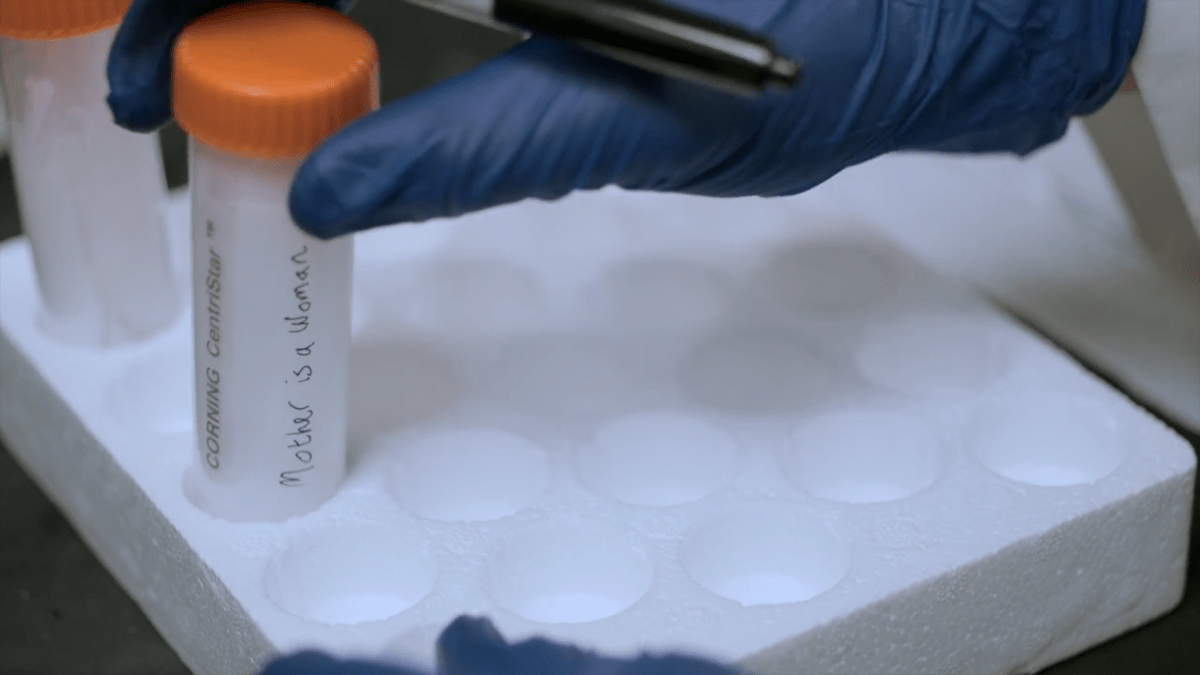
Jes Fan, Mother is a Woman, 2018, Video, HD, Color, 4:44.
“There’s nothing weirder than holding your mom’s excretions in your hand…”
Jes Fan, Mother is a Woman, 2018, Video, HD, Color, 4:44.
Fan’s intent was to make a cream with the estrogen extracted from his post-menopausal mother. When he gets back to the US he takes the samples to a lab and videographer Asa Westcott document the process and the participants that later try on the cream. The expression on each participant ranges from emotionless to smiling as they rub the cream into their skin.
There’s something strangely intimate about this whole piece. People take hormones for various reasons but there’s never a question of how it’s made or where it comes from. We share a relationship with the ones around us, our family, but we don’t take into account how they shape us and are a part of us. It made me evaluate how I view womanhood and relations that I had with my own mother. We’re close and I have a closeness with her but that’s not the same in everyone else’s case. And for that, I feel thankful.
Andy Warhol. Early Colored Jackie, 1964. Silkscreen ink on synthetic polymer paint on canvas; 40 x 40 in. Wadsworth Atheneum, Hartford, CT. Photo by Wadsworth Atheneum Collection
This work, titled Early Colored Jackie, is displayed in the Wadsworth Atheneum in Hartford, Connecticut. Warhol created this piece as a silkscreen print on synthetic polymer paint on canvas. As in typical Warhol fashion, he used blocks of bright, unrealistic colors to form the image of Jacqueline Kennedy. The light pink skin tone stands out from the dark blue background, while the bold red lipstick and seafoam green eyeshadow add pops of color to her face. The silkscreen print is taken from an official White House photograph snapped before the assassination of her husband, John F. Kennedy. It is printed in black ink on top of the colorful paint on the canvas. The photo used is cropped in close so it only includes the headshot of Jackie with a blank background.
Warhol was a pioneer of the pop art movement in which this piece was a part of. Jackie was a sign of royalty and glamour in the United States, which makes this piece relatable to the Marilynn Monroe silkscreen that Warhol is well-known for. Jackie was an icon through both her style and behavior for the American people and was one of the first First Lady’s to give more importance to her role as wife of the president. Warhol found inspiration for his subjects in celebrities as well as tragedy or death. This piece was made in 1964, about a year after JFK’s death. The Kennedy family as well as the country was still grieving. It is ironic that Warhol would have chosen a picture of Jackie smiling during such a trying time.
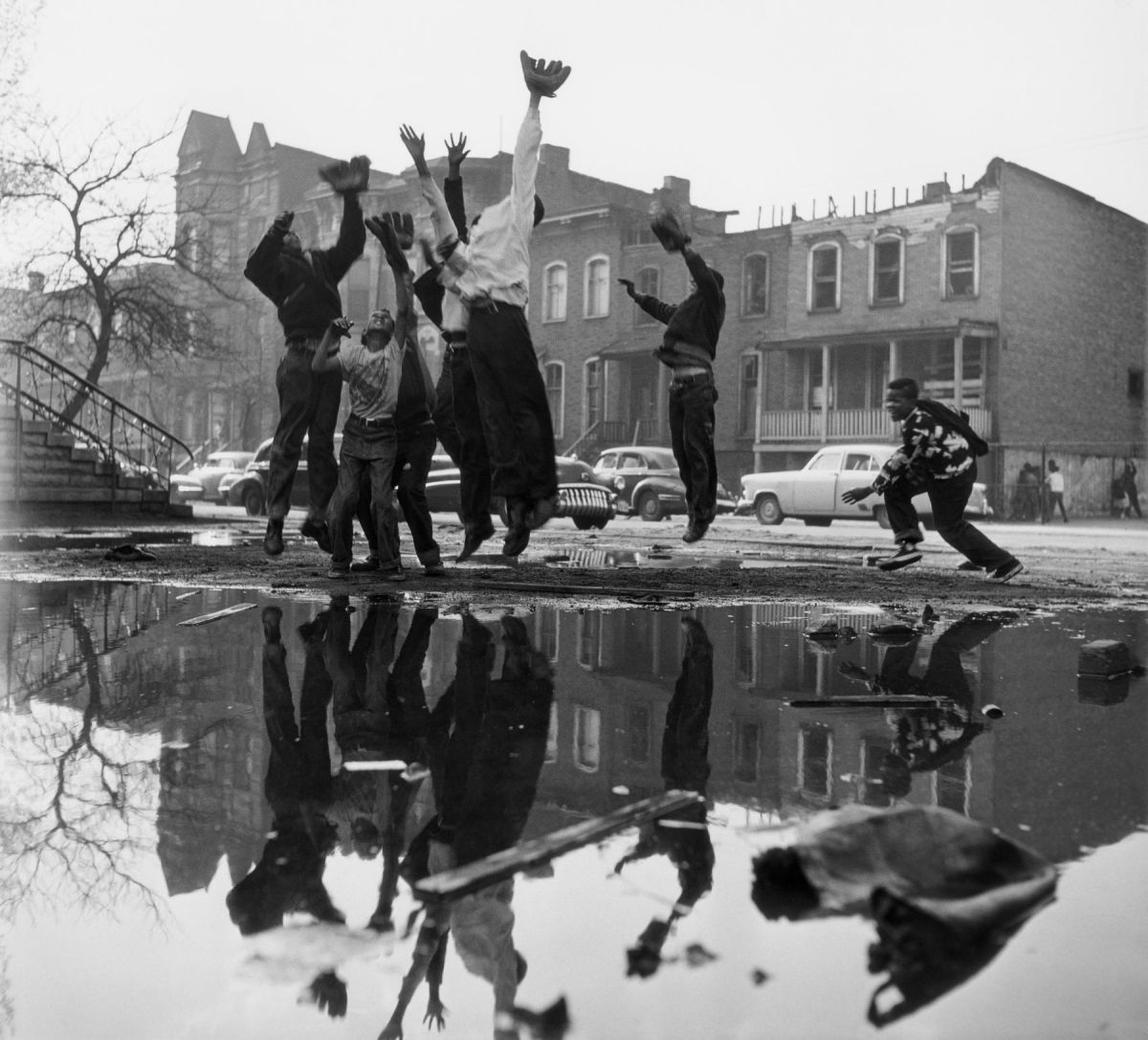
It’s already a well-known fact that the art world is heavily saturated with predominantly white male artists. Other artists of different ethnic backgrounds, however, tend to struggle with the representation, of not only with their art but in their daily lives. It’s a struggle to even be considered a human being by the general public as it is, so when I saw the photographer Gordon Parks presented in class my eyes lit up. Parks’ work really challenged the narrative placed on black Americans. Parks highlighted the will and determination to pursue the American Dream through the eyes of Black people despite years of disenfranchisement.
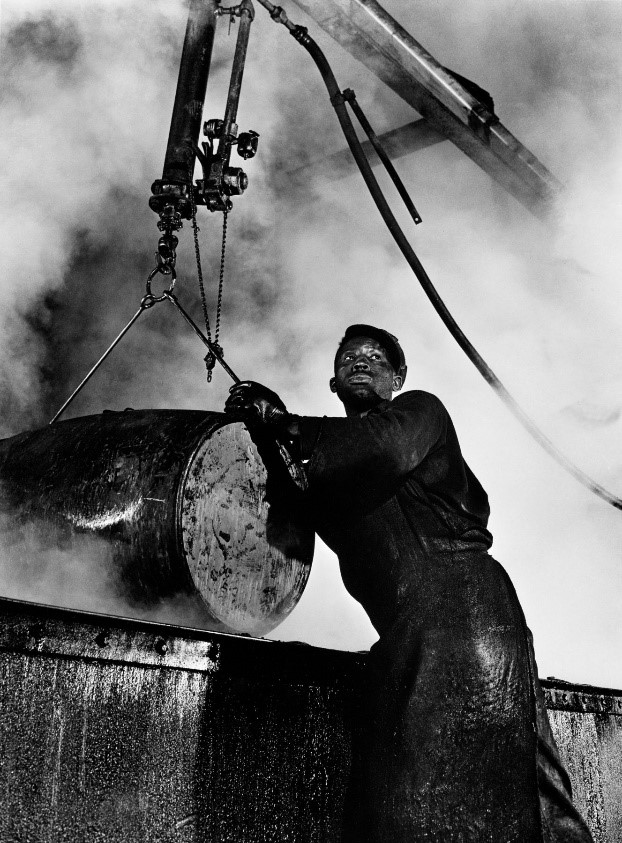
Gordon Parks, Grease Plant Worker, Pittsburgh, Pennsylvania, 1944
Grease Plant Worker features a young Black gentleman in a factory that is glancing into the distance, beyond the photographer. His body is leaning against a suspended barrel that he’s guiding. This body language promotes strength in the literal sense since he’s physically moving the object, but also through the metaphorical push the gentleman is making for his life: forward. The use of the man’s stance and the subject matter of where he worked effectively fought the narrative perpetuated by the media of Blacks being dangerous and lazy.
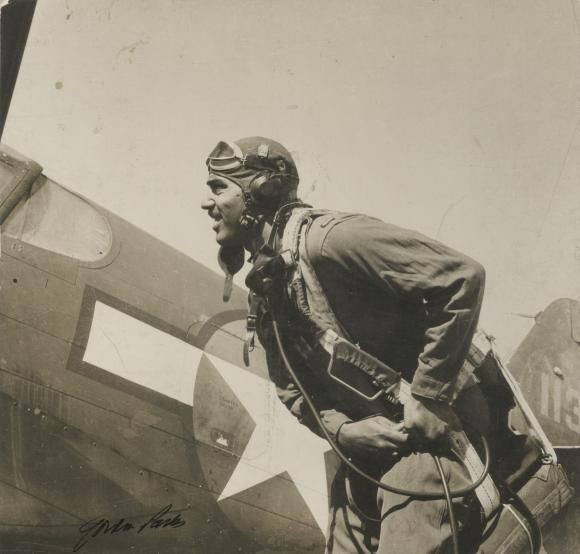
Gordon Parks, Lt. George Knox. 332nd Fighter Group training at Selfridge Field, Michigan, October 1943
Further combating the common misconceptions of the time, Parks photographed a dynamic shot of George Knox II, a black American pilot that pushed boundaries and defied the rules that shaped the social structure of America at that time. In the photograph, Knox is strapped in his gear preparing himself for his training with his team. This smiling serviceman demonstrates that he’s willing to sacrifice for the country alongside his fellow men to protect his place of birth, although the same country does not treat him as an equal.
Photography and other visual depictions of the 1940s usually featured the slow climb of white America as the face of the struggles to prosperity. But they weren’t the only community affected by the fall of the economy and the efforts of the other Americans restoring the country back to its glory. The accomplishments of the country were wildly inaccurate towards the minority groups, especially Black folk. Through his photographs, Parks shows that he and the black community residing in the melting pot that is the United States are strong, with goals, determination, and are more than the racist prejudice constantly presented.
Sources
Courage, Richard A. “Re-Presenting Racial Reality: Chicago’s New (Media) Negro Artists of the Depression Era.” Technoetic Arts: A Journal of Speculative Research 10, no. 2/3 (December 2012): 309–18. doi:10.1386/tear.10.2-3.309_1.
Mitchell, Kristina E., Amanda Martin-Hamon, and Elissa Anderson. “A Choice of Weapons: Photographs of Gordon Parks.” Art Education 55, no. 2 (March 2002): 25–32. doi:10.2307/3193987.
In the reading, Robert Morris: Boustrophedons the author, Pepe Kermal begins by talking about the artist, Robert Morris, and his unique artistic style, and his most recent creation. Kermal then goes into the background of Robert Morris by discussing how Morris’s works have been constantly referencing art history all while consistently creating connections to victims of past violent acts of crime. The author then gives examples of other works Morris had created such as, Dark Passage, Out of the Past, The Big Sleep, Criss-Cross, and many more that have similar underlying themes but also use the same type of media. Pepe Kermal also went into detail about how consistent Robert Morris was when bringing symbolism into his art works and how he tends to pull out pieces of history and old art forms to help create a new very modern artistic style of his own.
Throughout the entirety of the reading, Robert Morris: Boustrophedons, by Pepe Kermal I have come to reflect on a lot of information that the author had given to myself. From the article, I have learned that the art world is constantly changing and reshaping old techniques and traditions. Many artists today often look back to past art forms and expressions to find inspiration in their artworks today. For example, Robert Morris often looked back to modern art techniques, performance art, minimalism, and more. From the reading, I also enjoyed the fact that Robert Morris created art works and installations for victims of tragic events in history. I enjoyed this because I feel as though this forms a powerful stance on not only the artwork, but the artist as a person. Personally, I can relate to the artist in a way because my art typically resembles, past tragic events in my life. I can connect with this well because of the fact that we are both representing our darker emotions to create a different form of artistic expression.
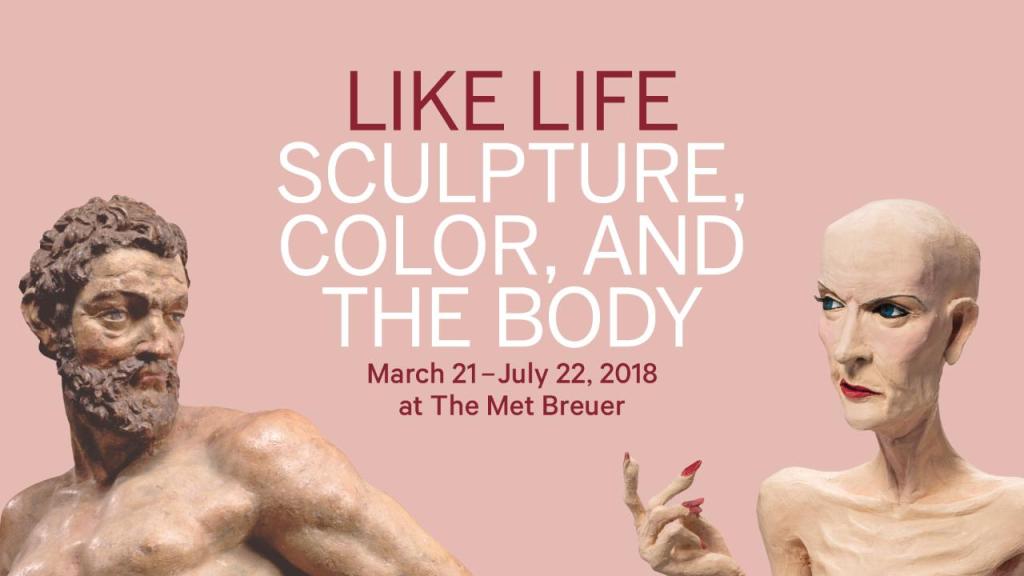
In the reading, Why Is the Met’s New Show About the Body in Art History So Stultifying and Dull?, by Jerry Saltz the author mainly discusses one of the art exhibitions at the Met, also known as Life Like. The article goes into a deeper discussion of how art history has developed and changed the way we view the human figure and bodies. The reading also talks about how in the past, artists typically only displayed the female figure nude however, this exhibition at the Met features the male nude as well. This display was created to showcase true human form by showing bodies with wounds, blood, wrapped in leather, giving birth, dead, asleep, and many more. The author then goes into detail on his opinion on the Western Art culture and how it is typically based off of themes of terror, sex, flesh, and sublimation. Which in turn, the author believes is not true human nature at all, or at least is not always the case with Western Art.
Overall, I feel as though this article was very insightful as to how we see art today, and what the public may or may not be attracted to. Through this article, I have learned that not all artworks are able to interpret an exact meaning to the individual person due to the fact that everyone has different experiences and viewpoints. Personally, I enjoyed the overall concept of the Life Like exhibition however, the author did not appreciate it in the same sense. The author believed that this was a misinterpretation of the human form that was solely based on the eyes of Western culture. I appreciated his opinion on the work, and i had found his information to be very valuable as I move forward through my own artistic career. Mainly so, when naming and creating a work. The artwork must be true to its title, and the underlying meaning of the piece needs to be captivating enough to draw attention and the works’ meaning to the audience it is being displayed to.
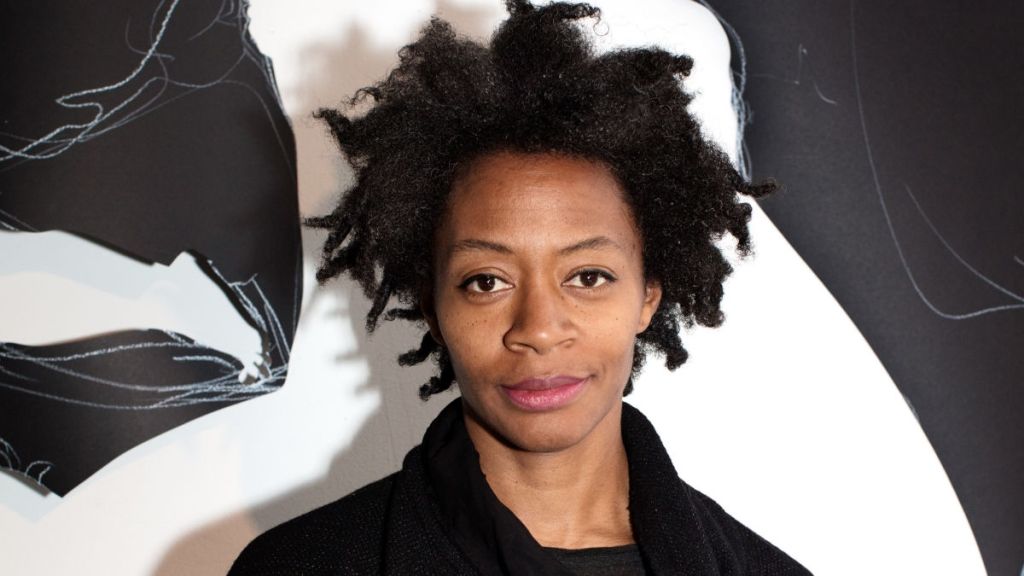
The artist that I feel has the most impactful stance on combating the dominant narratives of Western Art history today is the artist, Kara Walker. Kara Walker is one of the most profound American artists of her generation with artworks expressing her emotional struggle with the underlying truths behind social structure, violence and sexuality in western culture throughout history. In her creations, she has used her artistic abilities to give racism a voice by increasing the visibility of marginalized African American culture.
The first piece that caught my attention on this subject was, The Means to an End…A Shadow Drama in Five Acts, and this piece is a significant example as to how Kara Walker combats the narratives of Western Art History. In this piece, we can see a series of five panels, all in black and white, decorated with the silhouettes of six characters. This piece includes subtle yet graphic representations of citizens of America, and how they have never been depicted. Kara does this as an attempt to reduce the image of people, taking away skin color, characteristics, and facial features so the viewer is not completely certain of who Kara Walker is depicting. She does this in order for the audience to “deal with their own prejudices or fear or desires when they look at these images,”. This is seen to be impactful on the audiences she displays them to. Kara uses this work to have the viewer in-delve themselves into their subconscious mind to see whether or not the audience believes they have prejudice tendencies or not. This assists with combating racism in Western Art culture due to the fact that Walker is bringing those subconscious thoughts to light. She is doing this in order for the public to reevaluate how African Americans were depicted for so long, and how it affects their everyday lives now.
Consume, Kara Walker 1998
Another piece Kara Walker created that breaks down the typical norms of Western Art culture was, Consume, created in 1998. This work still sticks to the same artistic style Walker creates, using a white canvas and a black silhouette of two people. In this painting, one person is significantly taller than the other; the tallest one being a women suckling her own breast, and the smaller one being a little boy suckling on the fallic shaped dress material of the women. With this piece, Walker embellishes in the consumption of people as products of slave trade in the past, along with the consumption of breast milk in Walker’s versions of the Madonna lactans. This piece is combating the flaws of Western Art culture due to the fact that Kara Walker is attempting to denote gender, ambiguity, and race. By creating this piece, she is showing the boy performing a sexual act to “consume” the exotic female figure in front of him. This goes along with previous notations of the white male having degrading stances on African American women and the “foreignness” of their appearance. The message being interpreted in this piece exemplifies the subconscious mind of the viewer once again. Kara Walker not only uses her work to get her audience thinking however, she impacts her audience to go deep into their minds to discover what their true intentions and how wrong they may or may not be. With these two pieces, Kara Walker recreates the social construction of Western Art culture. Walker takes down the normality of what once were dominant narratives to redevelop the intentions and thoughts of the future of our artistic world.
With technology rapidly changing throughout the twenty-first century, many new innovations and discoveries have developed over a short period of time. While many of these technological advances have been to enhance communication, and the everyday lives of people, there have been many other ways that these advances have affected the culture of the art world as well. While there have been many art forms and movements over the past few centuries, a lot of up and coming art forms have been emerging as well. With the inclusion of augmented reality and virtual reality, the art form of immersive installations has been brought to light and is becoming increasingly popular as technology grows stronger. I believe that immersive installations are an important part of history in the art world due to the fact that they bring the viewer into the space of the art, and while using different mediums, give artists the opportunity to let the viewer endelve themselves within their art. This keeps artists thriving by creating these immersive installations because they are given the chance to create in a way they best know how.
Immersive installations are an important part of the history of the art world because they are actually different from AR/VR and stray away from the use of computers and technology. This is of significance because many people today are desensitized to technological improvements, and many forget what it is like to genuinely live “in the moment” they’re experiencing. Immersive installations consist of using patterns, mirrors, objects, lights to submerge the viewer into an alternate form of reality in the physical world around them. Now, the earliest forms of installation art have been traced back from the early 1920’s with works from artists such as Kurt Schwitter, Edgard Varèse, Le Corbusier, and Iannis Xenakis however, over time they developed into something much different. Today, immersive installations have become more complex and creative, giving them the chance to spike in popularity with increasingly new artists and viewers. This art form has impacted the history of our art world by reducing the amount of visual technology being used, and enhancing the viewers’ experience through artwork that is complex and real. This is also of importance because by creating powerful aesthetic environments, the artist is satisfying the viewer’s inherent desire to escape physical reality and become part of the art experience itself.
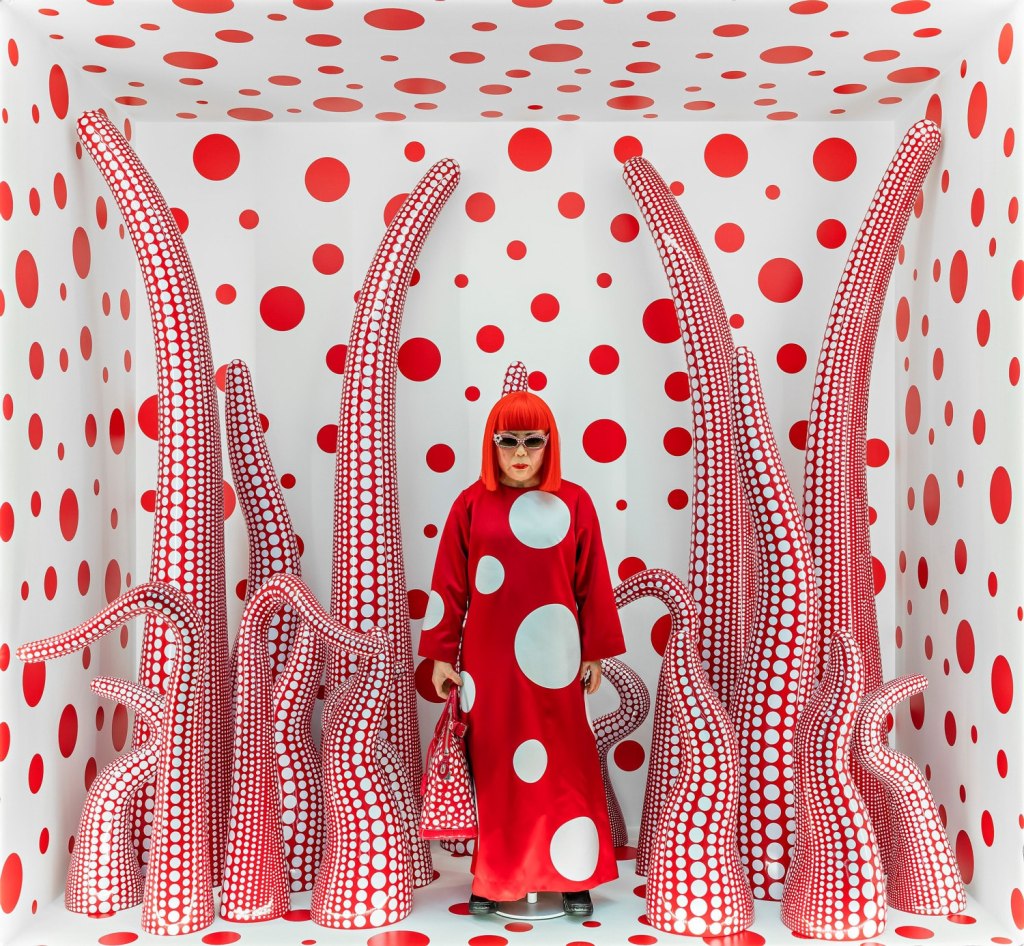
Out of all the up and coming immersive installation artists, there is one who soulfully brings her artistic creations to life using physical time and space. Yayoi Kusama is one of the most impactful immersive artists of the twenty-first century and continues to do so with her many new ideas and expressions. She claims her installations to be known as “infinity rooms” where she takes her personal experiences of hallucinosis, dissociation, and anxiety to create a physical space where one can submerge themselves in to “get away” from the real world in a safe environment. Yayoi Kusama is part of the reason as to why immersive installations are so pivotal to the history within contemporary art because as an artist, she has grown and developed over time just as the art world has. Some of her original works go as far back as 1965 where she first held a “floor show” consisting of just a mirrored room. Though not being as impactful in earlier years, Yayoi Kusama has mastered her art form by expressing how she struggles with her mentality the most. This is impactful because as a relevant topic of today, many people are now discovering the struggles of their mental illnesses and speaking up about them. Kusama is doing this through her art, but also giving many others a chance to be in a safe environment, whether or not they struggle with their mentality like she does.
Out of all the many new art forms arising in the twenty-first century, I feel as though immersive installations are the most significant. This rising art movement is significant to the history of the art world due to its involvement with the public, and getting people to feel and dive into the art world a loot more. This art form is more than just looking at a painting, it helps the viewer live within the work itself as art history has never truly experienced this on such an impactful level before.
Mitchell, Bonnie. “The Immersive Artistic Experience And The Exploitation Of Space,” CAT 2010 London Conference. January 2010, 98–107. https://doi.org/10.14236/ewic/cat2010.11.
Martin, Isabelle, “A Single Particle Among Billions: Yayoi Kusama and the Power of the Minute”. Oswald Research and Creativity Competition. University of Kentucky, 2017. https://uknowledge.uky.edu/oswald/1
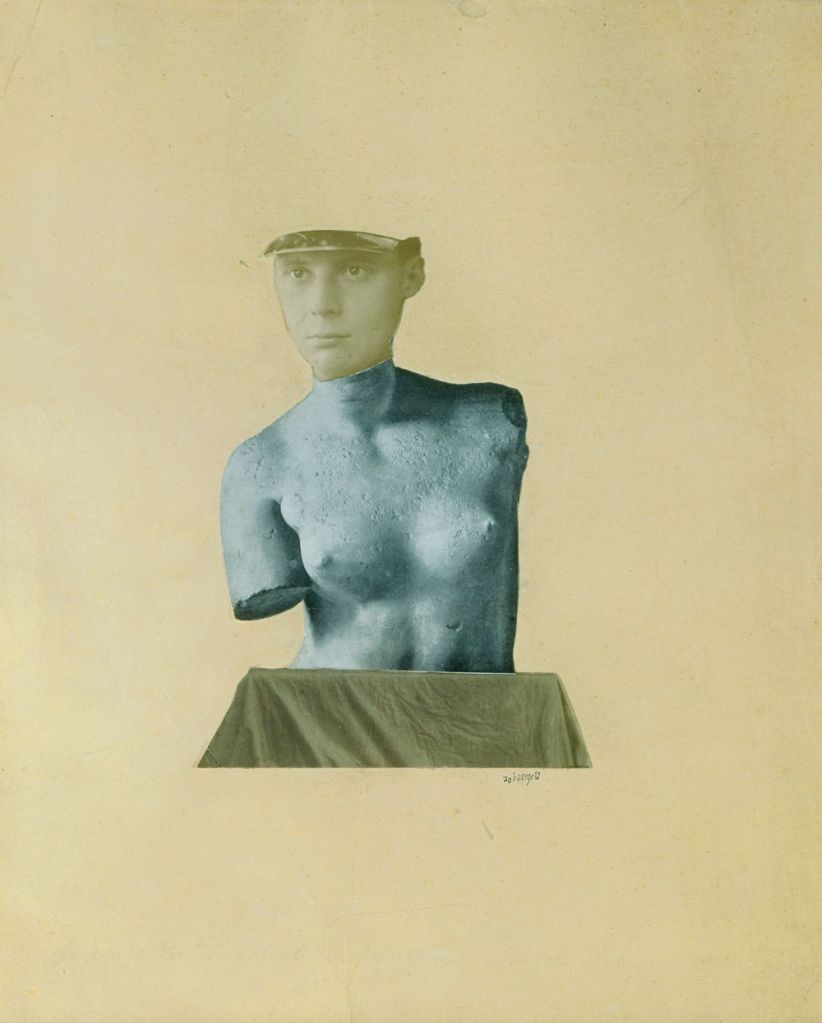
TypischeVertikalklitterung als Darstellung des Dada Baargeld, Johannes Baader, 1920
For years, artists have been creating new artistic styles and movements to break free from the traditional norms the artworld was established on. Many of which are famously remembered from the nineteenth and twentieth centuries. Two significant art movements that I have found to be the most interesting to compare are the Dada movement of the early twentieth century, and the Pop Art movement of the later to mid twentieth century. Dada and Pop Art have more comparisons than one may think however, they are still two different movements formed at different times. Dada and Pop Art could be seen as different due to the fact that the physical artworks are created from different points in history, and Pop Art did not comply with many of the traditional characteristics of Dada. However, the two art movements can be seen as similar due to their non-traditional contents and breaking from the artworld’s status quo.
Dadaism is an art movement that started in 1916 which was carried out due to the post effects World War I had on Europe and its economy.1 While Dada has been widely known for its extreme nature and non-traditional creations, it notoriously lasted until 1923. Compared to Pop Art, which went on from 1950 to about 1970, came about in America completely through satire and irony.2 Dada took away from the seriousness of art by forming a movement based around the idea that “anything can be art”3 and developed techniques such as ready-mades and collages. Opposing this, Pop Art which was recognized as, “a mirror of the spectrum of visual communications as well as representative of a constitutive channel (painting),”.4 Due to the creation and purpose behind these movements, their differences still stand out when one is able to narrow down and compare them.
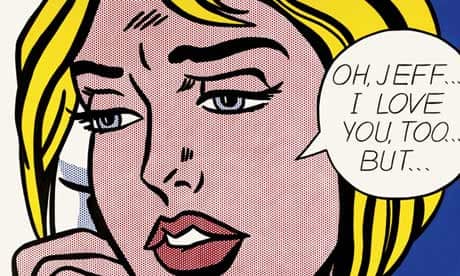
Oh, Jeff…I Love You, Too…But…, Roy Lichtenstein, 1964
Seeing as though these are two very different art styles, they can also be viewed as similar as well. Dadaism and Pop Art have many similarities between each other in their non-conformist creations of the traditional art world. As stated in Richardson’s journal, “Pop art is anti-social without being at all anti-cultural in the overwhelming sense that Dada was,”.5 What the author means by this, is that both of these significant art movements made it a point to base their work solely around rebellion or irony. Even though Dada took this movement more aggressively against the government, they both added humor and a whimsical energy to the pieces they created; both outside of the art world’s status quo. Another reason as to why these movements are seen as similar is because they compared social issues on consumerism as well. These two movements were said to be a, “direct result of competitive merchandising,” where at these different points in history, consumerism was a developing issue even though their economies were not in the best shape; causing artists to easily make ready-mades or satirical pieces poking fun at these issues going on in the world. 6
Overtime the art world has benefitted through various types of distinct art movements that were formed throughout the years. Many of which, could be seen as derivatives or variations of other movements. Dada and Pop Art could be seen in this way, seeing as though they have many similarities and differences between each other. While Dada and Pop Art were both created differently and during different periods of time, they continue to display many similarities to the purpose of the works created through them.
Sources
Gérard, Durozoi. “Dada in Paris.” History of the Surrealist Movement, The University of Chicago Press (2009).
Harrison, Sylvia. “Post Modern Assumptions.” Pop Art and the Origins of Post Modernism, Cambridge University Press (2001): 11–34.
Mancini, Lindsey. In Class Lecture.
Richardson, John Adkins. “Dada, Camp, and the Mode Called Pop.” The Journal of Aesthetics and Art Criticism 24, no. 4 (1966): 549-58. doi:10.2307/428780.
In my venture throughout the Wadsworth Atheneum Museum of Art, I had gotten to experience the sight of many exhibitions of talented artists from all over. The museum itself was created in the early 1800s in Hartford, Connecticut and founded by Daniel Wadsworth as one of the first American art patrons.1 The museum itself has further developed over the years incorporating artistic elements of Europe, Asia, the Middle East and more. The exhibition I visited was known as From Expressionism to Surrealism: Highlights of Modern Art from the Collection. This exhibition explored artworks from the Post-War time period through the visual representation of American Artists.2
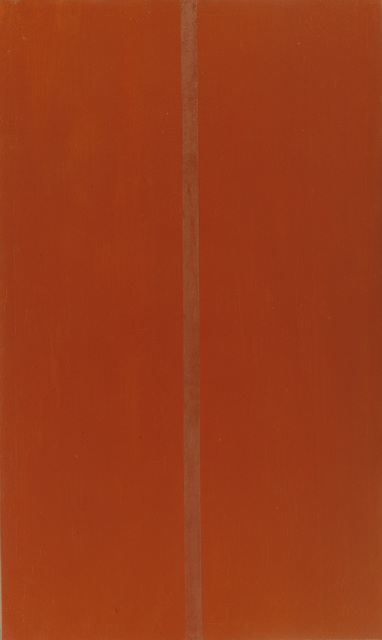
When walking into the exhibition the viewer enters through a set of glass doors into an expanded layout consisted of three rooms. Each room consisted of rectangular white walls with a doorway in the center, connected as three horizontal layouts with windows on the left wall. The first room contained the first set of eight Post-War paintings and sculptures stemming from the effects of World War II. The painting I was drawn to the most in this room was known as Onement II, created in 1948 by the artist Barnett Newman.3 This painting consisted of a singular, vertical red line across another red painted background. When reading the description about the painting I have learned that it was created to represent what Newman referred to as a “zip” like a zipper runs down a coat, dividing yet holding the same element together at the same time, This piece was also created to imply the perfect figure of the human body.4
As I traveled throughout the gallery, there were a number of art works that were brought to my attention however, the second one that gained my attention was Stack, created by Kenneth Noland in 1965, seen in the second room against the right-most wall. The artist created this work by rotating the canvas at forty-five degrees and applying vibrant bands of color that follow the margins of the canvas itself in a v-shaped pattern. The artist also applied a dot of blue paint in the top right corner of the piece to draw attention away from the rigid composition of the painting.5 I think this piece was an impactful part of the exhibition due to the fact that it had contained the ideal abstract expressionism that the Post-War movement had on American artists during this time period.
Overall the exhibition, From Expressionism to Surrealism: Highlights of Modern Art from the Collection, was intriguing as well as insightful to the viewer. What I enjoyed most about this exhibition was the fact that American artists had such a passion for surreal, abstract, and expressionist artworks during the time when the second world war was over. These works successfully educate the public on the subject matter at hand due to the fact that everyone during this time was starting to find happiness and spread love after the struggles that the war brought. The bright colors and unique brush strokes brought out a sense of life and movement to each of the pieces.




 Issues in Contemporary Art