In my venture throughout the Wadsworth Atheneum Museum of Art, I had gotten to experience the sight of many exhibitions of talented artists from all over. The museum itself was created in the early 1800s in Hartford, Connecticut and founded by Daniel Wadsworth as one of the first American art patrons.1 The museum itself has further developed over the years incorporating artistic elements of Europe, Asia, the Middle East and more. The exhibition I visited was known as From Expressionism to Surrealism: Highlights of Modern Art from the Collection. This exhibition explored artworks from the Post-War time period through the visual representation of American Artists.2
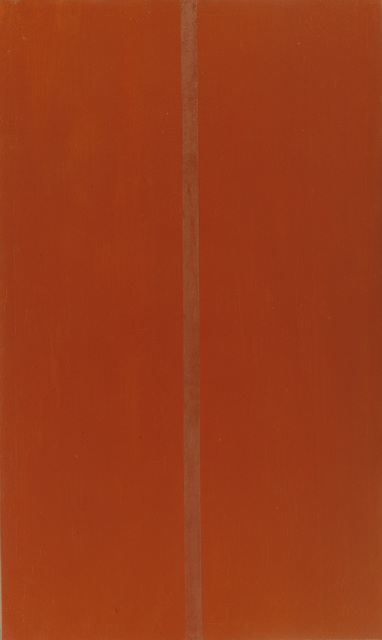
When walking into the exhibition the viewer enters through a set of glass doors into an expanded layout consisted of three rooms. Each room consisted of rectangular white walls with a doorway in the center, connected as three horizontal layouts with windows on the left wall. The first room contained the first set of eight Post-War paintings and sculptures stemming from the effects of World War II. The painting I was drawn to the most in this room was known as Onement II, created in 1948 by the artist Barnett Newman.3 This painting consisted of a singular, vertical red line across another red painted background. When reading the description about the painting I have learned that it was created to represent what Newman referred to as a “zip” like a zipper runs down a coat, dividing yet holding the same element together at the same time, This piece was also created to imply the perfect figure of the human body.4
As I traveled throughout the gallery, there were a number of art works that were brought to my attention however, the second one that gained my attention was Stack, created by Kenneth Noland in 1965, seen in the second room against the right-most wall. The artist created this work by rotating the canvas at forty-five degrees and applying vibrant bands of color that follow the margins of the canvas itself in a v-shaped pattern. The artist also applied a dot of blue paint in the top right corner of the piece to draw attention away from the rigid composition of the painting.5 I think this piece was an impactful part of the exhibition due to the fact that it had contained the ideal abstract expressionism that the Post-War movement had on American artists during this time period.
Overall the exhibition, From Expressionism to Surrealism: Highlights of Modern Art from the Collection, was intriguing as well as insightful to the viewer. What I enjoyed most about this exhibition was the fact that American artists had such a passion for surreal, abstract, and expressionist artworks during the time when the second world war was over. These works successfully educate the public on the subject matter at hand due to the fact that everyone during this time was starting to find happiness and spread love after the struggles that the war brought. The bright colors and unique brush strokes brought out a sense of life and movement to each of the pieces.
Sources
Artnet. “Kenneth Nolan.” Biography, Artnet Worldwide Corporation. 2008.
Artnet. “Barnett Newman.” Biography, Artnet Worldwide Corporation. 2009.
Kilkenny, Amy. “History” Wadsworth Atheneum Museum of Art, 2015. https://www.thewadsworth.org/about/history/
Jones, Jonathan. “Glimpses of the Sublime.” The Guardian. The Guardian, 16 May 2013. Web. 12 Apr. 2015.
 Issues in Contemporary Art