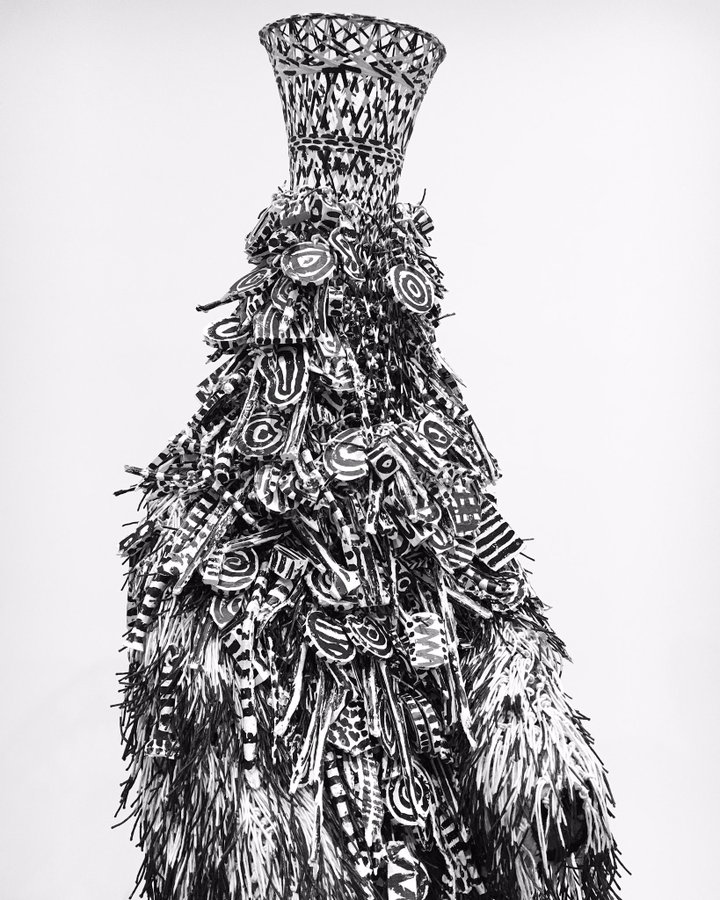
Walking into the Yale Art Gallery, Nick Cave’s Soundsuit (2006) is not a piece you would expect to see. Its tall stature is intimidating and a little frightening at first glance. The sculpture is very tall and almost looks like a monster that is covered head to toe in a mixture of wood, paint, and paper that looks like fringe on the arms and legs. It stands out amongst the other artworks in the room.
Nick Cave. Soundsuit, 2006. Paint, paper, cotton, wood, fabricated fiberglass; 90 × 27 × 19 in.”. American Art Gallery at Yale University Art Gallery, New Haven, CT. Photo by @ronnie_rysz.
Once reading the description of Cave’s process for the piece, it is clear that he intended for the sculpture to be unsettling. As a gay Black man, he knew that he would be seen as a threat in society. He says, “How do I exist in a place that sees me as a threat?” In response to this feeling, Cave wanted to create a piece that could be worn as protection or as a performance piece. Also, perhaps Cave wanted viewers to have a visual representation of what being a Black man in America feels like.
Photography has been used to document important moments for as long as cameras have been around. However, it has begun to transform into a contemporary art form in recent years. With picture-focused social media sites like Instagram and Snapchat being as popular as they are, photography is constantly changing and becoming more integrated into our lives everyday. We get to see into people’s daily lives, and there has been a shift towards desiring authenticity and realness. Documentary photography captures these real everyday events that happen in people’s lives. Documentary photography is a broad term, but the National Galleries Scotland describes it as, “…art which captures a real moment, conveying a message about the world. As opposed to photojournalism, which concentrates on breaking news events, it typically focuses on an ongoing issue or story seen through a series of photographs, drawing attention to difficult or dangerous world issues which require some form of remedial or political action.” Documentary photography can be about anything, as long as it is centered around people. Through this art form, we can learn about history, social issues, and feel connected to people we may not even know in real life.
James F. Gibson. Contrabands at Headquaters of General Lafayette, 1862. Photograph; 11.5 x 15 cm. Liberty of Congress, Washington, D.C. Image by Library of Congress Prints and Photographs Division.
Documenting important events used to only happen through writing. When cameras were first invented in the early 19th century, people saw this as a new way to pass on pieces of history. The earliest record of documentary photography dates back to the Civil War as this was the first big historical event since the emergence of the camera. There are a plethora of photos of the Union and Confederate soldiers, battles, slaves and ordinary life. One photograph titled Contrabands at Headquarters of General Lafayette shows a group of escaped enslaved people holding wash basins standing in front of a line of soldiers who have their arms crossed, and they are all posed in front of an old house, assumingly owned by General Lafayette. General Lafayette was the Confederate Army general, and it is implied that the soldiers had just captured the slaves standing in front of them. Reading about what the Civil War was like can paint a vague picture in your mind, but photographs like these bring on a new perspective. With documentary photography, people could see the realities of it with their own eyes.
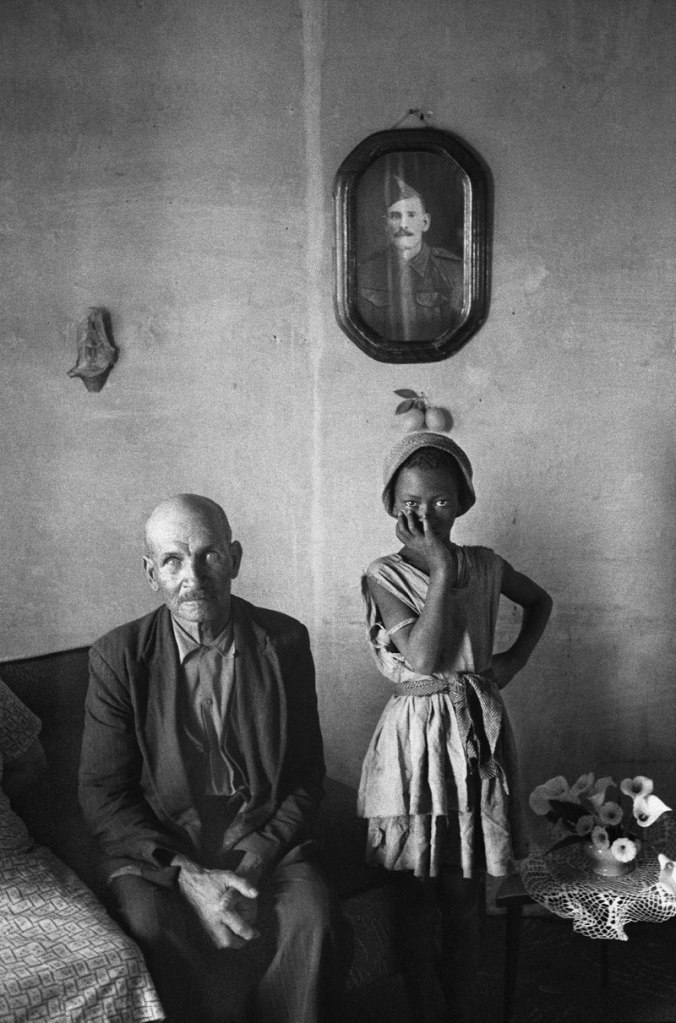
Knowing how powerful documentary photography can be, many photographers decided to use it to inspire social change. David Goldblatt was a South African photographer who documented the effects of apartheid on both Black and White people. To describe the aim behind his photography he once said, “I was very interested in the events that were taking place in the country as a citizen but, as a photographer, I’m not particularly interested, and I wasn’t then, in photographing the moment that something happens. I’m interested in the conditions that give rise to events.” One photograph titled A plot-holder with the daughter of his servant, Wheatlands, Randfontein (1962) depicts an older White man sitting next to a young Black girl. It is clear from this picture they are not close with each other. The man is clasping his hands together while the girl is standing with one hand covering her mouth. They both look visibly uncomfortable standing close to each other. This image illustrates the tension that apartheid has created between everyone. With social media, using photography to spread awareness of social issues has become the norm. In recent events, the riots and peaceful protests that took place after the police killing of George Floyd, an unarmed Black man in May 2020 brought on many powerful photos. For example, protesters in Minneapolis where the killing took place set multiple public buildings on fire in retaliation. In one photo, there is a multi-story building engulfed in flames with billows of smoke coming from the top. There are also two people running away from the building. This picture and others like it went viral, and brought more awareness to the severity of George Floyd’s death and more protests and riots around the U.S. followed suit.
David Goldblatt. A plot-holder with the daughter of his servant, Wheatlands, Randfontein, 1962. Gelatin silver print; 21 × 14.1 cm. The Art Institute of Chicago, Chicago, IL. Image by Huis Marcielle.
Being able to connect with people like David Goldblatt did is an important part of being a documentary photographer. Not everyone will just allow a random stranger to take their picture. Humans of New York is a photoblog turned Instagram account that focuses on ordinary people’s lives. For this project, photographer Brandon Stanton and his team interview random people off of the street and take casual photos of them. They are never planned or overly edited, and this captures the beauty of everyday people. The subjects are allowed to talk about whatever they want in these interviews, and some people even tell their life story. It gives a sense of humanity to people who you may not know. Photographer Hannah La Follette Ryan has a similar mission with her blog, although she does not usually talk to the people she photographs. Like Brandon Stanton, Ryan also uses Instagram for her documentary photography on the page @subwayhands. Each of her photos is a different pair of hands, or multiple pairs in some cases. Set in a random New York City subway, her subjects are unaware that their hands are being photographed. Journalist Helen Rosner who interviews Ryan states, “The hands that La Follette Ryan captures tell dense emotional stories; in their poses and grips, they take on the surreal semi-humanity of sculpture… They also, over months and years, tell collective stories of what we wear and carry: trends in manicured nails, watches, and rings; new models of phones and headphones. But the story told in her latest photos came on suddenly and is all-encompassing—a collective, simultaneous adjustment in how we interact with the city and with one another.” Although hands may not seem important in pictures, they are. People use them for everything, and they are a huge part of conveying body language. Through her photos, Ryan and viewers of her art and can connect with people without even saying a word.
Documentary photography is centered around people and their lives, whether they are extravagant or mundane. Its importance lies in the fact that it holds pieces of history, inspires social change, and helps us to feel more connected to others.
Gibson, James F. Contrabands at Headquaters of General Lafayette. 1862. Photograph; 11.5 x 15 cm. Liberty of Congress, Washington, D.C. https://www.loc.gov/item/2014646902/
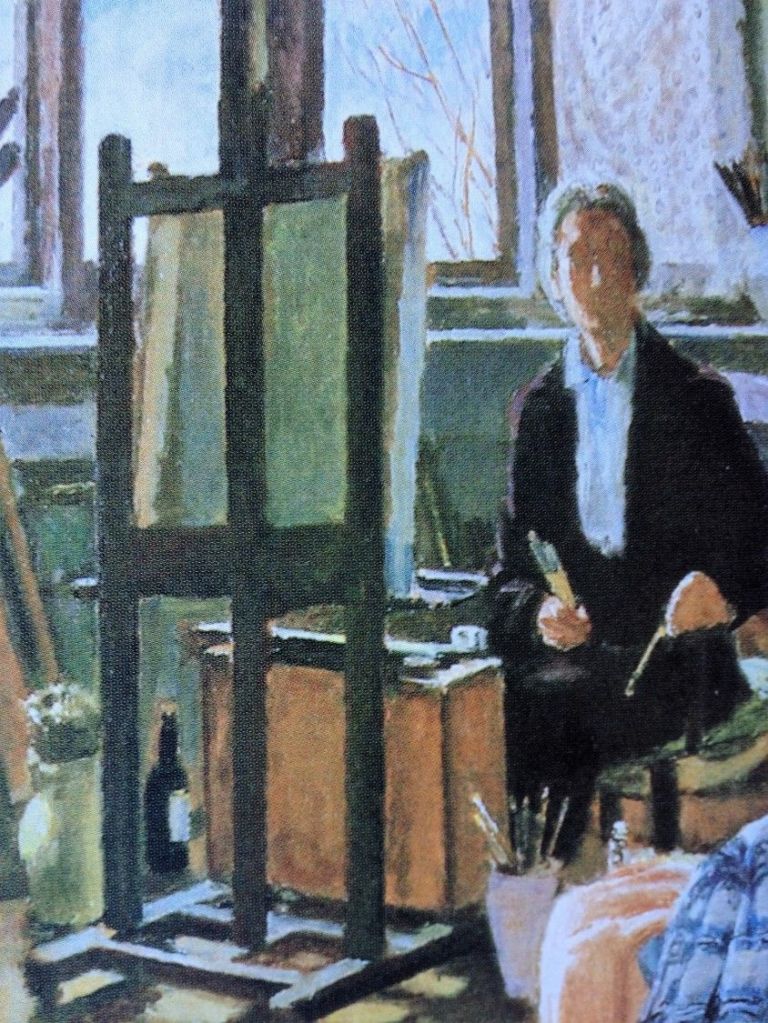
Vanessa Bell. The Artist in her Studio, 1952. Oil on canvas; 24″ x 20″. Paintings and Sculpture Collection at Yale Center for British Art, New Haven, CT. Image by Yale Center for British Art.
The Yale British Art Gallery’s Art in Focus: Women from the Center is an exhibit that took place from January 14th, 2021-October 10th, 2021. It was curated by current Yale University students Emma Gray, Sunnie Liu, Annie Roberts, Christina Robertson, and Olivia Thomas. According to the curators the exhibit is, “Inspired by Yale University’s celebration of 50 years of coeducation in Yale college and 150 years of coeducation in Yale graduate programs, Art in Focus: Women From the Center highlights women artists whose inventive art practices have enabled them to stake out space in the art world.” An exhibit like this is very important, because it showcases the importance of diverse female representation in art. When discussing art history, women artists, especially women of color, are usually left out of the picture and men are in the forefront. Finally, women of all backgrounds are taking the stage and are finding their place in the art world. One unfortunate downside of the exhibit is that it felt incomplete. Walking around, there seemed to be something missing, as if some pieces were taken down. However, the artwork that was showcased makes up for this.
One of the first things that is noticeable about the exhibit is that it is more diverse than most. The art world is notorious for not being very inclusive. For many years, women and people of color artists have been excluded from art museums. According to a 2018 study done on diversity in museums, researchers found that in 18 major art museums, 87% of artists represented were male, and 85% were White. In this exhibit, there are pieces from artists who are women of color such as Joy Gregory, a Black woman, and Rina Banerjee who is Indian American. Often, non-white artists are not showcased as much in art galleries; especially in galleries that focus on British art, where work from white artists is usually prioritized. Yale made a genuine effort to include women from different ethnicities, which is appreciated.
The stand-out part of the exhibit was Women as Muses. The female muse is the most prevalent theme in Western art. Throughout history, muses have been idealized and objectified by the male gaze, but these works challenge our understanding of the relationship between the artist and the muse. Often in Western art, artists’ muses (who are mainly women) are subject to being seen purely as objects. The onlooker does not see the muse as a whole person, but instead, only someone to gawk at and admire. Muses can also be used for male artists to project their sexist feelings onto. An example of this would be Pablo Picasso and the many women who inspired his works. Les Demoiselles d’Avignon (1907) which translates to “The Young Ladies of Avignon,” is a painting by Picasso that shows unflattering depictions of his five female subjects, who worked as prostitutes. The ladies are posed naked together, their bodies are abstract form, and their faces are deformed with traditionally masculine features. This work has been criticized for being dehumanizing to the women, especially because of the stigmatization around sex work in the 1900s. When discussing the meaning behind the painting, Rachel Higson states, “In Les Demoiselles, the women working in the brothel have angular vaginas and powerful poses expose the dangers of liberated female sexuality. This painting is about women, not for women—a formula on which so many patriarchal institutions rely. The phallic orientation of the pear and apple at the bottom center of the canvas reveals how exposed the genitalia and in essence the male viewer is when up against an independent woman.” Many people feel that Les Demoiselle d’Avignon and his other works with female subjects tap into Picasso’s fear of women’s sexual freedom.
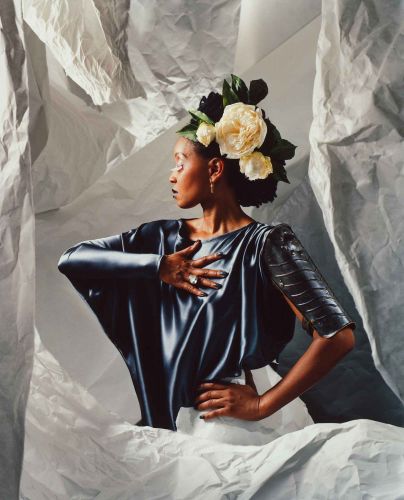
Neeta Madahar. Sharon with Peonies, 2009. Chromogenic print on photographic paper; Sheet: 39 3/4″ × 30″ and Image: 34 7/8″ × 28″. Prints and Drawings Collection at Yale Center For British Art, New Haven, CT. Image by Yale Center for British Art. Photo by Neeta Madahar.
In Women as Muses, female artists are reclaiming their power and depicting themselves through their own gaze, also known as the feminine gaze. Vanessa Bell’s 1952 painting The Artist in her Studio shows the artist herself sitting on a chair in front of an easel and canvas looking back at the viewer. She is holding paint brushes, suggesting that she is about to paint something, or is in the process of doing so. The color palette is muted, giving the painting a quaint and still feel. Bell perhaps was inspired by looking in the mirror and decided to paint herself. She may have also wanted to showcase what her painting process looks like. Another standout piece in the exhibition is Neeta Madahar’s Sharon with Peonies (2009) This piece is a part of a greater collection of works called Flora, which contains seventeen images of Madahar’s friends. She describes the goal of this project as,“The portraits, shot in a style reminiscent of 1930-50s glamor images, are not concerned with nostalgia, but anchored in the present, aware that fantasy personas are shams that can be superficially occupied and manipulated in front of the camera.” In this photograph, a dark skin Black woman with giant cream-colored peonies in her hair, wearing an asymmetrical blue metallic top. Her head is turned to the side and her eyes are closed, with one of her hands on her chest. Rarely in famous historical pictures and paintings are Black women the muses; this photograph subverts that.
Women being included in the art discussions is extremely important. A gallery as influential as Yale highlighting women of all backgrounds will hopefully inspire change in the art world. Women in Focus, although small, is worth the trip to the Yale British Art Gallery. There are very compelling artworks, and there is also diversity and representation for all women.
Madahar, Neeta. Sharon with Peonies. 2009. Chromogenic print on photographic paper, 39 3/4″ × 30″ and 34 7/8″ × 28″. Yale Center For British Art, New Haven, CT. https://collections.britishart.yale.edu/catalog/tms:81309
Topaz, Chad M., Bernhard Klingenberg,Daniel Turek,Brianna Heggeseth,Pamela E. Harris,Julie C. Blackwood,C. Ondine Chavoya,Steven Nelson, and Kevin M. Murphy. “Diversity of artists in major U.S. museums.” PLOS One. Last modified March 20, 2019. https://journals.plos.org/plosone/article?id=10.1371/journal.pone.0212852.
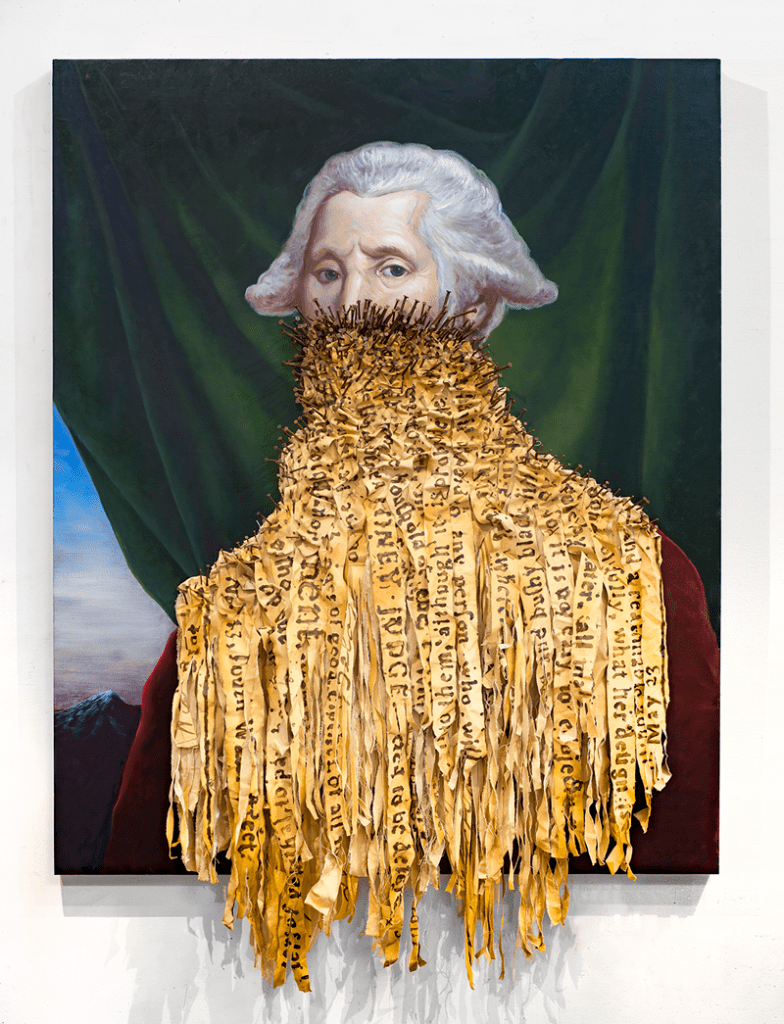
In this interview with Bomb Magazine, Titus Kaphar explains that he wants to bring attention to Black historical figures who are left out of discussions of American history. In one of Kaphar’s pieces named Absconded from the Household of the President of the United States (2016), there are multiple rusted nails tacked into a portrait of George Washington. The nails are all holding onto shredded pieces of paper with names of all the enslaved people that Washington owned. This piece calls out the fact that Americans credit George Washington for what he did for the country as the first U.S. President, while ignoring that the United States was built off the backs of enslaved people.
Titus Kaphar. Absconded from the Household of the President of the United States, 2016. Oil, canvas, and rusted nails on canvas; 60″ x 48″. Building a Legacy: Chrysler Collects for the Future, Norfolk, VA. Image by Kaphar Studio. Photo by Jeremy Lawson Studio.
Imperialist countries like the United States often like to mask the shame of its past. George Washington and multiple other Founding Fathers owned slaves. This is proved by states like Texas that are now trying to suppress the teaching of slavery and other horrific events in American history. I remember that I didn’t learn that the early presidents and other famous American figures owned slaves until I was in high school. Art like Titus’ is important because it shows how white-washed American history is, and how historical BIPOC figures are overlooked.
Sources
Titus Kaphar. Absconded from the Household of the President of the United States. 2016. Oil, canvas, and rusted nails on canvas, 60″ x 48″. Chrysler Museum of Art, Norfolk, VA.
At first glance, Dada and Surrealism can easily be mistaken for each other. This is because their styles and motivation behind the art is similar. Both of these movements are meant to make viewers of the art question logic. In her article on Dada and Surrealism, Alice Samusevich writes, “They sought to break down conventions in the arts in order to bring forth a new, improved culture…Surrealism was similar to the Dada movement because it was meant to defy the reason and logic in response to the seemingly unreasonable World War I.” However, if you look past the sometimes questionable, outlandish pieces both movements have to offer, you’ll find that their emergence, styles, and messages are different in a lot of ways.
Dada first emerged in Zurich, Switzerland 1914 as a result of the end of the first World War. As what happens with the end of most wars, countries have to rebuild and there is generally a more serious atmosphere. Many artists started to grow unhappy with the monotony of everyday life. Art historians at the MoMA explain, “For the disillusioned artists of the Dada movement, the war merely confirmed the degradation of social structures that led to such violence: corrupt and nationalist politics, repressive social values, and unquestioning conformity of culture and thought… Dada artists sought to expose accepted and often repressive conventions of order and logic, favoring strategies of chance, spontaneity, and irreverence.” Dada artists were often anti-establishment, left leaning individuals. They proudly rejected the meaning of traditional art and what they felt it stood for. Often, the art world and artists can be seen as pretentious, elitist, and so on. Dadaists, being against the bourgeoisie, rejected these ideas.
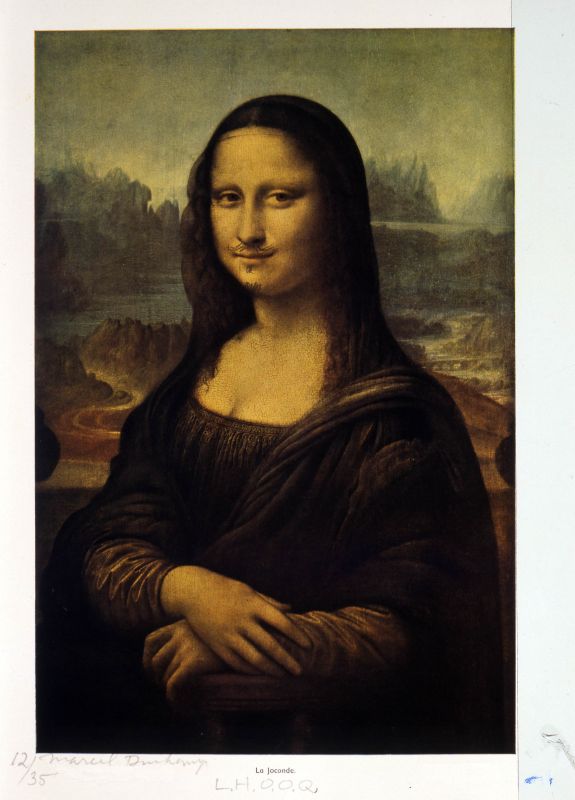
Marcel Duchamp. L.H.O.O.Q., 1919/1964 Rectified readymade. Pencil on reproduction; 30 x 23 cm. Collection of the Israel Museum, Jerusalem The Vera and Arturo Schwarz Collection of Dada and Surrealist Art. Image by Israel Museum. Photo by Avshalom Avital.
L.H.O.O.Q (1919) by leader of the Dada movement, Marcel Duchamp, depicts the Mona Lisa painting by Leonardo DaVinci with a handlebar mustache and goatee. This is known as a “readymade,” which gives new life and purpose to everyday objects. According to Dr. Charles Cramer and Dr. Kim Grant, “The readymade is divorced from its ordinary context and use value and re-presented in an art world context. This encourages us to encounter the object in a different way.” The piece is meant to be a comical critique of art in general. The Mona Lisa is one of the most iconic paintings in history, today it is worth about $850 million. By making a satirical piece of this piece, perhaps Duchamp was finding the humor in a painting that many people take so seriously.
As Dada art began to dwindle in popularity, Surrealism emerged in Paris in the early 1920s. Similar to Dada, Surrealism was also a response to the first World War. In his article on surrealism, art historian James Voorhies says, “The cerebral and irrational tenets of Surrealism find their ancestry in the clever and whimsical disregard for tradition fostered by Dadaism a decade earlier.” Surrealists wanted to introduce different ideas, and to inspire people to think beyond what they think they know about the world.
Unlike Dadaists, Surrealists consider themselves to be real artists. On the other hand, Dadaists’ art is meant to mock the art world; it is anti-art. Surrealism emerged not to mock, but to make people question rational thought. Surrealists’ goal was to make thought provoking work that makes you see the world in a new perspective. Also, although Dada and Surrealism came about because of World War I, dada was a negative and critical expression of feelings, while surrealism was a more positive expression. In other words, Dadaists used their art as an outlet to critique, and surrealists used their art to simply question. One example of this style of art is Lobster on Telephone (1938), a sculpture by Edward James and Salvador Dalí. The title describes the appearance of the work perfectly; there is a plastic, red lobster on top of an black rotary phone. These are two vastly different things that the average person would not think would go together. When asked why he created the piece, Dalí said, “I do not understand why, when I ask for a grilled lobster in a restaurant, I am never served a cooked telephone. I do not understand why champagne is always chilled and why on the other hand telephones, which are habitually so frightfully warm and disagreeably sticky to the touch, are not also put in silver buckets with crushed ice around them.” James and Dalí wanted viewers of the piece to question its purpose; was there even meant to be a purpose? Does all art have to have meaning or can it just exist for art’s sake?
Salvador Dalí. Lobster on a Telephone, 1938. Steel, plaster, rubber, resin and paper; 7″ x 13″ x 7″. Tate Modern, London, England. Image by Tate Britain. Photo by Salvador Dali, Gala-Salvador Dali Foundation/DACS, London 2020.
Known for their humor and not taking themselves too seriously, Dadaism and Surrealism have many things in common and it is easy to see why they are often mistaken for each other. They also have many differences as well; Dada was more negative, meant to critique, and was anti-establishment. On the other hand, Surrealists were more positive, meant to inspire questions, and they were less involved in politics when it came to their art. Despite their similarities and differences, they are two powerful art movements that are still respected and discussed today.
Frida Kahlo, birth name Magdalena Carmen Frida Kahlo y Calderón was born in Coyoacán, Mexico City, Mexico on July 6, 1907, to her parents Wilhelm Kahlo and Matilde Calderon y Gonzalez. She married famed Mexican painter Diego Rivera two times, once from 1929-1940, then married again later that same year until Kahlo’s death. Most of her paintings consist of self-portraits, and her art is considered surrealism, specifically magical realism.
Throughout her life, Kahlo has suffered a multitude of illnesses and accidents. In her youth she caught polio, and it is debated whether she had a birth defect that affected her spine and legs. Her chronic pain led to her being bedridden for a great deal of her life, leading her to use her free time to paint her portraits. In 1953, her leg was amputated. One of the most influential events that impacted her art was a bus crash. Kahlo was involved in a bus accident on September 17, 1925. At the age of 18, she and her boyfriend at the time, Alejandro Gómez Arias were on a public bus on their way home when it suddenly crashed into an electric car. Her pelvic bone had been fractured and her uterus and abdomen were punctured. Additionally, her spine had been broken in three places, her right leg in 11 places, her shoulder was dislocated, her collar bone was broken, and doctors later discovered that three additional vertebrae had been broken as well. Her health caused her much distress, and in 1953 she stated, “I am not sick. I am broken. But I am happy to be alive as long as I can paint.” While recovering, she used her time painting and turned her pain into art, also painting on her body cast. Describing her journey finding comfort in art, Wes Kelley writes, “This body altering event led to a life of surgeries, recoveries, and pain. She became an alcoholic, an adulterer (like her husband), and a masterful painter. Her horrible physical condition became the inspiration for her morbid and macabre paintings. Kahlo’s pain created works focusing on the death, decay, and brokenness of the human body.”
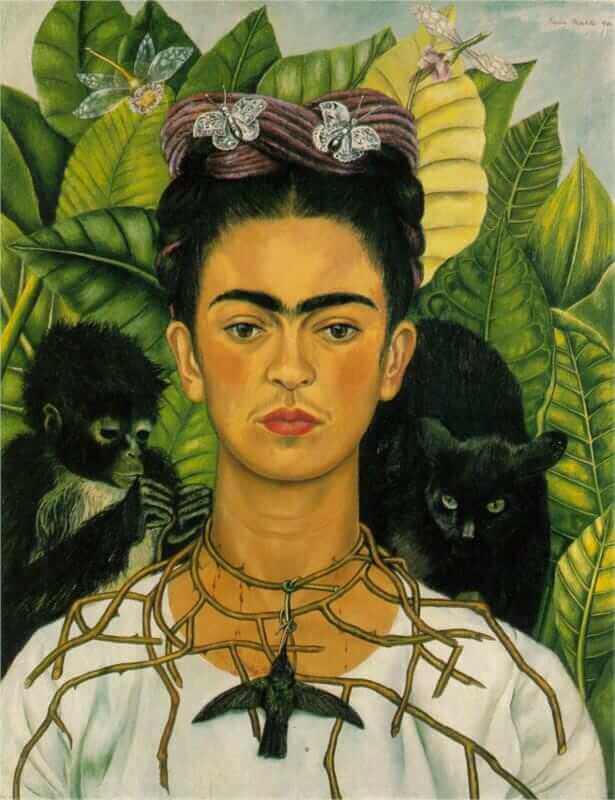
Frida Kahlo. Self Portrait with Thorn Necklace and Hummingbird, 1940. Oil on canvas; 24.11″ × 18.5″. Nickolas Muray collection at the Harry Ransom Center, Austin, TX. Image by FridaKahlo.org.
Most of Kahlo’s works are portraits of her surrounded by a beautiful, tropical landscape. Perhaps her being confined to a bed while sick inspired her to feel close to nature. For example, one of her most famous portraits, Self Portrait with Thorn Necklace and Hummingbird (1940), depicts Kahlo wearing a thorn necklace with a hummingbird attached to it. The necklace is so tight and sharp around her neck that it is drawing blood. On her left shoulder there is a black monkey, and there is a black cat, perhaps a panther, on her right. The background features many green leaves, suggesting that she is in a rainforest. Her stoic look in the painting may symbolize all the pain that she has endured, and how she has kept a brave face through it all.
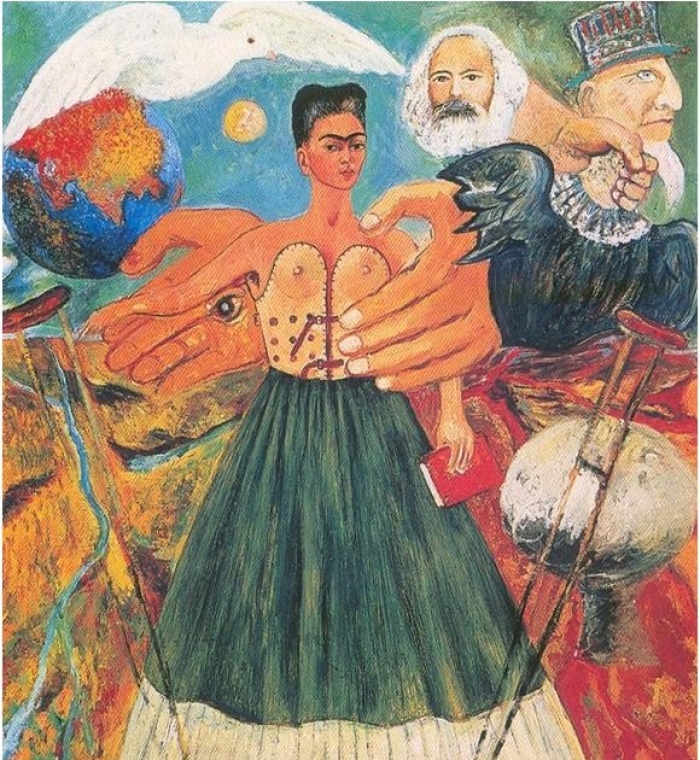
Frida Kahlo. Marxism Will Give Health to the Sick, 1954. Oil on masonite; 23.6″ x 29.9″. Frida Kahlo Museum, Mexico City, Mexico. Image by FridaKahlo.org
Besides her poor health, Kahlo’s politics also influenced her art. Kahlo was a Marxist, joining the Young Communist League and the Mexican Communist Party while at school. She was born just three years before the Mexican Revolution. In her later years as a painter, she would want to show her political side more. For example, she has a piece called Marxism Will Give Health to the Sick (1954). In the self-portrait, Kahlo is standing in the middle of the canvas with her left arm stretched out to her side, and her right arm at her side with her holding a red book, which is She is wearing a long green skirt and a corset or upper body cast with straps. There are crutches at her side, indicating that she is unwell. In the right-hand corner of the painting, there is the head of Karl Marx attached to a hand, which is gripping onto a bald eagle with the head of Uncle Sam. There are two hands outstretched toward her. These may represent the hands of Marxism coming to save Kahlo from the oppression of imperialism and capitalism.
Women are taught early on that body hair is “un-ladylike,” and because of this, many of them shave. Kahlo, however, heavily rejected society’s ideas of traditional femininity and what a woman “should” be. In her diary she once wrote, “I used to think I was the strangest person in the world but then I thought there are so many people in the world, there must be someone just like me who feels bizarre and flawed in the same ways I do. I would imagine her, and imagine that she must be out there thinking of me, too.” She was never afraid to stand out and break conventions, which is what makes her an important feminist figure today. She proudly sported a unibrow and mustache. She also did not shave her legs or underarms either. In all of her portraits, she makes her unibrow and mustache prominent.
Kahlo died a week after her 47th birthday on July 13, 1954 in her home village from a pulmonary embolism. Like most artists, Frida Kahlo did not get the full recognition for her art that she deserved until she died. Today, she remains an influential artist who used her misfortunes to guide her art.
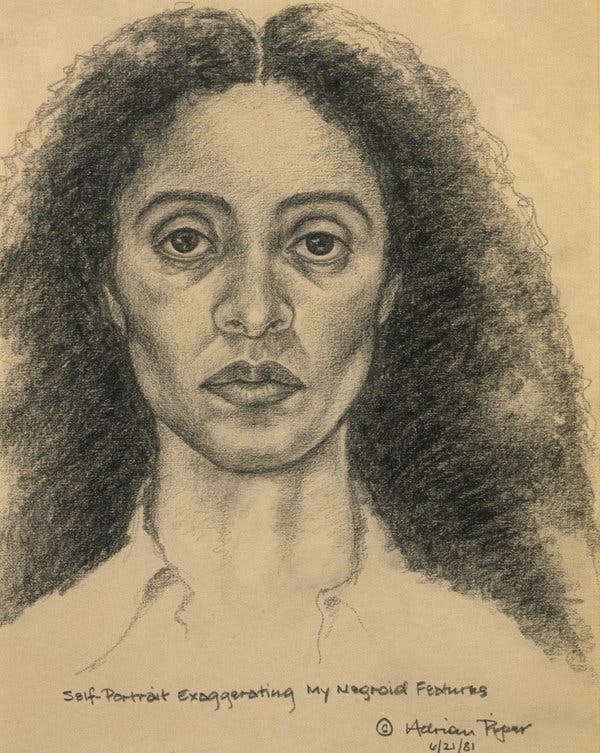
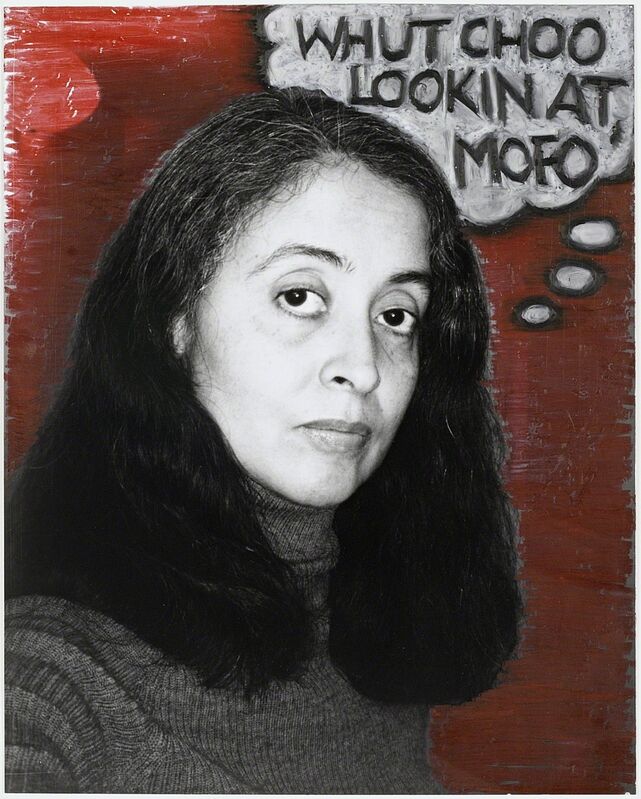
Adrian Margaret Smith Piper was born on September 20th, 1948 in New York, New York to mixed race parents, and she identifies as a Black woman. She is a conceptual artist who does performance pieces, with most of her art being confrontational critiques on society. She was inspired by the injustices she experienced and witnessed to use herself as a form of expression. In 1971 she wrote, “I can no longer see discrete forms or objects in art as viable reflections or expressions of what seems to me to be going on in this society. They refer back to conditions of separateness, order, exclusivity, and the stability of easily accepted functional identities that no longer exist.” In two of her pieces, Self Portrait Exaggerating my Negroid Features (1981) and Self Portrait of a Nice White Lady (1995), Piper aims to deconstruct viewers’ perceptions of race and identity.
Adrian Piper. Self Portrait Exaggerating my Negroid Features, 1981. Pencil on paper; 10″ x 8″. Collection of Eileen Harris Norton, Los Angeles, CA. Image by Arthur.
Her piece, Self Portrait Exaggerating my Negroid Features (1981) features a self-portrait of Piper with pronounced facial features like a wide nose, afro-textured hair, and full lips, which are features that she does not naturally have. For her whole life, Piper was mistaken for being many different races and ethnicities other than Black because of her light skin and smaller facial features. Although this may not be her intention with the portrait, another way to examine this piece is perhaps Piper is taking a stand against the types of faces that are usually depicted in Western art art. Western beauty standards are very Eurocentric; European features like pale skin, long hair, and a small nose are praised. These beauty standards translate into art, and Western artists throughout history have depicted beautiful women as those with these specific features. These characteristics are often associated with femininity, elegance, and softness. The most common Black/non-White features like wide noses, darker skin, and curly/textured hair are not given this same exposure and are even demonized in the Western world. Piper could be giving power back to non-White features by depicting herself this way.
In Self Portrait of a Nice White Lady, Piper challenges the concept of race. In this picture, there is a photograph of Piper with a straight face and a speech bubble that says “Whut choo Lookin At MOFO” in front of a burgundy background. Due to racial biases, the concept of a White woman, specifically a “nice White lady” is automatically associated with positive attributes like friendliness, femininity, intelligence, and so on. The Studio Museum writes, “The image refutes its title by presenting Piper as herself, a Black woman, who cannot be reduced to being simply “nice.” The work’s text—“Whut choo lookin at, mofo?”—is a call to pay attention and confront how stereotypes inform the way we read people.”
Adrian Piper. Self-Portrait as a Nice White Lady, 1995. Black and white autophoto with oil-crayon drawing; 18 1/4″ × 14 1/4″. A Constellation Collection at the Studio Museum in Harlem, New York City, NY. Image by The Studio Museum.
The fact that the nice White lady is talking in African American Vernacular English (AAVE) could be jarring, considering that AAVE is often seen as an “unintelligent” and “aggressive” dialect, traits that are not associated with White women. In this work, Piper is directly challenging the viewer’s perception of what it means to be a White woman by having her say the exact opposite of what many people may believe a nice White lady would say.
Although Piper’s work is successful in challenging Western art, it is important to note that her being a light-skin, White passing Black woman makes it easier for her art to be valued. She has been allowed in spaces that her dark skin counterparts have not been. Race is phenotypic as much as it is genotypic. Just because someone is racially Black does not mean that they will experience all of the plights of being a Black person if society does not perceive them that way. In Self Portrait Exaggerating my Negroid Features, Piper even had to extremely emphasize her facial features to show that she is Black. In her 1986 piece, Calling Card (I am black), Piper had to point out that she was Black when people would say racist things around her because they assumed she was another race. On the other hand, Piper never denies her Blackness, and if anything, uses her privilege as a White passing Black person to call attention to important topics.


 Issues in Contemporary Art