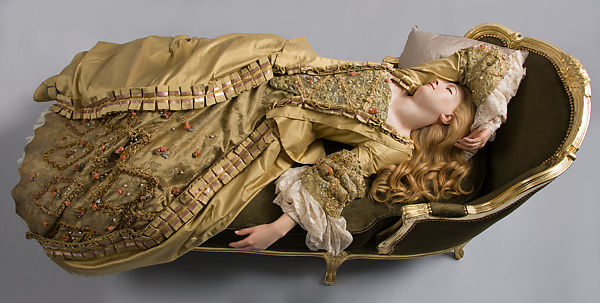
Sleeping Beauty, Philippe Curtius 1989, Sculpture; 32 11/16 × 65 3/8 × 29 1/8 in., 112.4 lb. New York. The Metropolitan Museum of Art [The Met Breuer]. “Like Life: Sculpture, Color, and the Body,”
In Jerry Saltz article about his response on The Met Exhibition Life Like, we as the readers learn about his opinions on this hyperrealism take on the body. He described this exhibit as a frenemy, while in his response criticizes the fast in the artwork chosen with the met being such a prestigious museum. Saltz calls the exhibit “devolatilizing slog” which doesn’t make anything sound even remotely appealing about it. He bashes the western art that the exhibit is comprised of but compliments its equality with being a fair mix of both male and female nudes which was often not seen before the me-too movement. With all the negativity about this exhibit he finishes off with stating that he still recommends it, specifically for its unique pieces that would often not be featured or seen by those
My overall response to the content was overall shock by the amount of negativity Saltz combined in his writing. It seems like a very harsh critique and review of something that from my understanding is exactly what it says it is. I went into further detail looking up this exhibit so I could see it all and read the Mets description of it and compare it to how Saltz described it. He seemed very angry at the exhibit as it was almost a letdown but for me isn’t this the same with every exhibit put together, there is always going to be someone who doesn’t understand the overall tones and meaning behind the work. But it’s still important to learn about and see things we wouldn’t necessarily be interested in or understand fully.
Frida Kahlo, birth name Magdalena Carmen Frida Kahlo y Calderón was born in Coyoacán, Mexico City, Mexico on July 6, 1907, to her parents Wilhelm Kahlo and Matilde Calderon y Gonzalez. She married famed Mexican painter Diego Rivera two times, once from 1929-1940, then married again later that same year until Kahlo’s death. Most of her paintings consist of self-portraits, and her art is considered surrealism, specifically magical realism.
Throughout her life, Kahlo has suffered a multitude of illnesses and accidents. In her youth she caught polio, and it is debated whether she had a birth defect that affected her spine and legs. Her chronic pain led to her being bedridden for a great deal of her life, leading her to use her free time to paint her portraits. In 1953, her leg was amputated. One of the most influential events that impacted her art was a bus crash. Kahlo was involved in a bus accident on September 17, 1925. At the age of 18, she and her boyfriend at the time, Alejandro Gómez Arias were on a public bus on their way home when it suddenly crashed into an electric car. Her pelvic bone had been fractured and her uterus and abdomen were punctured. Additionally, her spine had been broken in three places, her right leg in 11 places, her shoulder was dislocated, her collar bone was broken, and doctors later discovered that three additional vertebrae had been broken as well. Her health caused her much distress, and in 1953 she stated, “I am not sick. I am broken. But I am happy to be alive as long as I can paint.” While recovering, she used her time painting and turned her pain into art, also painting on her body cast. Describing her journey finding comfort in art, Wes Kelley writes, “This body altering event led to a life of surgeries, recoveries, and pain. She became an alcoholic, an adulterer (like her husband), and a masterful painter. Her horrible physical condition became the inspiration for her morbid and macabre paintings. Kahlo’s pain created works focusing on the death, decay, and brokenness of the human body.”
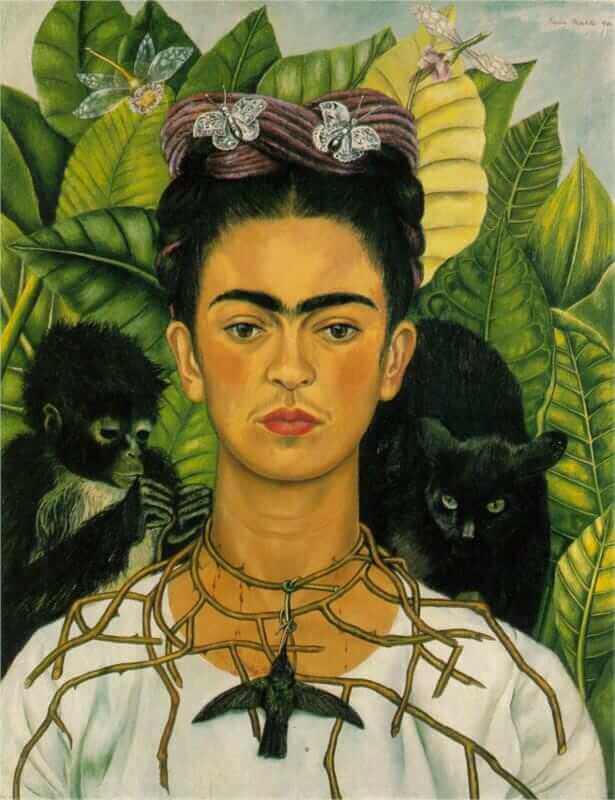
Frida Kahlo. Self Portrait with Thorn Necklace and Hummingbird, 1940. Oil on canvas; 24.11″ × 18.5″. Nickolas Muray collection at the Harry Ransom Center, Austin, TX. Image by FridaKahlo.org.
Most of Kahlo’s works are portraits of her surrounded by a beautiful, tropical landscape. Perhaps her being confined to a bed while sick inspired her to feel close to nature. For example, one of her most famous portraits, Self Portrait with Thorn Necklace and Hummingbird (1940), depicts Kahlo wearing a thorn necklace with a hummingbird attached to it. The necklace is so tight and sharp around her neck that it is drawing blood. On her left shoulder there is a black monkey, and there is a black cat, perhaps a panther, on her right. The background features many green leaves, suggesting that she is in a rainforest. Her stoic look in the painting may symbolize all the pain that she has endured, and how she has kept a brave face through it all.
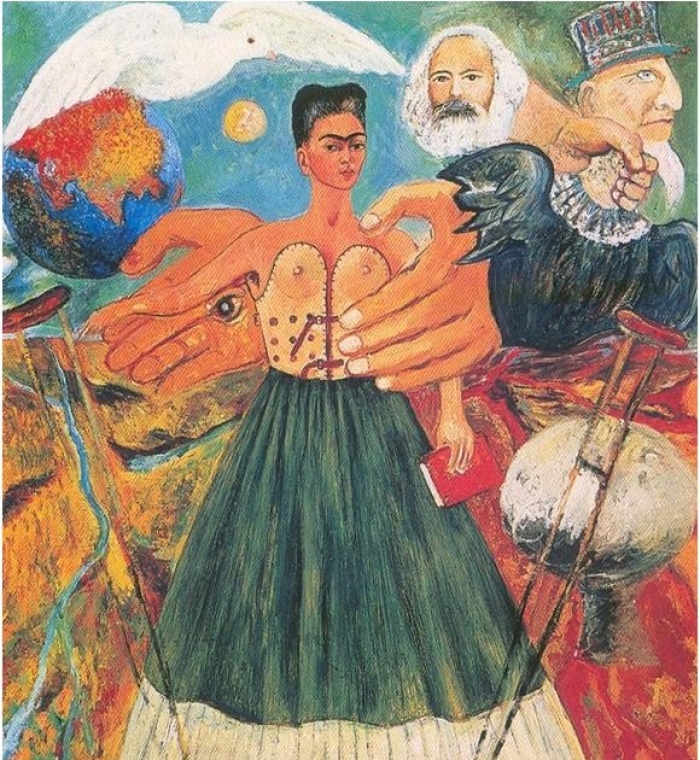
Frida Kahlo. Marxism Will Give Health to the Sick, 1954. Oil on masonite; 23.6″ x 29.9″. Frida Kahlo Museum, Mexico City, Mexico. Image by FridaKahlo.org
Besides her poor health, Kahlo’s politics also influenced her art. Kahlo was a Marxist, joining the Young Communist League and the Mexican Communist Party while at school. She was born just three years before the Mexican Revolution. In her later years as a painter, she would want to show her political side more. For example, she has a piece called Marxism Will Give Health to the Sick (1954). In the self-portrait, Kahlo is standing in the middle of the canvas with her left arm stretched out to her side, and her right arm at her side with her holding a red book, which is She is wearing a long green skirt and a corset or upper body cast with straps. There are crutches at her side, indicating that she is unwell. In the right-hand corner of the painting, there is the head of Karl Marx attached to a hand, which is gripping onto a bald eagle with the head of Uncle Sam. There are two hands outstretched toward her. These may represent the hands of Marxism coming to save Kahlo from the oppression of imperialism and capitalism.
Women are taught early on that body hair is “un-ladylike,” and because of this, many of them shave. Kahlo, however, heavily rejected society’s ideas of traditional femininity and what a woman “should” be. In her diary she once wrote, “I used to think I was the strangest person in the world but then I thought there are so many people in the world, there must be someone just like me who feels bizarre and flawed in the same ways I do. I would imagine her, and imagine that she must be out there thinking of me, too.” She was never afraid to stand out and break conventions, which is what makes her an important feminist figure today. She proudly sported a unibrow and mustache. She also did not shave her legs or underarms either. In all of her portraits, she makes her unibrow and mustache prominent.
Kahlo died a week after her 47th birthday on July 13, 1954 in her home village from a pulmonary embolism. Like most artists, Frida Kahlo did not get the full recognition for her art that she deserved until she died. Today, she remains an influential artist who used her misfortunes to guide her art.
Adrian Margaret Smith Piper was born on September 20th, 1948 in New York, New York to mixed race parents, and she identifies as a Black woman. She is a conceptual artist who does performance pieces, with most of her art being confrontational critiques on society. She was inspired by the injustices she experienced and witnessed to use herself as a form of expression. In 1971 she wrote, “I can no longer see discrete forms or objects in art as viable reflections or expressions of what seems to me to be going on in this society. They refer back to conditions of separateness, order, exclusivity, and the stability of easily accepted functional identities that no longer exist.” In two of her pieces, Self Portrait Exaggerating my Negroid Features (1981) and Self Portrait of a Nice White Lady (1995), Piper aims to deconstruct viewers’ perceptions of race and identity.
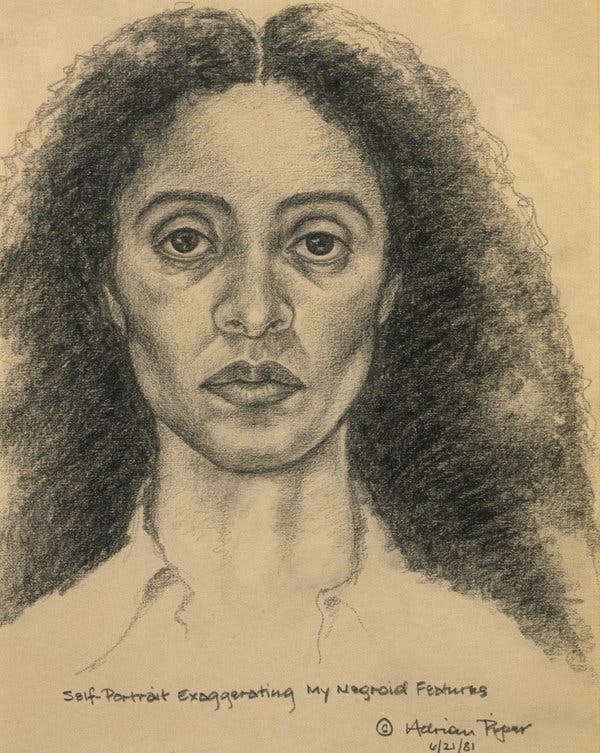
Adrian Piper. Self Portrait Exaggerating my Negroid Features, 1981. Pencil on paper; 10″ x 8″. Collection of Eileen Harris Norton, Los Angeles, CA. Image by Arthur.
Her piece, Self Portrait Exaggerating my Negroid Features (1981) features a self-portrait of Piper with pronounced facial features like a wide nose, afro-textured hair, and full lips, which are features that she does not naturally have. For her whole life, Piper was mistaken for being many different races and ethnicities other than Black because of her light skin and smaller facial features. Although this may not be her intention with the portrait, another way to examine this piece is perhaps Piper is taking a stand against the types of faces that are usually depicted in Western art art. Western beauty standards are very Eurocentric; European features like pale skin, long hair, and a small nose are praised. These beauty standards translate into art, and Western artists throughout history have depicted beautiful women as those with these specific features. These characteristics are often associated with femininity, elegance, and softness. The most common Black/non-White features like wide noses, darker skin, and curly/textured hair are not given this same exposure and are even demonized in the Western world. Piper could be giving power back to non-White features by depicting herself this way.
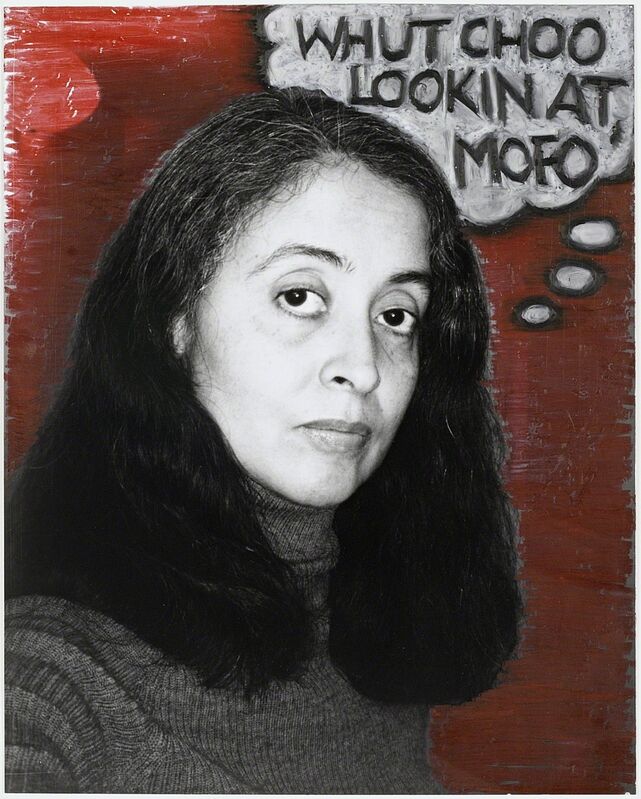
In Self Portrait of a Nice White Lady, Piper challenges the concept of race. In this picture, there is a photograph of Piper with a straight face and a speech bubble that says “Whut choo Lookin At MOFO” in front of a burgundy background. Due to racial biases, the concept of a White woman, specifically a “nice White lady” is automatically associated with positive attributes like friendliness, femininity, intelligence, and so on. The Studio Museum writes, “The image refutes its title by presenting Piper as herself, a Black woman, who cannot be reduced to being simply “nice.” The work’s text—“Whut choo lookin at, mofo?”—is a call to pay attention and confront how stereotypes inform the way we read people.”
Adrian Piper. Self-Portrait as a Nice White Lady, 1995. Black and white autophoto with oil-crayon drawing; 18 1/4″ × 14 1/4″. A Constellation Collection at the Studio Museum in Harlem, New York City, NY. Image by The Studio Museum.
The fact that the nice White lady is talking in African American Vernacular English (AAVE) could be jarring, considering that AAVE is often seen as an “unintelligent” and “aggressive” dialect, traits that are not associated with White women. In this work, Piper is directly challenging the viewer’s perception of what it means to be a White woman by having her say the exact opposite of what many people may believe a nice White lady would say.
Although Piper’s work is successful in challenging Western art, it is important to note that her being a light-skin, White passing Black woman makes it easier for her art to be valued. She has been allowed in spaces that her dark skin counterparts have not been. Race is phenotypic as much as it is genotypic. Just because someone is racially Black does not mean that they will experience all of the plights of being a Black person if society does not perceive them that way. In Self Portrait Exaggerating my Negroid Features, Piper even had to extremely emphasize her facial features to show that she is Black. In her 1986 piece, Calling Card (I am black), Piper had to point out that she was Black when people would say racist things around her because they assumed she was another race. On the other hand, Piper never denies her Blackness, and if anything, uses her privilege as a White passing Black person to call attention to important topics.
 Issues in Contemporary Art