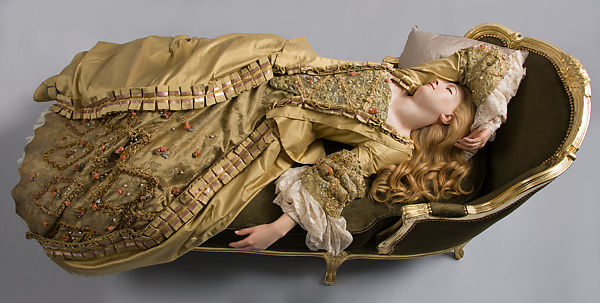
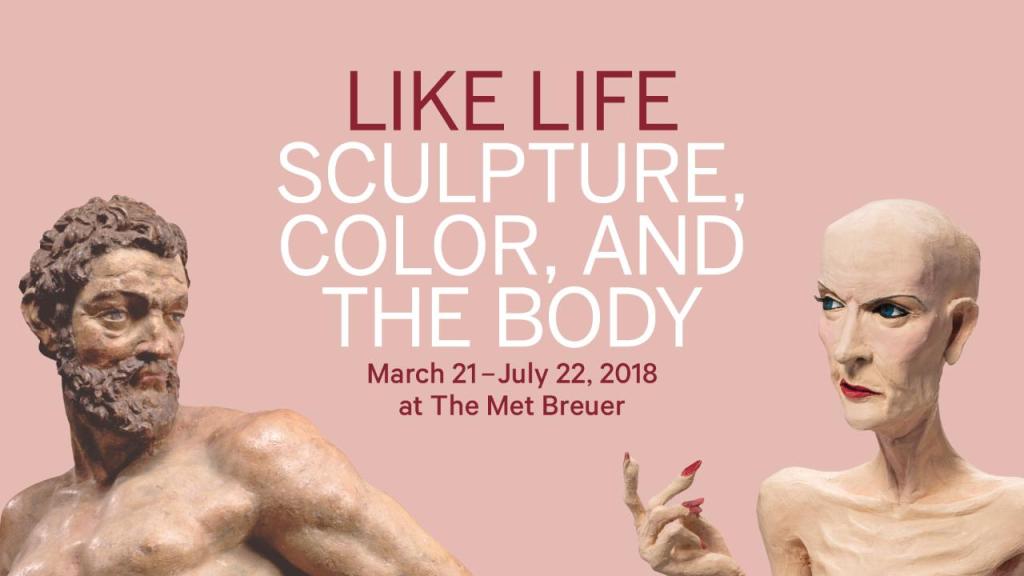
Sleeping Beauty, Philippe Curtius 1989, Sculpture; 32 11/16 × 65 3/8 × 29 1/8 in., 112.4 lb. New York. The Metropolitan Museum of Art [The Met Breuer]. “Like Life: Sculpture, Color, and the Body,”
In Jerry Saltz article about his response on The Met Exhibition Life Like, we as the readers learn about his opinions on this hyperrealism take on the body. He described this exhibit as a frenemy, while in his response criticizes the fast in the artwork chosen with the met being such a prestigious museum. Saltz calls the exhibit “devolatilizing slog” which doesn’t make anything sound even remotely appealing about it. He bashes the western art that the exhibit is comprised of but compliments its equality with being a fair mix of both male and female nudes which was often not seen before the me-too movement. With all the negativity about this exhibit he finishes off with stating that he still recommends it, specifically for its unique pieces that would often not be featured or seen by those
My overall response to the content was overall shock by the amount of negativity Saltz combined in his writing. It seems like a very harsh critique and review of something that from my understanding is exactly what it says it is. I went into further detail looking up this exhibit so I could see it all and read the Mets description of it and compare it to how Saltz described it. He seemed very angry at the exhibit as it was almost a letdown but for me isn’t this the same with every exhibit put together, there is always going to be someone who doesn’t understand the overall tones and meaning behind the work. But it’s still important to learn about and see things we wouldn’t necessarily be interested in or understand fully.
Frida Kahlo, birth name Magdalena Carmen Frida Kahlo y Calderón was born in Coyoacán, Mexico City, Mexico on July 6, 1907, to her parents Wilhelm Kahlo and Matilde Calderon y Gonzalez. She married famed Mexican painter Diego Rivera two times, once from 1929-1940, then married again later that same year until Kahlo’s death. Most of her paintings consist of self-portraits, and her art is considered surrealism, specifically magical realism.
Throughout her life, Kahlo has suffered a multitude of illnesses and accidents. In her youth she caught polio, and it is debated whether she had a birth defect that affected her spine and legs. Her chronic pain led to her being bedridden for a great deal of her life, leading her to use her free time to paint her portraits. In 1953, her leg was amputated. One of the most influential events that impacted her art was a bus crash. Kahlo was involved in a bus accident on September 17, 1925. At the age of 18, she and her boyfriend at the time, Alejandro Gómez Arias were on a public bus on their way home when it suddenly crashed into an electric car. Her pelvic bone had been fractured and her uterus and abdomen were punctured. Additionally, her spine had been broken in three places, her right leg in 11 places, her shoulder was dislocated, her collar bone was broken, and doctors later discovered that three additional vertebrae had been broken as well. Her health caused her much distress, and in 1953 she stated, “I am not sick. I am broken. But I am happy to be alive as long as I can paint.” While recovering, she used her time painting and turned her pain into art, also painting on her body cast. Describing her journey finding comfort in art, Wes Kelley writes, “This body altering event led to a life of surgeries, recoveries, and pain. She became an alcoholic, an adulterer (like her husband), and a masterful painter. Her horrible physical condition became the inspiration for her morbid and macabre paintings. Kahlo’s pain created works focusing on the death, decay, and brokenness of the human body.”
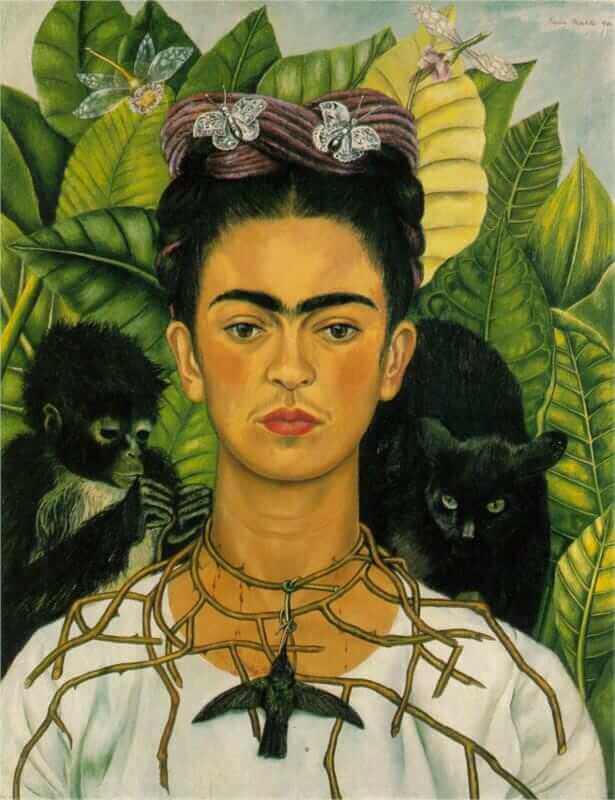
Frida Kahlo. Self Portrait with Thorn Necklace and Hummingbird, 1940. Oil on canvas; 24.11″ × 18.5″. Nickolas Muray collection at the Harry Ransom Center, Austin, TX. Image by FridaKahlo.org.
Most of Kahlo’s works are portraits of her surrounded by a beautiful, tropical landscape. Perhaps her being confined to a bed while sick inspired her to feel close to nature. For example, one of her most famous portraits, Self Portrait with Thorn Necklace and Hummingbird (1940), depicts Kahlo wearing a thorn necklace with a hummingbird attached to it. The necklace is so tight and sharp around her neck that it is drawing blood. On her left shoulder there is a black monkey, and there is a black cat, perhaps a panther, on her right. The background features many green leaves, suggesting that she is in a rainforest. Her stoic look in the painting may symbolize all the pain that she has endured, and how she has kept a brave face through it all.
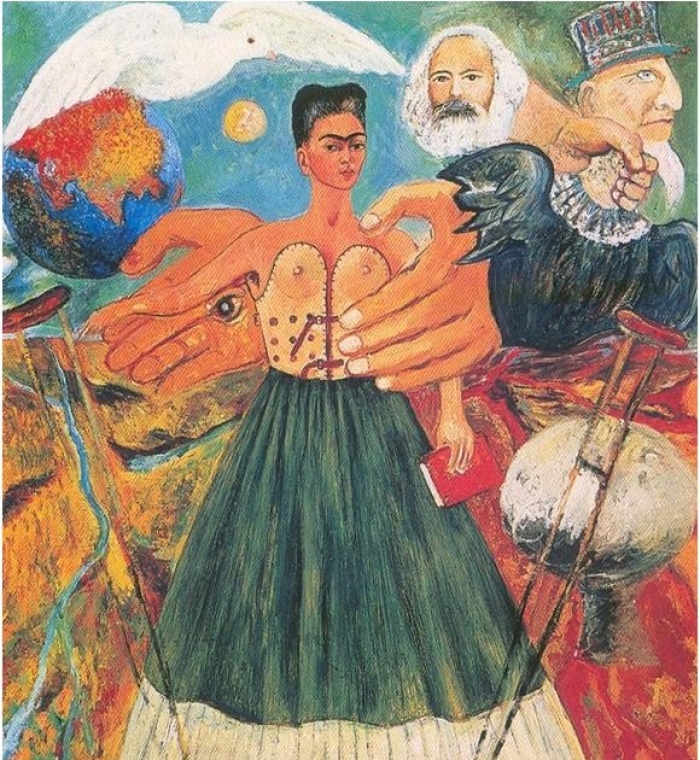
Frida Kahlo. Marxism Will Give Health to the Sick, 1954. Oil on masonite; 23.6″ x 29.9″. Frida Kahlo Museum, Mexico City, Mexico. Image by FridaKahlo.org
Besides her poor health, Kahlo’s politics also influenced her art. Kahlo was a Marxist, joining the Young Communist League and the Mexican Communist Party while at school. She was born just three years before the Mexican Revolution. In her later years as a painter, she would want to show her political side more. For example, she has a piece called Marxism Will Give Health to the Sick (1954). In the self-portrait, Kahlo is standing in the middle of the canvas with her left arm stretched out to her side, and her right arm at her side with her holding a red book, which is She is wearing a long green skirt and a corset or upper body cast with straps. There are crutches at her side, indicating that she is unwell. In the right-hand corner of the painting, there is the head of Karl Marx attached to a hand, which is gripping onto a bald eagle with the head of Uncle Sam. There are two hands outstretched toward her. These may represent the hands of Marxism coming to save Kahlo from the oppression of imperialism and capitalism.
Women are taught early on that body hair is “un-ladylike,” and because of this, many of them shave. Kahlo, however, heavily rejected society’s ideas of traditional femininity and what a woman “should” be. In her diary she once wrote, “I used to think I was the strangest person in the world but then I thought there are so many people in the world, there must be someone just like me who feels bizarre and flawed in the same ways I do. I would imagine her, and imagine that she must be out there thinking of me, too.” She was never afraid to stand out and break conventions, which is what makes her an important feminist figure today. She proudly sported a unibrow and mustache. She also did not shave her legs or underarms either. In all of her portraits, she makes her unibrow and mustache prominent.
Kahlo died a week after her 47th birthday on July 13, 1954 in her home village from a pulmonary embolism. Like most artists, Frida Kahlo did not get the full recognition for her art that she deserved until she died. Today, she remains an influential artist who used her misfortunes to guide her art.
Adrian Margaret Smith Piper was born on September 20th, 1948 in New York, New York to mixed race parents, and she identifies as a Black woman. She is a conceptual artist who does performance pieces, with most of her art being confrontational critiques on society. She was inspired by the injustices she experienced and witnessed to use herself as a form of expression. In 1971 she wrote, “I can no longer see discrete forms or objects in art as viable reflections or expressions of what seems to me to be going on in this society. They refer back to conditions of separateness, order, exclusivity, and the stability of easily accepted functional identities that no longer exist.” In two of her pieces, Self Portrait Exaggerating my Negroid Features (1981) and Self Portrait of a Nice White Lady (1995), Piper aims to deconstruct viewers’ perceptions of race and identity.
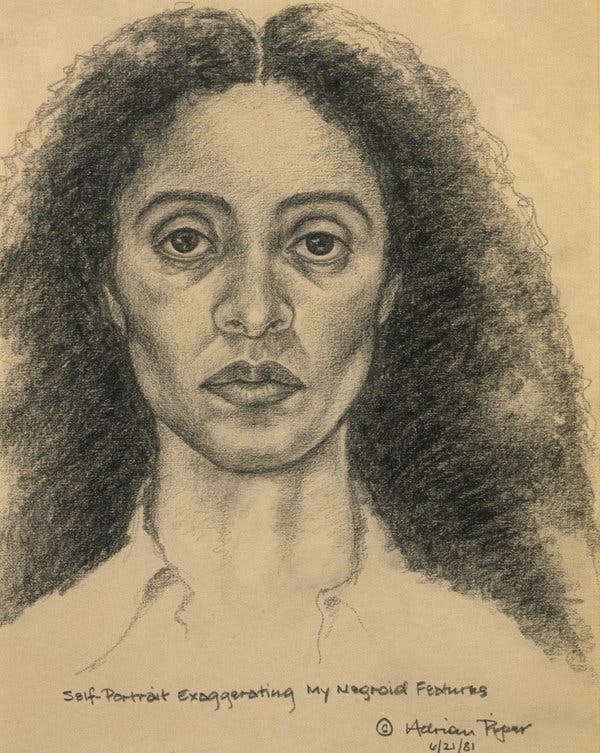
Adrian Piper. Self Portrait Exaggerating my Negroid Features, 1981. Pencil on paper; 10″ x 8″. Collection of Eileen Harris Norton, Los Angeles, CA. Image by Arthur.
Her piece, Self Portrait Exaggerating my Negroid Features (1981) features a self-portrait of Piper with pronounced facial features like a wide nose, afro-textured hair, and full lips, which are features that she does not naturally have. For her whole life, Piper was mistaken for being many different races and ethnicities other than Black because of her light skin and smaller facial features. Although this may not be her intention with the portrait, another way to examine this piece is perhaps Piper is taking a stand against the types of faces that are usually depicted in Western art art. Western beauty standards are very Eurocentric; European features like pale skin, long hair, and a small nose are praised. These beauty standards translate into art, and Western artists throughout history have depicted beautiful women as those with these specific features. These characteristics are often associated with femininity, elegance, and softness. The most common Black/non-White features like wide noses, darker skin, and curly/textured hair are not given this same exposure and are even demonized in the Western world. Piper could be giving power back to non-White features by depicting herself this way.
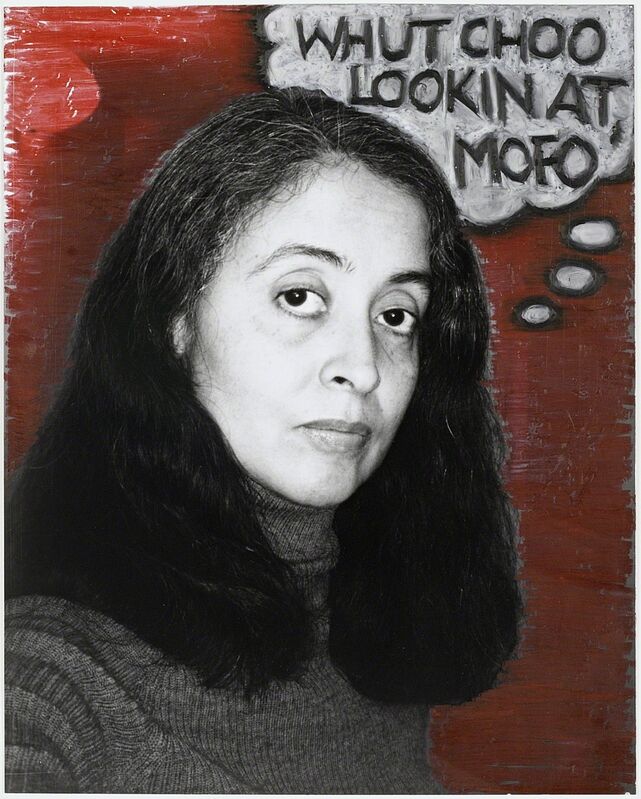
In Self Portrait of a Nice White Lady, Piper challenges the concept of race. In this picture, there is a photograph of Piper with a straight face and a speech bubble that says “Whut choo Lookin At MOFO” in front of a burgundy background. Due to racial biases, the concept of a White woman, specifically a “nice White lady” is automatically associated with positive attributes like friendliness, femininity, intelligence, and so on. The Studio Museum writes, “The image refutes its title by presenting Piper as herself, a Black woman, who cannot be reduced to being simply “nice.” The work’s text—“Whut choo lookin at, mofo?”—is a call to pay attention and confront how stereotypes inform the way we read people.”
Adrian Piper. Self-Portrait as a Nice White Lady, 1995. Black and white autophoto with oil-crayon drawing; 18 1/4″ × 14 1/4″. A Constellation Collection at the Studio Museum in Harlem, New York City, NY. Image by The Studio Museum.
The fact that the nice White lady is talking in African American Vernacular English (AAVE) could be jarring, considering that AAVE is often seen as an “unintelligent” and “aggressive” dialect, traits that are not associated with White women. In this work, Piper is directly challenging the viewer’s perception of what it means to be a White woman by having her say the exact opposite of what many people may believe a nice White lady would say.
Although Piper’s work is successful in challenging Western art, it is important to note that her being a light-skin, White passing Black woman makes it easier for her art to be valued. She has been allowed in spaces that her dark skin counterparts have not been. Race is phenotypic as much as it is genotypic. Just because someone is racially Black does not mean that they will experience all of the plights of being a Black person if society does not perceive them that way. In Self Portrait Exaggerating my Negroid Features, Piper even had to extremely emphasize her facial features to show that she is Black. In her 1986 piece, Calling Card (I am black), Piper had to point out that she was Black when people would say racist things around her because they assumed she was another race. On the other hand, Piper never denies her Blackness, and if anything, uses her privilege as a White passing Black person to call attention to important topics.
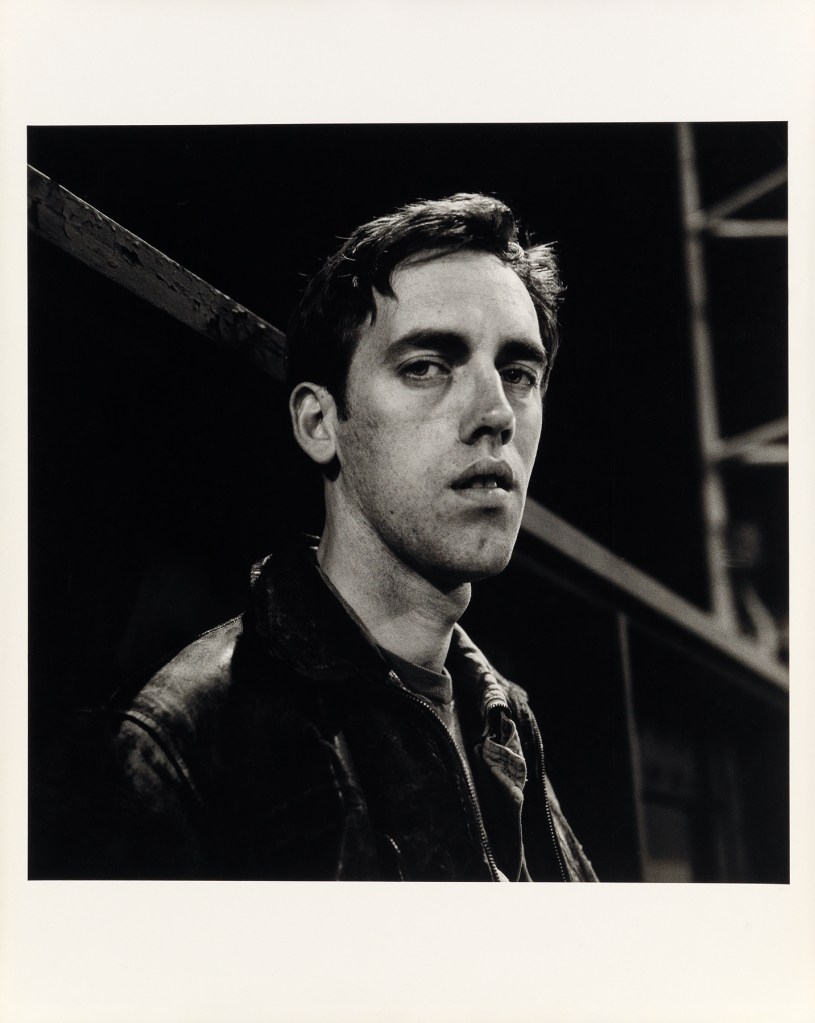
Peter Hujar. David Wojnarowicz: Manhattan-Night (III), 1985. Silver Print; 14.5 x 14.8 in. (36.8 x 37.5 cm). Image by Artnet.com.
Throughout Western history, especially in the United States, members of the LGBTQ+ communities have faced discrimination. Speaking specifically on the homosexual subsection of the community, people have historically been pressured to keep their sexuality hidden out of fear of public ridicule and physical violence. The fight against LGBTQ+ oppression began in 1924, when Henry Gerber formed the United State’s first documented gay rights organization. Over time this resistance grew, becoming especially prominent in the art world. One artist known for his portrayal of the gay community was David Wojnarowicz. Through a variety of media and artwork, David Wojnarowicz fought to increase visibility of the gay community and voice the issues they faced that society often ignored.
David Wojnarowicz. Untitled (One Day This Kid…), 1990. Photostat; 29.8 × 40.1in. (75.7 × 101.9cm). Whitney Collection, New York City, New York. Image by Whitney.org.
Born in 1954, David Wojnarowicz was a gay American artist and AIDS activist who lived in New York during the AIDS epidemic of the 1980s. Throughout his career, he used painting, performance, film, and photography to draw attention to civil rights and gay identity within American popular culture. Through his art, Wojnarowicz expressed his fear, anger, and frustration by drawing attention to the homophobia, stigmatization, and conservatism that plagued society. In doing so, he gave voice to the marginalized individuals of his community. To accomplish this, many of Wojnarowicz’s projects were based on his own experiences or those of other LGBTQ+ individuals he met during his travels. A particularly strong piece that accomplishes this is Untitled (One Day This Kid…). Created in 1990 and last exhibited in the Whitney Museum in 2018, this piece consists of a black-and-white self-portrait of the artist as a child, surrounded by text. Juxtaposed with the smiling face, the text describes the persecution he would face in his adulthood from his family, church, school, government, and medical communities just for being gay. He describes how the child would be,“faced with electro-shock, drugs, and conditioning therapies,” as well as being, “subject to loss of home, civil rights, jobs, and all conceivable freedoms,” all because, “he discovers he desires to place his naked body on the naked body of another boy.” By combining text and image, the artist makes visible the narrative that he, and many other gay individuals, lived through. In a time where the struggles of the gay community were obscured from the public eye, he stood his ground and made his story heard. The viewer is confronted by the reality that all these terrible acts have occurred to innocent people, including children, because society chose to criminalize life as a gay person—a subject matter that was severely under represented in the art community out of fear of hostility. Wojnarowicz continued to make the struggles of the gay community visible in his photo series titled Room 1423.
David Wojnarowicz. Room 1423, 1987. Gelatin silver prints; 30.5 x 24.5in. (77.5 x 62.2cm) each. Images by Americamagazine.org.
Photographed on November 26, 1987, Room 1423 depicts Wojnarowicz’s close-friend and partner Peter Hujar moments after death. Wojnarowicz was in the hospital room with Hujar when he died from AIDS related complications. Shortly following his passing, Wojnarowicz asked everyone to leave the room so he could photograph Hujar one final time. The three emotional shots he took of Hujar’s head, hand, and feet make up the images in this series. In the first photo, Hujar’s dark lifeless eyes and ajar mouth make for an emotional and haunting image. In another shot, his bony hand rests upon the hospital bed sheets. Lastly, his worn feet can be seen sticking out from under the blanket. Through these images, Wojnarowicz confronts the viewer with the macabre loss of life many faced during the AIDS epidemic. Without words he captures pain and heartbreak, showcasing the humanity and suffering of the gay community to a society that tried to dehumanize them, especially those affected by AIDS. Much like Untitled (One Day This Kid…), viewers are presented with an aspect of gay life frequently hidden from the eye of the public.
Wojnarowicz’s activism through art continued until 1992 when he too passed away from AIDS-related complications.
Throughout his life, Wojnarowicz was continuously pressured into silence by the family that surrounded him, the media that erased him, and the society that fought against him. Though his life was tragically cut short, the efforts he made as an artist and activist helped pave the way for future LGBTQ+ artists and the continued growth of representation in art history.
“Beyond a beauty cream, Mother is a Woman invites you to rethink kinship through the pores of your skin” – Jes Fan
When the body and binary are taken out what are we left with? Jes Fan thinks of that often when creating his work. Being queer-identifying and a minority in the US, he is no stranger to mixing the topics of gender, identity, and race. Taking biological materials from their context within the body, Fan incorporates science to figure out the essence of their meaning and lends a completely new one for his audience. In Mother is a Woman, the Hong Kong-born andBrooklyn based artist went back to his home country to get his samples for his next piece from his mother.
Jes Fan, Mother is a Woman, 2018, Video, HD, Color, 4:44.
“There’s nothing weirder than holding your mom’s excretions in your hand…”
Jes Fan, Mother is a Woman, 2018, Video, HD, Color, 4:44.
Fan’s intent was to make a cream with the estrogen extracted from his post-menopausal mother. When he gets back to the US he takes the samples to a lab and videographer Asa Westcott document the process and the participants that later try on the cream. The expression on each participant ranges from emotionless to smiling as they rub the cream into their skin.
There’s something strangely intimate about this whole piece. People take hormones for various reasons but there’s never a question of how it’s made or where it comes from. We share a relationship with the ones around us, our family, but we don’t take into account how they shape us and are a part of us. It made me evaluate how I view womanhood and relations that I had with my own mother. We’re close and I have a closeness with her but that’s not the same in everyone else’s case. And for that, I feel thankful.
Andy Warhol. Early Colored Jackie, 1964. Silkscreen ink on synthetic polymer paint on canvas; 40 x 40 in. Wadsworth Atheneum, Hartford, CT. Photo by Wadsworth Atheneum Collection
This work, titled Early Colored Jackie, is displayed in the Wadsworth Atheneum in Hartford, Connecticut. Warhol created this piece as a silkscreen print on synthetic polymer paint on canvas. As in typical Warhol fashion, he used blocks of bright, unrealistic colors to form the image of Jacqueline Kennedy. The light pink skin tone stands out from the dark blue background, while the bold red lipstick and seafoam green eyeshadow add pops of color to her face. The silkscreen print is taken from an official White House photograph snapped before the assassination of her husband, John F. Kennedy. It is printed in black ink on top of the colorful paint on the canvas. The photo used is cropped in close so it only includes the headshot of Jackie with a blank background.
Warhol was a pioneer of the pop art movement in which this piece was a part of. Jackie was a sign of royalty and glamour in the United States, which makes this piece relatable to the Marilynn Monroe silkscreen that Warhol is well-known for. Jackie was an icon through both her style and behavior for the American people and was one of the first First Lady’s to give more importance to her role as wife of the president. Warhol found inspiration for his subjects in celebrities as well as tragedy or death. This piece was made in 1964, about a year after JFK’s death. The Kennedy family as well as the country was still grieving. It is ironic that Warhol would have chosen a picture of Jackie smiling during such a trying time.
It’s already a well-known fact that the art world is heavily saturated with predominantly white male artists. Other artists of different ethnic backgrounds, however, tend to struggle with the representation, of not only with their art but in their daily lives. It’s a struggle to even be considered a human being by the general public as it is, so when I saw the photographer Gordon Parks presented in class my eyes lit up. Parks’ work really challenged the narrative placed on black Americans. Parks highlighted the will and determination to pursue the American Dream through the eyes of Black people despite years of disenfranchisement.
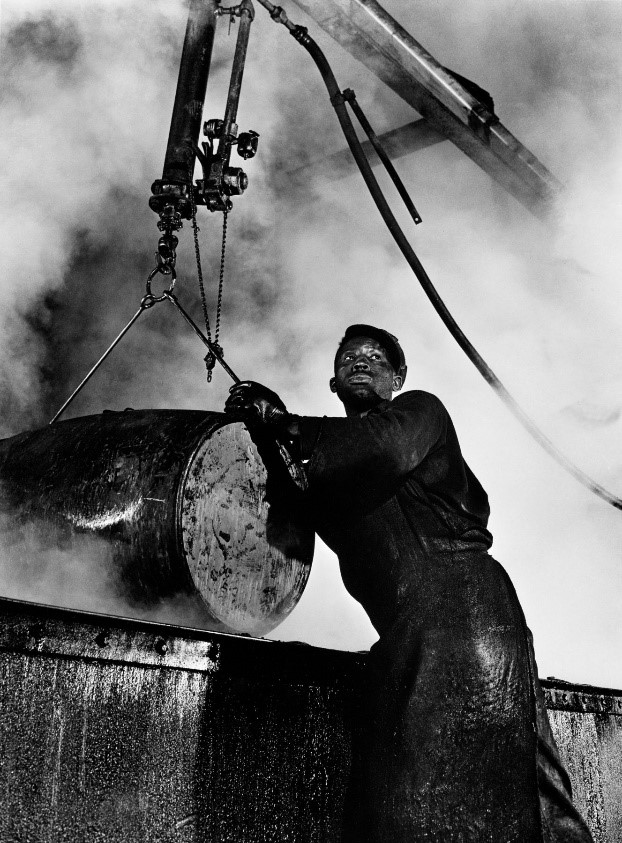
Gordon Parks, Grease Plant Worker, Pittsburgh, Pennsylvania, 1944
Grease Plant Worker features a young Black gentleman in a factory that is glancing into the distance, beyond the photographer. His body is leaning against a suspended barrel that he’s guiding. This body language promotes strength in the literal sense since he’s physically moving the object, but also through the metaphorical push the gentleman is making for his life: forward. The use of the man’s stance and the subject matter of where he worked effectively fought the narrative perpetuated by the media of Blacks being dangerous and lazy.
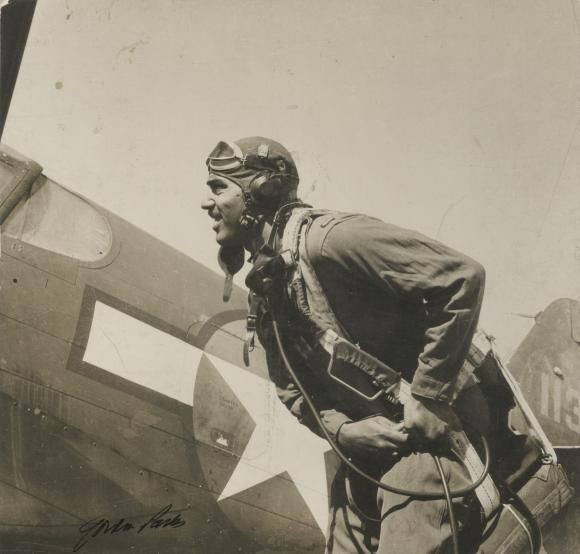
Gordon Parks, Lt. George Knox. 332nd Fighter Group training at Selfridge Field, Michigan, October 1943
Further combating the common misconceptions of the time, Parks photographed a dynamic shot of George Knox II, a black American pilot that pushed boundaries and defied the rules that shaped the social structure of America at that time. In the photograph, Knox is strapped in his gear preparing himself for his training with his team. This smiling serviceman demonstrates that he’s willing to sacrifice for the country alongside his fellow men to protect his place of birth, although the same country does not treat him as an equal.
Photography and other visual depictions of the 1940s usually featured the slow climb of white America as the face of the struggles to prosperity. But they weren’t the only community affected by the fall of the economy and the efforts of the other Americans restoring the country back to its glory. The accomplishments of the country were wildly inaccurate towards the minority groups, especially Black folk. Through his photographs, Parks shows that he and the black community residing in the melting pot that is the United States are strong, with goals, determination, and are more than the racist prejudice constantly presented.
Sources
Courage, Richard A. “Re-Presenting Racial Reality: Chicago’s New (Media) Negro Artists of the Depression Era.” Technoetic Arts: A Journal of Speculative Research 10, no. 2/3 (December 2012): 309–18. doi:10.1386/tear.10.2-3.309_1.
Mitchell, Kristina E., Amanda Martin-Hamon, and Elissa Anderson. “A Choice of Weapons: Photographs of Gordon Parks.” Art Education 55, no. 2 (March 2002): 25–32. doi:10.2307/3193987.
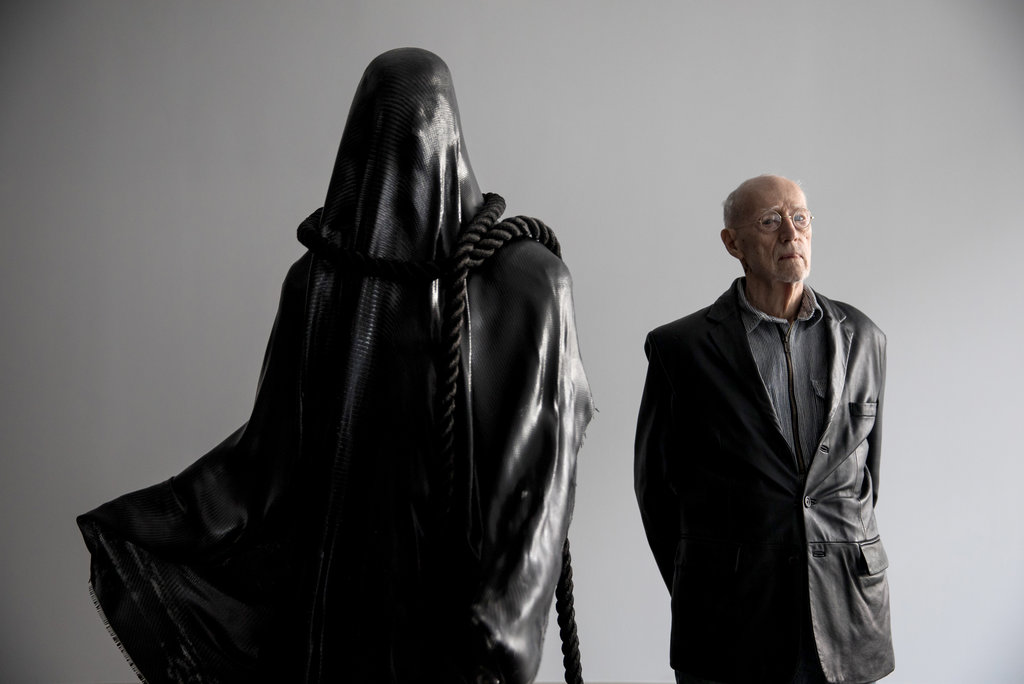
In the reading, Robert Morris: Boustrophedons the author, Pepe Kermal begins by talking about the artist, Robert Morris, and his unique artistic style, and his most recent creation. Kermal then goes into the background of Robert Morris by discussing how Morris’s works have been constantly referencing art history all while consistently creating connections to victims of past violent acts of crime. The author then gives examples of other works Morris had created such as, Dark Passage, Out of the Past, The Big Sleep, Criss-Cross, and many more that have similar underlying themes but also use the same type of media. Pepe Kermal also went into detail about how consistent Robert Morris was when bringing symbolism into his art works and how he tends to pull out pieces of history and old art forms to help create a new very modern artistic style of his own.
Throughout the entirety of the reading, Robert Morris: Boustrophedons, by Pepe Kermal I have come to reflect on a lot of information that the author had given to myself. From the article, I have learned that the art world is constantly changing and reshaping old techniques and traditions. Many artists today often look back to past art forms and expressions to find inspiration in their artworks today. For example, Robert Morris often looked back to modern art techniques, performance art, minimalism, and more. From the reading, I also enjoyed the fact that Robert Morris created art works and installations for victims of tragic events in history. I enjoyed this because I feel as though this forms a powerful stance on not only the artwork, but the artist as a person. Personally, I can relate to the artist in a way because my art typically resembles, past tragic events in my life. I can connect with this well because of the fact that we are both representing our darker emotions to create a different form of artistic expression.
In the reading, Why Is the Met’s New Show About the Body in Art History So Stultifying and Dull?, by Jerry Saltz the author mainly discusses one of the art exhibitions at the Met, also known as Life Like. The article goes into a deeper discussion of how art history has developed and changed the way we view the human figure and bodies. The reading also talks about how in the past, artists typically only displayed the female figure nude however, this exhibition at the Met features the male nude as well. This display was created to showcase true human form by showing bodies with wounds, blood, wrapped in leather, giving birth, dead, asleep, and many more. The author then goes into detail on his opinion on the Western Art culture and how it is typically based off of themes of terror, sex, flesh, and sublimation. Which in turn, the author believes is not true human nature at all, or at least is not always the case with Western Art.
Overall, I feel as though this article was very insightful as to how we see art today, and what the public may or may not be attracted to. Through this article, I have learned that not all artworks are able to interpret an exact meaning to the individual person due to the fact that everyone has different experiences and viewpoints. Personally, I enjoyed the overall concept of the Life Like exhibition however, the author did not appreciate it in the same sense. The author believed that this was a misinterpretation of the human form that was solely based on the eyes of Western culture. I appreciated his opinion on the work, and i had found his information to be very valuable as I move forward through my own artistic career. Mainly so, when naming and creating a work. The artwork must be true to its title, and the underlying meaning of the piece needs to be captivating enough to draw attention and the works’ meaning to the audience it is being displayed to.
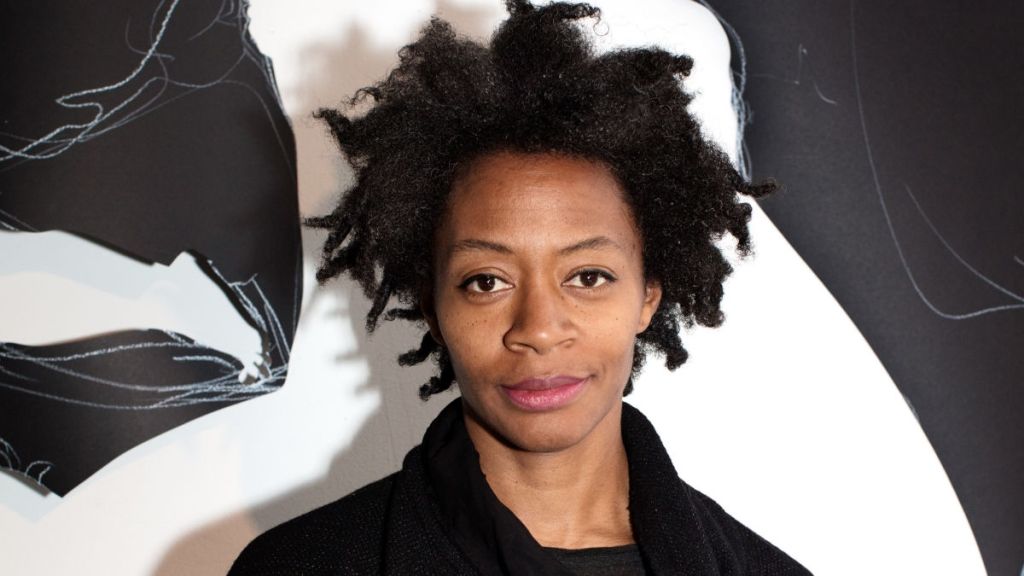
The artist that I feel has the most impactful stance on combating the dominant narratives of Western Art history today is the artist, Kara Walker. Kara Walker is one of the most profound American artists of her generation with artworks expressing her emotional struggle with the underlying truths behind social structure, violence and sexuality in western culture throughout history. In her creations, she has used her artistic abilities to give racism a voice by increasing the visibility of marginalized African American culture.
The first piece that caught my attention on this subject was, The Means to an End…A Shadow Drama in Five Acts, and this piece is a significant example as to how Kara Walker combats the narratives of Western Art History. In this piece, we can see a series of five panels, all in black and white, decorated with the silhouettes of six characters. This piece includes subtle yet graphic representations of citizens of America, and how they have never been depicted. Kara does this as an attempt to reduce the image of people, taking away skin color, characteristics, and facial features so the viewer is not completely certain of who Kara Walker is depicting. She does this in order for the audience to “deal with their own prejudices or fear or desires when they look at these images,”. This is seen to be impactful on the audiences she displays them to. Kara uses this work to have the viewer in-delve themselves into their subconscious mind to see whether or not the audience believes they have prejudice tendencies or not. This assists with combating racism in Western Art culture due to the fact that Walker is bringing those subconscious thoughts to light. She is doing this in order for the public to reevaluate how African Americans were depicted for so long, and how it affects their everyday lives now.
Consume, Kara Walker 1998
Another piece Kara Walker created that breaks down the typical norms of Western Art culture was, Consume, created in 1998. This work still sticks to the same artistic style Walker creates, using a white canvas and a black silhouette of two people. In this painting, one person is significantly taller than the other; the tallest one being a women suckling her own breast, and the smaller one being a little boy suckling on the fallic shaped dress material of the women. With this piece, Walker embellishes in the consumption of people as products of slave trade in the past, along with the consumption of breast milk in Walker’s versions of the Madonna lactans. This piece is combating the flaws of Western Art culture due to the fact that Kara Walker is attempting to denote gender, ambiguity, and race. By creating this piece, she is showing the boy performing a sexual act to “consume” the exotic female figure in front of him. This goes along with previous notations of the white male having degrading stances on African American women and the “foreignness” of their appearance. The message being interpreted in this piece exemplifies the subconscious mind of the viewer once again. Kara Walker not only uses her work to get her audience thinking however, she impacts her audience to go deep into their minds to discover what their true intentions and how wrong they may or may not be. With these two pieces, Kara Walker recreates the social construction of Western Art culture. Walker takes down the normality of what once were dominant narratives to redevelop the intentions and thoughts of the future of our artistic world.







 Issues in Contemporary Art