Amoako Boafo

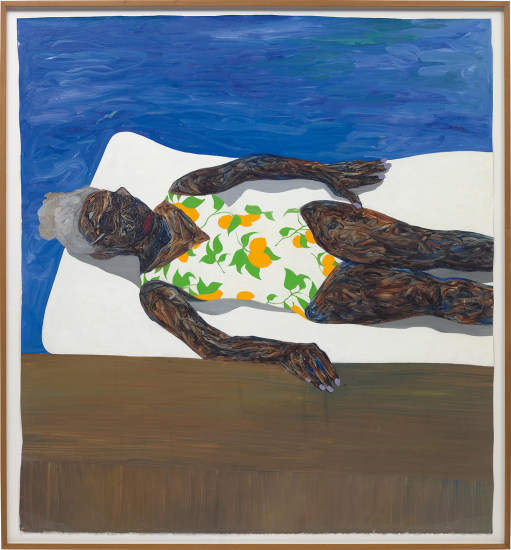
Amoako Boafo. The Lemon Bathing Suit, 2019. Oil on Unstretched Canvas; 81×76 inches. Photo by Phillips London.

            Thomas “Amoako” Boafo born on May 10th, 1984 in Ghana is an up and coming painter in the art world, thought to be one of the Most Influential Artists of 2020.[1] He grew up in Osu in the Greater Acra Region of Ghanna, losing his father at a young age, living with his financially struggling single mother. While he had dreams of being an artist, he thought it simply wasn’t possible, “It’s something that I wanted to do from the beginning, but in Ghana, we don’t have the arts infrastructure. You have to find those things yourself.”[2] Luckily for Boafo, his mothers employer must have seen talent in the young mans work, footing his tuition and allowing him to go to the Accra’s Ghanatta College of Art, graduating in 2008 with the Best Portrait Painter of the Year award. In 2014 he moved to Vienna with his soon to be wife Sunada Mesquita, and enrolled in the Academy of Fine Arts for his MFA.

            He struggled when he first moved to Vienna to make it as an artist, painting portraits of those in the city’s cultural area until he learned to ditch his brushes and work with his fingers, creating extremely interesting and textured art that won him his next award in 2017, the Walter Koschatzky Art Award for an Artist Under 25. His artwork is known for its bold colors and patterns, challenging the perceptions of black subjectivity, diversity, and complexity.[3] Other than the figures in the paintings, the colors in the paintings are almost completely monochromatic, mixing solid paint and complex patterns in a way that makes the skin and poses pop.

            His art finally began to gain further notoriety in 2018 when Kehinde Wiley, an artist known for his presidential portrait of Barack Obama, reached out to purchase one of his works, and subsequently notified his own galleries to his find. While his gallery in Los Angeles had never seen one of Boafo’s pieces before, they offered him a spot when a larger show fell through not even weeks later. The Artists pieces were listed at $10,000 dollars each, and the show was sold out by the end of the second day.

            His work quickly grew and grew in popularity, His booth at the Mariane Ibrahim Gallery at Art Basel in Miami Beach back in 2019 similarly sold out. In 2020 his performance only grew, At Phillips in London his painting The Lemon Bathing Suit (2019) a painting featuring an older black woman, resting on a white water float next to the side of a pool in a bathing suit adorned with lemons, sold for the equivalent of $875,000, which was more than thirteen times its original estimate. His work has been acquired by multiple institutions as well, and is not featured in the Guggenheim, the Los Angeles County Museum of Art, and Vienna’s Albertina Museum.[4]

            In this year he collaborated with Dior designer Kim Jones for his 2021 collection, and opened a show called “I Stand By Me” at Mariane Ibrahim’s Chicago gallery. The show, being his first solo exhibition, focuses on reflection during a time of crisis, using techniques that maximize both expression and minimalism, celebrating subjects bound to the world around them, sourcing European wallpapers to explore the possibilities of photo transfers.[5]

            While the artist is just getting started its clear that his art is going to only keep going, exploring even more possibilities with his exploration of color and texture.


[1] Artsy Editors, “The Most Influential Artists of 2020”, Artsy.com, December 7th, 2021, https://www.artsy.net/article/artsy-editorial-influential-artists-2020

[2] Nate Freedman, “The Swift, Cruel, Incredible Rise of Amoako Boafo: How Feverish Selling and Infighting Built the Buzziest Artist of 2020”, Artnet, Artnet Worldwide Corporation, September 28th, 2020, https://news.artnet.com/art-world/amoako-boafo-1910883

[3] RobertsProjectsLA, “Amoako Boafo” Roberts Projects, Art Dealers Association of America, accessed December 12th ,2020, https://www.robertsprojectsla.com/artists/amoako-boafo

[4] Arsty, The Most Influential Artists of 2020

[5] Miriane Ibrahim, “Amoako Boafo – I Stand By Me”, Mariane Ibrahim, 2020, https://marianeibrahim.com/exhibitions/29-amoako-boafo-i-stand-by-me/overview/


Sources

Amoako Boafo – I Stand By Me. (2020). Retrieved from Mariane Ibrahim: https://marianeibrahim.com/exhibitions/29-amoako-boafo-i-stand-by-me/overview/

Amoako Boafo. (2021, December 12). Retrieved from Roberts Projects: https://www.robertsprojectsla.com/artists/amoako-boafo

Freeman, N. (2020, September 28). The Swift, Cruel, Incredible Rise of Amoako Boafo: How Feverish Selling and Infighting Built the Buzziest Artist of 2020. Retrieved from Artnet: https://news.artnet.com/art-world/amoako-boafo-1910883

The Most Influential Artists of 2020. (2020, December 7). Retrieved from Artsy: https://www.artsy.net/article/artsy-editorial-influential-artists-2020
Exhibition Review on Britain in the World: A Display of the Collections

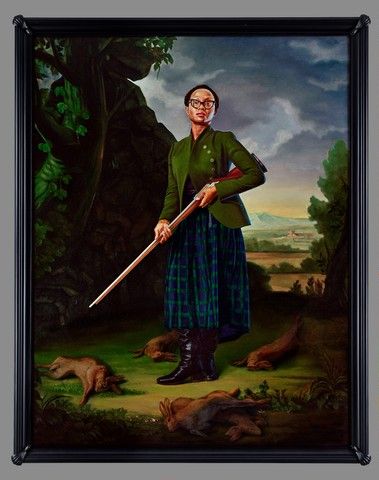
Kehinde Wiley, Portrait of Lynette Yiadom-Boakye, Jacob Morland of Capplethwaite 2017
Oil on canvas 120 5/16 × 93 5/16 in. (305.6 × 237 cm)
Yale University Art Gallery and Yale Center for British Art, Purchased with a gift from Mary and Sean Kelly in honor of Courtney J. Martin and with the Janet and Simeon Braguin Fund and Friends of British Art Fund

Britain in the World: A Display of the Collections is an exhibition featured at the Yale Center for British art in New Haven, Connecticut. “This installation reveals how frequently the story of art in Britain focuses on a narrative of international exchange. This arrangement addresses the impact of immigration and travel on British art and culture across the centuries, and the role that the arts have played in propagating Britain’s imperial vision—exploring the ways in which the perception of the British Empire influenced how Britain’s saw themselves and others.” The overall them is very well reflected among each piece of art displayed in this collection. We see many different depictions as well as many different time periods displayed throughout this exhibition giving us a wider look into the theme of British culture and the travels they faced.
When walking into the museum, this is the first exhibition you walk through, as you walk in you see billboard size artwork displayed up the wall with a larger than life feeling. It is a truly beautiful first sight and really a stupendous way to start an exhibit. However, the exhibition is split between two floors, and we have the large circular shaped grand room, but the rest of the floor is of a completely different exhibition giving a very unsettling and disconnected feeling. The rest of the Britain in the World Exhibition is up two floors higher, leaving us very disconnected overall. The fourth floor is very well lit with white walls the really contrast the artwork well; most of them have gold frames which helps the balance. One eye-catching feature is noticeable while on the top floor, you have an opening where you can look out to the center of the building and if you look down you see the rest of the exhibition two floors down. It is a very interesting lookout point that the viewer can use, but even with the two-floor layout I still find the space that is set in chronological order, to be arranged in very pleasing way.
A few pieces of art that stuck out to me and made an impression on the overall theme of British culture included, a portrait of the artist Lynette Yiadom-Boakye by Kehinde Wiley and Theodor von Holst’s The Wish, 1840. These two painting are a part of the British in the World Exhibition and are both feature portraits of women but in a very different way. I think these two represent strong women, one dated back to the mid-nineteenth century and one in today’s time of the twenty-first century. Wiley’s painting is bold and vibrant, representing another artist in a strong way as a Scottish bunny hunter. However, Holst paints a darker vibe portrait of a women that appears to be a psychic, hence the title the wish. I found myself drawn to both pieces, overall, there is many unique and different styled pieces in the exhibition that might speak to you.
In conclusion, I would have to rate British in the World Exhibition a four out of five. While the artwork was incredible filling with many different forms and style that touch on all art created by the British and their culture throughout their journeys The setup of the exhibition really leaves the chronological set up disjointed and confusing. It seems like two different exhibitions because of the layout instead of one big cohesive exhibition. I feel as if it would’ve been better to keep the exhibition on just one floor so we could fully divulge in the art instead of starting the exhibition, going into another that is completely different and then going back.

Sources
“Britain in the World: A Display of the Collections.” Yale Center for British Art. Accessed October 3, 2021. https://britishart.yale.edu/exhibitions-programs/britain-world-display-collections.
“YCBA Collections Search.” On. Accessed October 6, 2021. https://collections.britishart.yale.edu/?f%5Bdetailed_onview_ss%5D%5B%5D=On%2Bview.
“Kehinde Wiley: A New Republic.” Brooklyn Museum: Kehinde Wiley: A New Republic. Accessed October 6, 2021. https://www.brooklynmuseum.org/exhibitions/kehinde_wiley_new_republic/.

The Exploration Between Surrealism and Expressionism

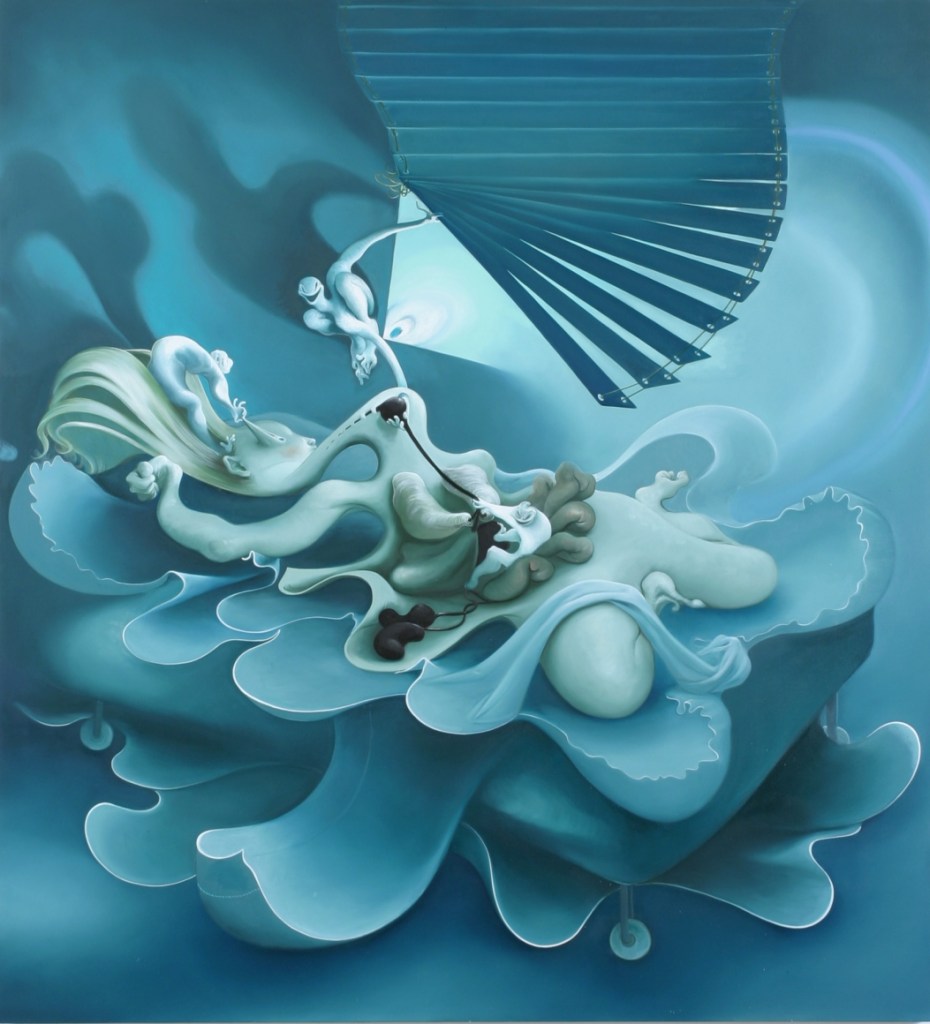
Inka Essenhigh, In Bed. 2005. Oil on Canvas; 68 X 62 inches. 303 Gallery, New York

In the beginning of the twentieth century art was moving more towards mind tantalizing ways then we had previously seen before. Surrealism is the art movement that started in the 1920s and the main concept is for you to look beyond what your eyes are seeing and use your subconscious mind to understand what you’re looking at. Expressionism dates to 1910 with the idea of the artists understanding and not necessarily reality itself but more so the meaning, the expression behind the object or experience. Both requiring the viewer to look further then what meets the eye, surrealism and expressionism are two very different art movements allow us to explore our subconscious mind to reveal deeper meanings.

These two art movements came about in very different ways. But I feel as though they have such a strong connection in the art world as final pieces. “Although both Surrealism and Expressionism are troubled with the perception of the unconscious behavior, surrealism is conventional in introduction while the later one is over-romantic.”[1] Robert Hobbs was known for  exploring the idea of expressionism and surrealism in the hope to understand their methods and help us become aware of their different techniques. But just because two things are done in different ways doesn’t mean they cannot be similar. I think it in fact makes them have even more in common as a complete art piece.

For example, I took a further look at Inka Essenhigh, In Bed. This piece depicted the Surrealism art style, we see a blue tinted representation of a women lying in bed. The woman appears to be stretched out in a way of resembling an octopus with extremities extended out cascading through the canvas. This woman lays over a large bed with the sheets draping alongside her tentacles creates a sea-like feeling. As we begin to look even further, we notice what appears to be window with blinds, that lurk down over the women creating a lurking demon like effect. This depiction instantly reminds the onlooker of a nightmare scene, from the muted blue tones to the unrealistic and eerie aspects to the whole. The entire image requires us to look closely and really use our minds to feel and see everything the artist is trying to tell us in the canvas. This instantly compares to Käthe Kollwitz Death Grabbing at a Group of Children (Tod greift in eine Kinderschar) from the series Death (Tod). In a completely different medium and style, we see here a child in pain; he looks to be screaming and a dark figure coming above that is taking him. From the title we can infer that this figure is death, here to take the child. This again, is a dark piece that with a little subconscious thought we can understand the entire meaning of the piece. The lithograph medium helps us understand the depth and darkness surrounding the underlying meaning of this piece.

When comparing these two styles we can see a line connecting the subconscious mind among surrealism and expressionism to one another. While they have their differences, the overall depicted art from these movements both display a deeper psychological response that the viewer uncovers.

Bibliography

Hobbs, Robert C. “Early Abstract Expressionism and Surrealism.” Art Journal 45, no. 4 (1985): 299–302. https://doi.org/10.2307/776801.

Park West Gallery. “What Is Surrealism? How Art Illustrates the Unconscious.” Park West Gallery. Park West Gallery, January 7, 2021. https://www.parkwestgallery.com/what-is-surrealism-art/.

Polcari, Stephen. “Abstract Expressionism: ‘New and Improved.’” Art Journal 47, no. 3 (1988): 174–80. http://www.jstor.org/stable/777043.

Taylor & Francis. “Early Abstract Expressionism and Surrealism.” https://www.tandfonline.com/doi/abs/10.1080/00043249.1985.10792314?tab=permissions&scroll=top.

Inka Essenhigh. In Bed, 2005. Oil on canvas. (A&T 29)

Käthe Kollwitz. Death Grabbing at a Group of Children (Tod greift in eine Kinderschar) from the series Death (Tod), 1934. Lithograph. Museum of Modern Art Collection.


[1] Hobbs, Robert C. “Early Abstract Expressionism and Surrealism.” Art Journal 45, no. 4 (1985): 299–302.

Contemporary Traditional Art of Tlisza Jaurique

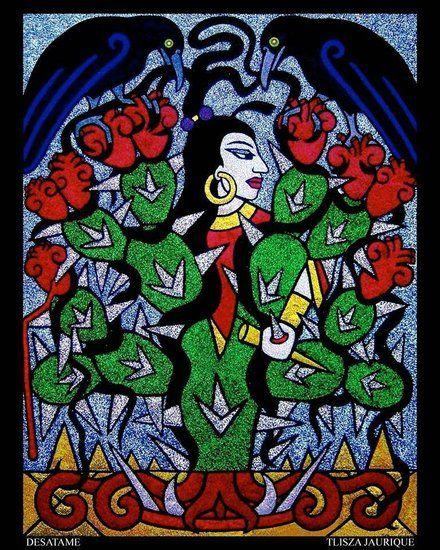
Tlisza Jaurique, “Desátame,” (Unravel Me), 2005. Painting.  Taller Puertorriqueño’s Lorenzo Homar Gallery

Over the time we have spent looking at art and artists in the course I have found myself drawn to artists I find connections with. While researching, I came across Tlisza Jaurique, her work is mesmerizing, while combining traditional Latin culture with new media. Jaurique pulls from her Mexican roots to show her cultural identity throughout all her work. She tends to prominently create her work inspired by traditional Mexican celebrations such as day of the dead and the feast day of the Virgin of Guadalupe. Jaurique work incorporates a mix of topography, painting and sculpture while showing clearing iconography with a pinch of glitter. The expression behind her work is to give us insight on the meaning of Mexican traditions using symbolism and beauty.[1]

Tlisza Jaurique brings a whole new light to Western art through all of her work with the use of her main ingredient, glitter. When we think of glitter we tend to think of something involving a child’s arts and crafts project. But Jaurique uses glitter in a way that enhances the strong figures and symbols her art is centered around in a way that accentuates her art and does not diminish it. The glitter is along the circular mirrors in her pieces to show emphasize the idea of reflection.[2] Using this technique makes us the viewer feel directly involved into the work, whether we can fully understand what is being portrayed. Taqueria makes us challenge our first thoughts and dig deeper to understand of the Mexican traditions and history she is so proud of. By using glitter in the empowering yet contemporary way, the layering of materials and cultural symbolism create a unique and honorary body of work.

Chicana art is about expressing the cultural ideas of Mexican culture. Tlisza clearly embodies this and using her cultures to shock meaning into all her work. Her art is all about the spirit of Mexican traditions while pushing the politics she places among her art which are often very subtle. These ideas can often be overlooked by the pure beauty of her art, however once we as the viewers recognize these things, we cannot unsee the importance of them. She connects her work to issues like many other Chicana artists.[3] Specifically, she uses the issues around the border through an activist approach to create meaning in all her art she communicates these issues through tiny details throughout her pieces. Tiny details that include things like the Virgin, sacred hearts, cacti, and even speech scrolls all have important meaning in her Mexican heritage.

One of her most striking and intellectually challenging pieces is her 2005-piece Desatame, (unravel me). This piece hangs on the wall and immediately we were drawn in by the bright colors portrayed throughout around the piece. The entire piece is glitter, besides the black border, but in every component and layer we see symbolism speaking to the issues that Latin American artist face. We also see the same features and center focal point of a strong women featured in her 2000’s piece Mayahuel.[4] Both works by Jaurique clearly intertwine the Chicana culture with the underlying meaning of women empowerment and cultural appreciation flowing through the entire body of art.  

Jauquire does such an astounding job tying in her cultural traditions in a new contemporary fashion. Her art is so bright and fun, but by using a limited palate the glitter does not become overwhelming, instead it adds another layer for us to digest. Tlisza Jauquire is a great representation of a Chicana artist trying to help others fully understand the culture of Latin American artists, and how express issues they face in their culture in their work using symbolism while keeping the art intriguing.  The way she can use so much traditional heritage and turn it into a contemporary piece, while using a material many never thought of as inspiring.

Sources

 “About the Art.” La Barca Cantina, May 4, 2021. Accessed October 21, 2021 https://labarcacantina.com/about-the-artist/.

“A Contemporary Madonna Counterpoint:Mexico & Puerto Rico/ On View through April 12.” Taller Puertorriqueo. Accessed October 21, 2021. https://tallerpr.org/contemporary-madonna-counterpointmexico-puerto-rico/.

“Tlisza Jaurique Glitters at Taller Puertorriqueño.” Artblog, July 9, 2019. Accessed October 21, 2021 https://www.theartblog.org/2014/04/tlisza-jaurique-glitters-at-taller-puertorriqueno/.


[1] About the Art.” La Barca Cantina, May 4, 2021. Accessed October 21, 2021 https://labarcacantina.com/about-the-artist/

[2] “Tlisza Jaurique Glitters at Taller Puertorriqueño.” Artblog, July 9, 2019. Accessed October 21, 2021 https://www.theartblog.org/2014/04/tlisza-jaurique-glitters-at-taller-puertorriqueno/.

[3] “A Contemporary Madonna Counterpoint:Mexico & Puerto Rico/ On View through April 12.” Taller Puertorriqueo. Accessed October 21, 2021. https://tallerpr.org/contemporary-madonna-counterpointmexico-puerto-rico/.

[4]  “About the Art.” La Barca Cantina, May 4, 2021. Accessed October 21, 2021 https://labarcacantina.com/about-the-artist/

New World Photographer, Neeta Madahar Bibliography

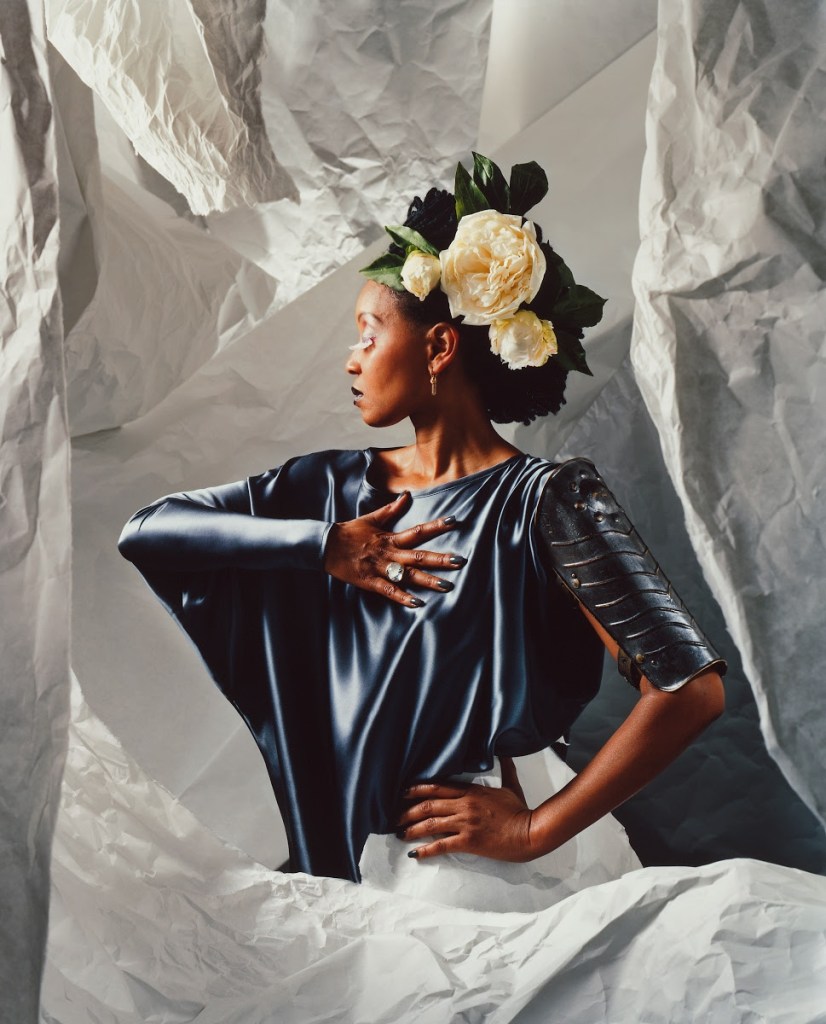
Title: Sharon with Peonies
Creator: Neeta Madahar
Date Created: 2009
Physical Dimensions: 40 x 30 inches, 45 x 37⅜ x 1 inches framed
Type: Photograph
Rights: Collection of the Kemper Museum of Contemporary Art, Kansas City, Missouri, Gift of Neeta Madahar and Paul Hemingway. © Neeta Madahar. Photo: Miller Yezerski Gallery, Boston.
Medium: chromogenic color print on Kodak Ultra Endura paper

Neeta Madahar was born in 1966 in England, she went through many years of schooling originally getting a degree in mathematics. She chooses to follow her own path rather than her families and furthered her education with a degree from the Winchester School of Art in 1999 where she focused on videography. She then went on to the University of Southampton in England and received a BA Honors degree in Fine Art. In 2003, she graduated from the School of the Museum of Fine Arts, Boston and Tufts University, Boston with a Master of Fine Art degree in Studio Art. During the end of her studies, she completed her thesis work called Sustenance, this was her first work that got the attention and recognition her work deserved.
Madahar is a British citizen with her cultural upbringing coming from her Indian roots, who lived and worked in the United States. This unique upbringing helped her find ways to references themes of transition and migration in her work. She is most known in the art world for her interesting photography in which she explores natural aspects in different perspectives about what is real versus perception and the power of observation. Her first major show was in 2004, creating a new look in the world of photography.
Neeta Madahar has exhibited her work both in the United States and Europe. She has even had a solo show in Oakville Galleries, in Ontario Canada back in 2007. Other than the many shows she has been apart off Madahar has been rewarded several prestigious commissions from places like Hardwood House, Film and Video Umbrella, and Photoworks. These are companies that work to serve the general public in easily accessible ways. On top of that, her work is kept in many public collections including the Victoria and Albert Museum in London and Harvard University’s Fogg Art Museum in Massachusetts.
Madahar has been featured in well-known publications like The New York Times, The Boston Globe and even Aesthetic Magazine. She was even a top feature in Portfolio magazine’s special issue about the UK’s fifty most significant contemporary photographers. Since then, was awarded by the National Media Museum in the UK a very prestigious award of the Bradford Fellowship in Photography. The museum even decided to culminate her major solo exhibition from October 2009 to February 2010.

Sources
Instagram. Accessed October 5, 2021. https://www.instagram.com/neeta_madahar/.
“Neeta Madahar.” Aesthetica Magazine. Accessed October 5, 2021. https://aestheticamagazine.com/neeta-madahar/.
“Neeta Madahar.” Brooklyn Museum: Neeta Madahar. Accessed October 5, 2021. https://www.brooklynmuseum.org/eascfa/about/feminist_art_base/neeta-madahar.
“Official Website of Neeta Madahar – Fine Artist, Yoga and Meditation Teacher.” Neeta Madahar – fine artist, Yoga and meditation teacher. Accessed October 5, 2021. https://www.neetamadahar.com/.

Reflection on Jerry Saltz’s “Why is the Met’s New Show in Art History so Stultifying and Dull

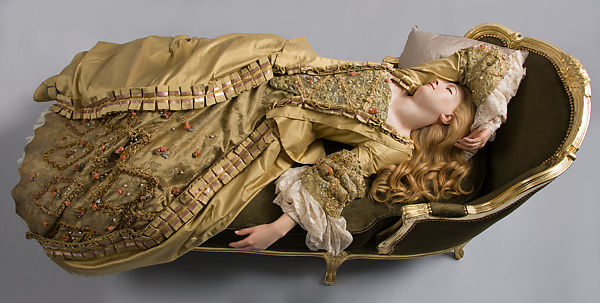
Sleeping Beauty, Philippe Curtius 1989, Sculpture; 32 11/16 × 65 3/8 × 29 1/8 in., 112.4 lb. New York. The Metropolitan Museum of Art [The Met Breuer]. “Like Life: Sculpture, Color, and the Body,” 

In Jerry Saltz article about his response on The Met Exhibition Life Like, we as the readers learn about his opinions on this hyperrealism take on the body. He described this exhibit as a frenemy, while in his response criticizes the fast in the artwork chosen with the met being such a prestigious museum. Saltz calls the exhibit “devolatilizing slog” which doesn’t make anything sound even remotely appealing about it. He bashes the western art that the exhibit is comprised of but compliments its equality with being a fair mix of both male and female nudes which was often not seen before the me-too movement. With all the negativity about this exhibit he finishes off with stating that he still recommends it, specifically for its unique pieces that would often not be featured or seen by those

My overall response to the content was overall shock by the amount of negativity Saltz combined in his writing. It seems like a very harsh critique and review of something that from my understanding is exactly what it says it is. I went into further detail looking up this exhibit so I could see it all and read the Mets description of it and compare it to how Saltz described it. He seemed very angry at the exhibit as it was almost a letdown but for me isn’t this the same with every exhibit put together, there is always going to be someone who doesn’t understand the overall tones and meaning behind the work. But it’s still important to learn about and see things we wouldn’t necessarily be interested in or understand fully.

The Life & Art of Frida Kahlo

        Frida Kahlo, birth name Magdalena Carmen Frida Kahlo y Calderón was born in Coyoacán, Mexico City, Mexico on July 6, 1907, to her parents Wilhelm Kahlo and Matilde Calderon y Gonzalez. She married famed Mexican painter Diego Rivera two times, once from 1929-1940, then married again later that same year until Kahlo’s death. Most of her paintings consist of self-portraits, and her art is considered surrealism, specifically magical realism.

        Throughout her life, Kahlo has suffered a multitude of illnesses and accidents.  In her youth she caught polio, and it is debated whether she had a birth defect that affected her spine and legs. Her chronic pain led to her being bedridden for a great deal of her life, leading her to use her free time to paint her portraits. In 1953, her leg was amputated. One of the most influential events that impacted her art was a bus crash. Kahlo was involved in a bus accident on September 17, 1925. At the age of 18, she and her boyfriend at the time, Alejandro Gómez Arias were on a public bus on their way home when it suddenly crashed into an electric car. Her pelvic bone had been fractured and her uterus and abdomen were punctured. Additionally, her spine had been broken in three places, her right leg in 11 places, her shoulder was dislocated, her collar bone was broken, and doctors later discovered that three additional vertebrae had been broken as well. Her health caused her much distress, and in 1953 she stated, “I am not sick. I am broken. But I am happy to be alive as long as I can paint.” While recovering, she used her time painting and turned her pain into art, also painting on her body cast. Describing her journey finding comfort in art, Wes Kelley writes, “This body altering event led to a life of surgeries, recoveries, and pain. She became an alcoholic, an adulterer (like her husband), and a masterful painter. Her horrible physical condition became the inspiration for her morbid and macabre paintings. Kahlo’s pain created works focusing on the death, decay, and brokenness of the human body.”

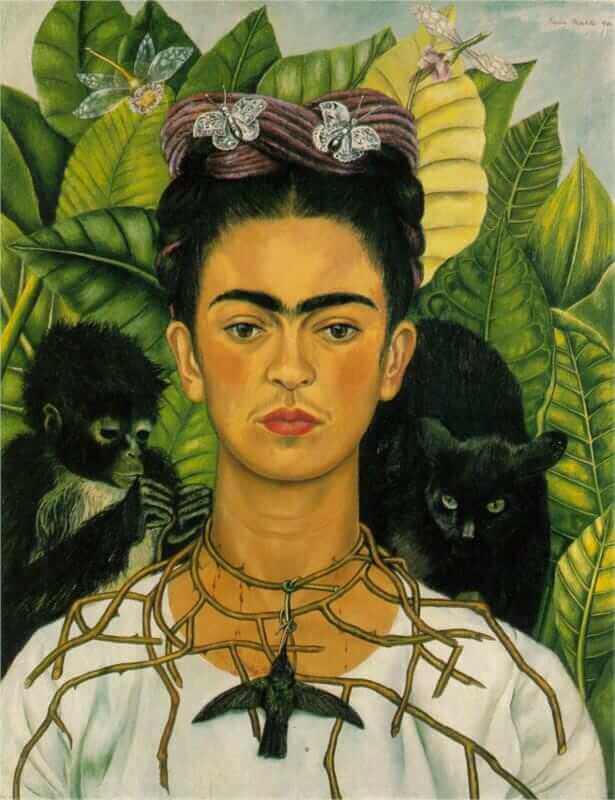
Frida Kahlo. Self Portrait with Thorn Necklace and Hummingbird, 1940. Oil on canvas; 24.11″ × 18.5″. Nickolas Muray collection at the Harry Ransom Center, Austin, TX. Image by FridaKahlo.org.

        Most of Kahlo’s works are portraits of her surrounded by a beautiful, tropical landscape. Perhaps her being confined to a bed while sick inspired her to feel close to nature. For example, one of her most famous portraits, Self Portrait with Thorn Necklace and Hummingbird (1940), depicts Kahlo wearing a thorn necklace with a hummingbird attached to it. The necklace is so tight and sharp around her neck that it is drawing blood. On her left shoulder there is a black monkey, and there is a black cat, perhaps a panther, on her right. The background features many green leaves, suggesting that she is in a rainforest. Her stoic look in the painting may symbolize all the pain that she has endured, and how she has kept a brave face through it all. 

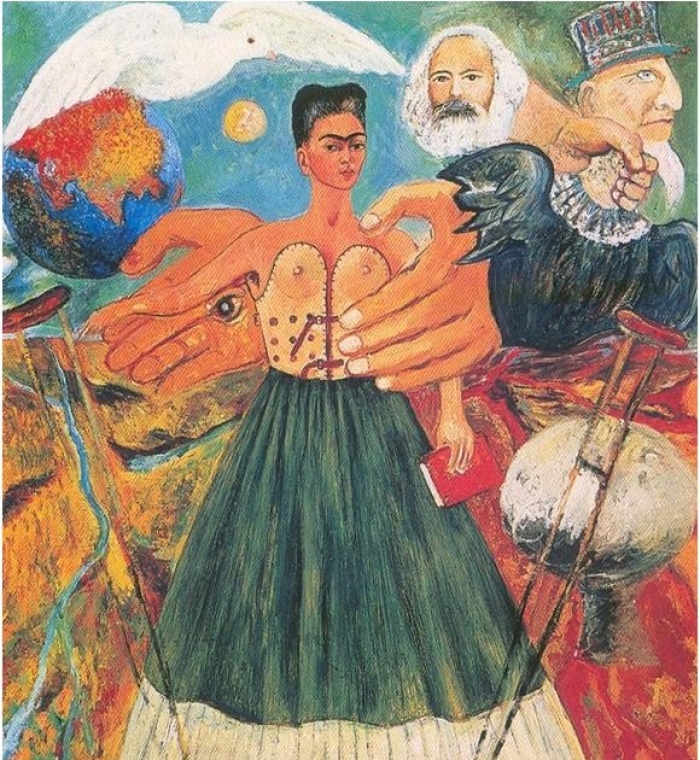
Frida Kahlo. Marxism Will Give Health to the Sick, 1954. Oil on masonite; 23.6″ x 29.9″. Frida Kahlo Museum, Mexico City, Mexico. Image by FridaKahlo.org

        Besides her poor health, Kahlo’s politics also influenced her art. Kahlo was a Marxist, joining the Young Communist League and the Mexican Communist Party while at school. She was born just three years before the Mexican Revolution. In her later years as a painter, she would want to show her political side more. For example, she has a piece called Marxism Will Give Health to the Sick (1954). In the self-portrait, Kahlo is standing in the middle of the canvas with her left arm stretched out to her side, and her right arm at her side with her holding a red book, which is She is wearing a long green skirt and a corset or upper body cast with straps. There are crutches at her side, indicating that she is unwell. In the right-hand corner of the painting, there is the head of Karl Marx attached to a hand, which is gripping onto a bald eagle with the head of Uncle Sam. There are two hands outstretched toward her. These may represent the hands of Marxism coming to save Kahlo from the oppression of imperialism and capitalism.

        Women are taught early on that body hair is “un-ladylike,” and because of this, many of them shave. Kahlo, however, heavily rejected society’s ideas of traditional femininity and what a woman “should” be. In her diary she once wrote, “I used to think I was the strangest person in the world but then I thought there are so many people in the world, there must be someone just like me who feels bizarre and flawed in the same ways I do. I would imagine her, and imagine that she must be out there thinking of me, too.” She was never afraid to stand out and break conventions, which is what makes her an important feminist figure today. She proudly sported a unibrow and mustache. She also did not shave her legs or underarms either. In all of her portraits, she makes her unibrow and mustache prominent.        

Kahlo died a week after her 47th birthday on July 13, 1954 in her home village from a pulmonary embolism.  Like most artists, Frida Kahlo did not get the full recognition for her art that she deserved until she died. Today, she remains an influential artist who used her misfortunes to guide her art.

Sources

Almeida, Laura. “Quotes from Frida Kahlo.” Denver Art Museum. Last modified December 28, 2020. https://www.denverartmuseum.org/en/blog/quotes-frida-kahlo 

Kahlo, Frida. “Marxism Will Give Health to the Sick – by Frida Kahlo.” Accessed December 13, 2021.  https://www.fridakahlo.org/marxism-will-give-health-to-the-sick.jsp

Kahlo, Frida. “Self-Portrait with Thorn Necklace and Hummingbird, 1940.” Accessed December 13, 2021.

https://www.fridakahlo.org/self-portrait-with-thorn-necklace-and-hummingbird.jsp.

Kelley, Wes. “The Painful Life of Frida Kahlo: How Injury Led to Inspiration.” Medium. Medium, May 18, 2020. https://medium.com/@wnkelley13/the-painful-life-of-frida-kahlo-how-injury-led-to-inspiration-839210d3b58

LibQuotes. “Frida Kahlo Quote.” Lib Quotes. Accessed December 13, 2021.

https://libquotes.com/frida-kahlo/quote/lbd2f7e

Maranzani, Barbara. “How a Horrific Bus Accident Changed Frida Kahlo’s Life.” Biography.com. A&E Networks Television, June 17, 2020. https://www.biography.com/news/frida-kahlo-bus-accident. The Art Story. “Frida Kahlo Biography, Life & Quotes.” The Art Story. Accessed on December 13, 2021  https://www.theartstory.org/artist/kahlo-frida/life-and-legacy/.

The Art Story. “Frida Kahlo Biography, Life & Quotes.” The Art Story. Accessed on December 13, 2021  https://www.theartstory.org/artist/kahlo-frida/life-and-legacy/.

Adrian Piper’s Confrontational Art

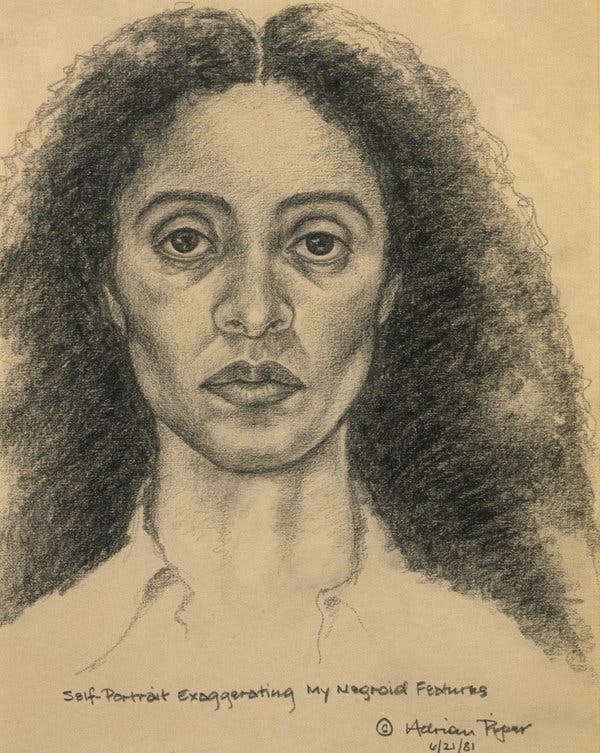
        Adrian Margaret Smith Piper was born on September 20th, 1948 in New York, New York to mixed race parents, and she identifies as a Black woman. She is a conceptual artist who does performance pieces, with most of her art being confrontational critiques on society. She was inspired by the injustices she experienced and witnessed to use herself as a form of expression. In 1971 she wrote, “I can no longer see discrete forms or objects in art as viable reflections or expressions of what seems to me to be going on in this society. They refer back to conditions of separateness, order, exclusivity, and the stability of easily accepted functional identities that no longer exist.” In two of her pieces, Self Portrait Exaggerating my Negroid Features (1981) and Self Portrait of a Nice White Lady (1995), Piper aims to deconstruct viewers’ perceptions of race and identity.

Adrian Piper. Self Portrait Exaggerating my Negroid Features, 1981.
Pencil on paper; 10″ x 8″. Collection of Eileen Harris Norton, Los Angeles, CA. Image by Arthur.

         Her piece, Self Portrait Exaggerating my Negroid Features (1981) features a self-portrait of Piper with pronounced facial features like a wide nose, afro-textured hair, and full lips, which are features that she does not naturally have. For her whole life, Piper was mistaken for being many different races and ethnicities other than Black because of her light skin and smaller facial features. Although this may not be her intention with the portrait, another way to examine this piece is perhaps Piper is taking a stand against the types of faces that are usually depicted in Western art art. Western beauty standards are very Eurocentric; European features like pale skin, long hair, and a small nose are praised. These beauty standards translate into art, and Western artists throughout history have depicted beautiful women as those with these specific features. These characteristics are often associated with femininity, elegance, and softness. The most common Black/non-White features like wide noses, darker skin, and curly/textured hair are not given this same exposure and are even demonized in the Western world. Piper could be giving power back to non-White features by depicting herself this way.      

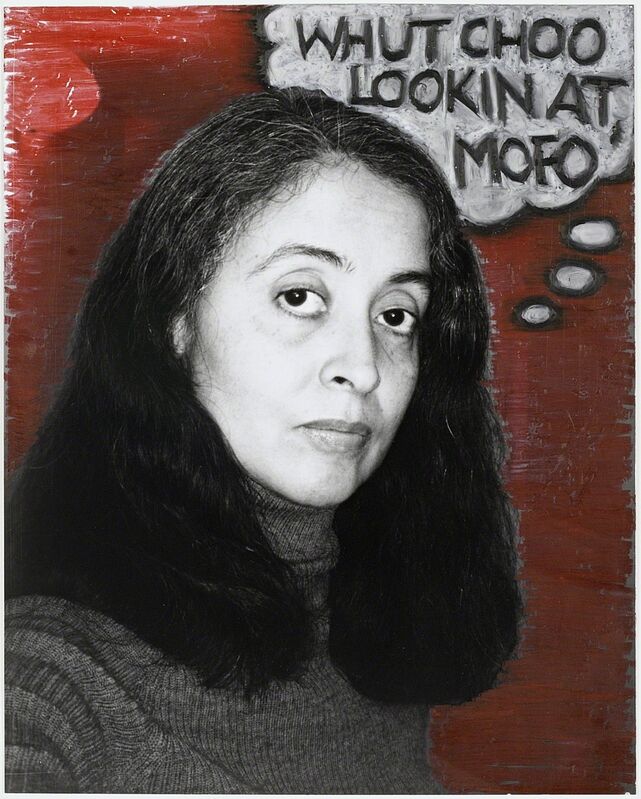
        In Self Portrait of a Nice White Lady, Piper challenges the concept of race. In this picture, there is a photograph of Piper with a straight face and a speech bubble that says “Whut choo Lookin At MOFO” in front of a burgundy background. Due to racial biases, the concept of a White woman, specifically a “nice White lady” is automatically associated with positive attributes like friendliness, femininity, intelligence, and so on. The Studio Museum writes, “The image refutes its title by presenting Piper as herself, a Black woman, who cannot be reduced to being simply “nice.” The work’s text—“Whut choo lookin at, mofo?”—is a call to pay attention and confront how stereotypes inform the way we read people.” 

Adrian Piper. Self-Portrait as a Nice White Lady, 1995. Black and white autophoto with oil-crayon drawing; 18 1/4″ × 14 1/4″. A Constellation Collection at the Studio Museum in Harlem, New York City, NY. Image by The Studio Museum.

The fact that the nice White lady is talking in African American Vernacular English (AAVE) could be jarring, considering that AAVE is often seen as an “unintelligent” and “aggressive” dialect, traits that are not associated with White women. In this work, Piper is directly challenging the viewer’s perception of what it means to be a White woman by having her say the exact opposite of what many people may believe a nice White lady would say.        

Although Piper’s work is successful in challenging Western art, it is important to note that her being a light-skin, White passing Black woman makes it easier for her art to be valued. She has been allowed in spaces that her dark skin counterparts have not been. Race is phenotypic as much as it is genotypic. Just because someone is racially Black does not mean that they will experience all of the plights of being a Black person if society does not perceive them that way. In Self Portrait Exaggerating my Negroid Features, Piper even had to extremely emphasize her facial features to show that she is Black. In her 1986 piece, Calling Card (I am black), Piper had to point out that she was Black when people would say racist things around her because they assumed she was another race. On the other hand, Piper never denies her Blackness, and if anything, uses her privilege as a White passing Black person to call attention to important topics.

Sources

Arthur. “Adrian Piper – Self Portrait Exaggerating My Negroid Features, 1981.” Arthur. Accessed November 11, 2021. https://arthur.io/art/adrian-piper/self-portrait-exaggerating-my-negroid-features

Encyclopedia Britannica. “Adrian Piper.” Encyclopædia Britannica. Encyclopædia Britannica, inc. Accessed November 2021. https://www.britannica.com/biography/Adrian-Piper

National Gallery of Art. “Calling Card (INational Gallery of Art Am Black).” nga.gov. Accessed November 2021. https://www.nga.gov/collection/art-object-page.203123.html

Steinhauer, Jillian. “Adrian Piper’s Uncomfortable Art,”The New Republic, May 30, 2018. https://newrepublic.com/article/148298/outside-comfort-zone-adrian-piper 

Studio Museum. “Self-Portrait as a Nice White Lady.” The Studio Museum in Harlem, December 3, 2020. https://studiomuseum.org/node/60854.

Frida Kahlo: Challenging Western Gender and Identity Norms

Magdalena Carmen Frida Kahlo y Calderón known in the art world as just Frida Kahlo was a Mexican painter whose work primarily focuses on themes of identity, death, and personal life experience.  Kahlo’s Self-Portrait with Cropped Hair and double self portrait The Two Fridas capture her struggle with identity. Kahlo’s colorful self-portraits and surrealist paintings challenged the gender and identity norms of the Western world.

Frida Kahlo. Self-Portrait with Cropped Hair, 1940. Oil on canvas; 40 x 27.9 cm. MoMA Collection, New York City, NY. Image by MoMA.

Kahlo disagreed with the Western concepts of gender from an early age. Directly challenging gender norms, Self-Portrait with Cropped Hair (1940) shows the artist in a men’s suit with a traditionally male haircut. She is seated in a chair in the center of the frame making eye contact with the viewer. She is holding scissors in one hand and a lock of hair in the other and it appears that she has just cut her own hair. There are locks of hair scattered throughout the foreground and middle ground of the painting. At the time of this painting, women traditionally presented with long hair and wearing a dress or skirt. In Mexico a women’s long hair was a sign of beauty and womanhood. 

She exhibits herself in this painting from an androgynous angle sporting mens attier and a short hair cut. By cutting her hair, Kahlo stripps herself of the idealistic portrayal of what a woman should look like. Due to the artist’s medical issues and injuries, Kahlo was unable to bear children and suffered multiple miscarriages. Carrying a child and raising a family was something that was expected of women at that time while the men worked to support the family financially. This burdened Kahlo and created personal conflict with her identity as a woman. This painting was created following the artist’s divorce to her husband in 1939. During this time Kahlo swore she would sell her art inorder to be financially independent from any man. Therefore, this painting where she appears more masculine can also represent her becoming her own husband, and show that women do not need to rely on a man to be independent. This painting broke boundaries of both feminine beauty and expectations. 

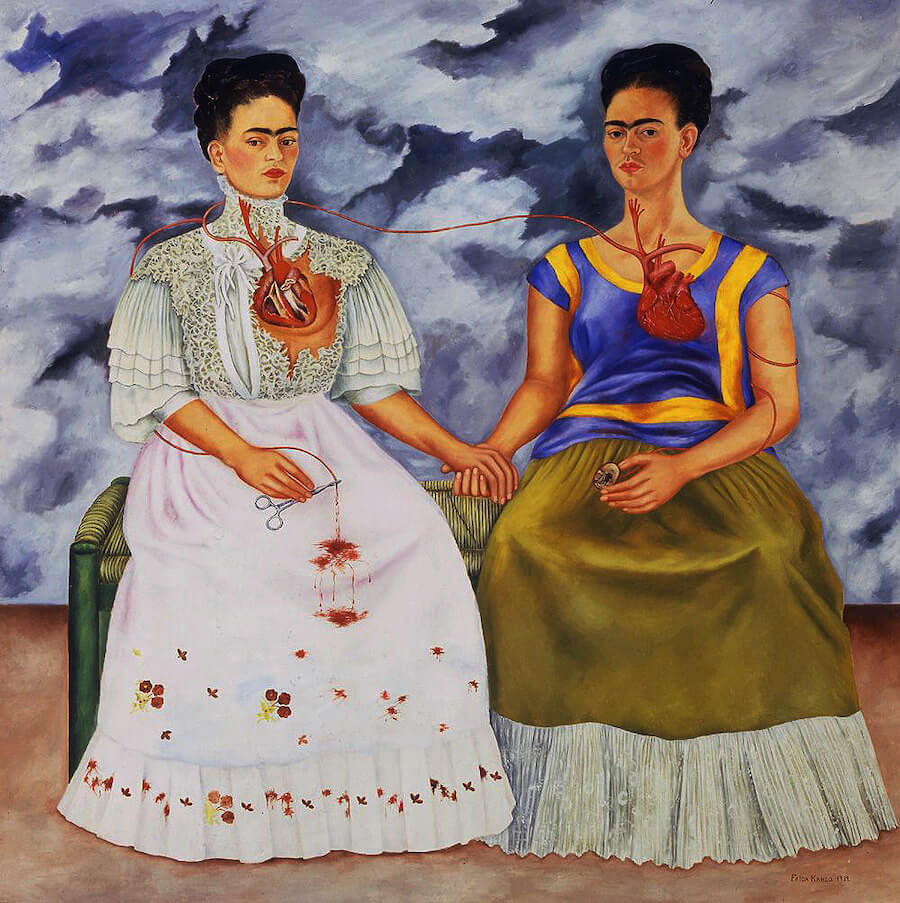
Frida Kahlo. The Two Fridas, 1939. Oil on canvas; 173.5 x 173 cm. Museo de Arte Moderno, Mexico City, Mexico. Image by Museo de Arte Moderno.

Not only did Kahlo document her ambiguity and experimentation with her identity as a woman, she also expressed her mixed heritage. In her painting The Two Fridas (1939) the artist depicts two sides of herself. On the left is Kahlo in a white European style dress in connection to her German heritage from her fathers side. And on the right she is depicted wearing a traditional Mexican skirt and blouse to represent her Mexican and Spanish heritage from her mothers side. The two figures are seated on a bench holding hands against a dark cloudy background. Their hearts are exposed and appear to be connected by a vein. 

Kahlo moved to the United States in 1930 during the time of the Great Depression. This was an uncertain time for immigrants coming from Mexico and discrimination against spanish-speaking individuals grew as unemployment rates rose. This painting shows how the artist’s two very different sides are connected. Kahlo was proud of her Mexican and Spanish heritage and she symbolizes this in the attire worn by her on the right. She shows that although she had immigrated from Mexico, She would not cut herself off from her Mexican heritage. America was thought to have been a “melting pot” where inorder to avoid discrimination a person had to abandon their culture to fit into the societal norms of the U.S. This painting fights this idea that a person had to fully conform to the identity of their location. 

The work of Frida Kahlo fights both gender constructs and the discrimination faced by immigrants. Her work stems from Kahlo’s own personal experiences and reality as a woman of both European and Mexican descent. Her work continues to be an inspiration by challenging the gender and identity norms of the Western world.

Sources

Bakewell, Liza. “Frida Kahlo: A Contemporary Feminist Reading.” Frontiers: A Journal of Women Studies 13, no. 3 (1993): 165–89. https://doi.org/10.2307/3346753.

Blakemore, Erin. “The Brutal History of Anti-Latino Discrimination in America.” Google. Google, August 29, 2018. https://www.google.com/amp/s/www.history.com/.amp/news/the-brutal-history-of-anti-lat ino-discrimination-in-america.

The Museum of Modern Art. 2021. Frida Kahlo. Self-Portrait with Cropped Hair. 1940 | MoMA. [online] Available at: https://www.moma.org/collection/works/78333?artist_id=2963&page=1&sov_referrer=artist.

The Contemporary Art Form of 3D Printing

3D printing can be dated back to 1860, however, 3D printing as we know it today has only been around since the mid 1980’s. Since 2007, the price of 3D printers has continued to go down and these machines have become more and more affordable. This new affordability has given way to a new widespread and popular art form. 3D printing is now used in many different industries to create a variety of things. Those who focus on utilizing this technology to create artwork push the limits of creative possibility within contemporary art by combining technology and art. 

3D printing can also be known as digital manufacturing or fabrication. Using software such as Morphi or Autodesk 123d Design, the creator first designs a digital 3D model of their form. Those who don’t know how to utilize these software programs can go to websites like thingiverse.com where they can find previously designed digital files which can be downloaded and sent to the 3D printer. The machine then creates 3D objects through an additive process of layering a material from bottom to top. Materials can include polymer plastics, metal, and ceramics among others. Those working with this technology to design prints can create practical items which can be used. For example, one could create a battery cover for a remote where the original has gone missing. On the other hand, designers can engineer creative works meant for display purposes. Today, 3D printing is used in areas such as the medical, aerospace, and automotive industries. However, because this technology allows the creator to print virtually anything, it is also a new popular tool used in contemporary art. In the art world, this technology can be seen used in sculpture, fashion, jewelry making, and architecture among other artistic uses.

More and more contemporary art forms utilize technology in one way or another. 3D printing has naturally found its way into the sculptural art of contemporary artists such as Joshua Harker. Joshua Harker, one of the most recognized artists in the field of 3D printed sculpture is considered to be a “pioneer and visionary” in this medium and is credited as the “first to break the design & manufacturing threshold of possibility.”

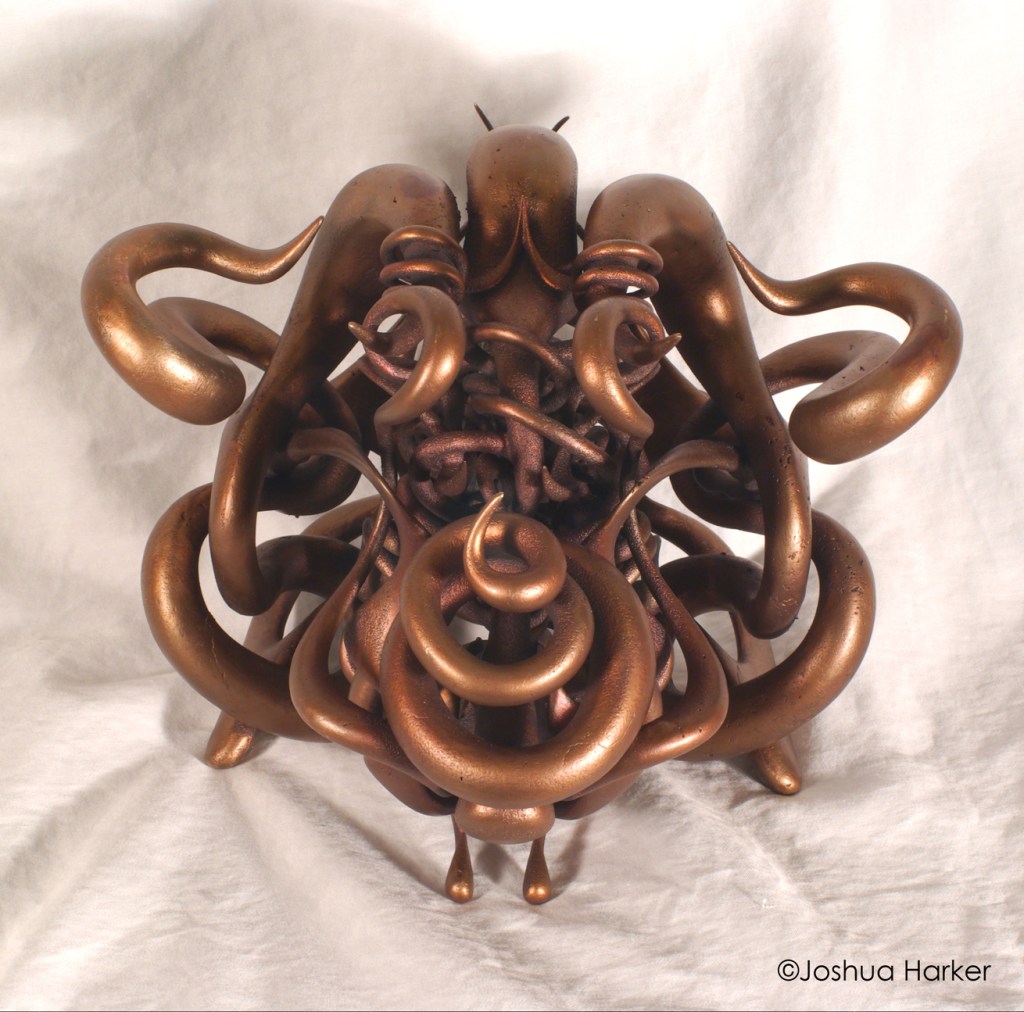
Joshua Harker. Dynamic Transcendental Migration, 2013. 3D Print. Photo by Joshua Harker.

His series of 3D printed sculptures titled Tangles are a mesmerizing collection of alien-like intricate and complex tangles. The tangles appear to be made of intertwined snake-like strands which are thicker in the middle and taper off to points at the end to form these serpentine creations. Each sculpture is printed with cast bronze to bridge traditional techniques of bronze sculpture making with this technologically advanced technique. 

Artists who utilize this technology must change the way they think in terms of  construction. Unlike other sculptural mediums, this requires the designer to think of a sculpture on a minuscule layer by layer basis (layers are typically 0.2 millimeters thick). Creating a design which successfully translates from design file to physical 3D form can be difficult depending on the complexity of the piece. Another reason why artists like Joshua Harker are so highly regarded. These abstract pieces would not be possible to create without the use of 3D technology. Therefore, the “practical impossibilities of their existence” has been considered a critical milestone or turning point in 3D printed art and contemporary sculpture. With the introduction of 3D printers artists like Harker have been able to expand their artists capabilities in areas such as sculpture and bring forth new innovative designs that would otherwise not exist.

This new ability to create works of art that could not have previously been crafted has been pivotal within contemporary art. 3D printing technology allows for endless creative possibilities and extends the realm of possibility within art. As technology improves and advances to provide artists with new mediums and tools, art is pushed to new limits and widens the possibility of creation. The creation of new technology in art will not stop here and contemporary art will continue to change as it has with 3D printing. 

Sources

“About.” Joshua Harker, April 18, 2021. https://www.joshharker.com/about/.

N. Shahrubudin, T.C. Lee, and R. Ramlan. “An Overview on 3D Printing Technology: Technological, Materials, and Applications.” Procedia Manufacturing 35 (August 14, 2019): 1286–96. https://doi.org/10.1016/j.promfg.2019.06.089.

Smith, Shaunna. “3D Printing: Where Art and Technology Collide .” TRENDS , 2014, 16–23. https://www.taea.org/taea/Docs/2014/TRENDS-2014.pdf#page=17.

“Tangle Sculpture Series.” Joshua Harker, February 11, 2018. https://www.joshharker.com/art/tangles/.