Wendy Red Star is part of an emerging network of contemporary artists who seek to push back against stereotypical depictions of Native Americans in both art and society. Growing up as a part of the Crow Nation, Red Star remembered seeing Native Americans, especially Native women, showcased in a variety of degrading roles by white Westerners[1]. The motivation for much of her work comes from her desire to satirize this flawed perception. Known best for her self-referential photographs, she’s able to decontextualize Western misconceptions of Native life through her work.
The first piece, entitled Twin Peaks or Bust #9 from the series White Squaw is one of her most outrageous. It references a series of adult Western romance novels she’d seen and immediately knew she wanted to parody[2]. She casts herself as its brash, over-sexualized heroine, suggestively licking the crude reproduction of a tomahawk. Tomahawks are often coded as a symbol of Native American warfare and resistance to colonization[3]. The catchphrase “hard pressed for revenge, she knows all the right moves!” sits alongside the image, a further trivialization of Native stereotypes. It seems to comment upon the “savage” label imposed upon them by early colonizers. Even in the 80’s and 90’s, when cheesy romance novels such as this abounded, that label of “savage” persisted and was even capitalized upon to create a sense of sexual danger. A clearance sticker marks the book down to only $1.00, perhaps to comment on how cheapened Native culture has become through the white Western gaze.
The piece is undeniably over the top as if to double down on the absurdity of Western fetishization of Native women. Its composition harkens back to the cringe-worthy covers of 80’s & 90’s-era romance novel covers, and is in effect quite unappealing as an image. The foreground of the image is an illustration of several unrelated scenes involving early Native Americans. These scenes include a Native American couple in the throes of passion, a screaming, gun-toting Native man, white soldiers on horseback, and what appears to be a white saloon girl hiking up her dress. It’s clearly hand-drawn, evident of a time before digital cover art. In contrast, Red Star’s Native woman is a sloppily cut silhouette from a photograph. She wears bright red lipstick, with heavy, modern eye makeup. The fake yellow feather poking straight out of her headband alludes to the inauthenticity of her Native-inspired clothing, causing her to appear more like an offensive Halloween costume or adult film star than an actual Native American woman. I find that in her efforts to create this intentionally disconcerting image, she takes a more clear stand against the stereotypes she’s embellishing. Its unpleasantness almost holds a mirror up to non-Native viewers, as this must be how appalled actual Native Americans feel when viewing images of their own culture from the un-educated Western perspective.
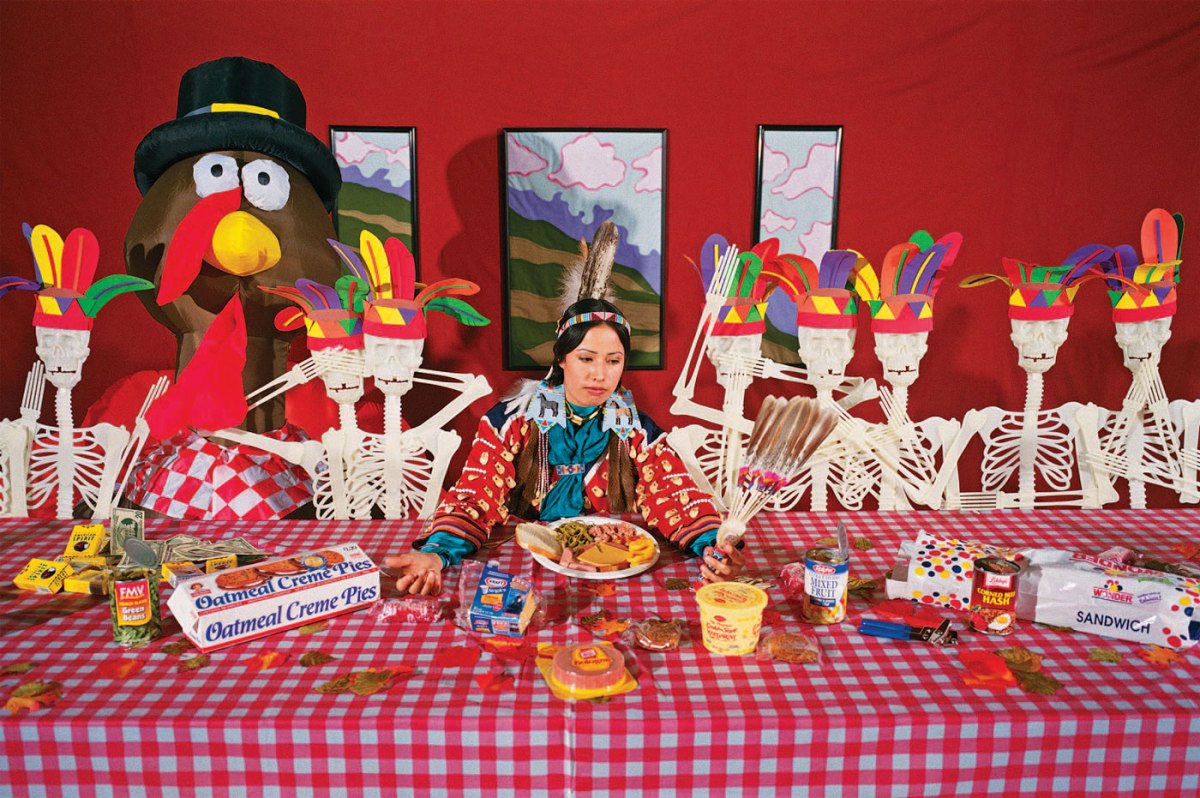
The next image, The Last Thanks, offers a more traditionally acceptable style of photography, while staying unflinchingly true to Red Star’s message. It confronts Western presumptions of the first Thanksgiving dinner. Red Star sits dead-center at a picnic table, wearing what appears to be authentic Native-American dress and staring questioningly at the feathered fan in her hand. She is surrounded by objects which commodify Native American culture as related to the concept of Thanksgiving. On either side of her is a line of anatomical skeleton models adorned with fake feathered headdresses, the sort of construction paper DIY almost every child in the United States has been made to craft at some point in their early education. One seat at the table is reserved for a giant inflatable turkey wearing a novelty pilgrim hat. The table itself is adorned with the plastic, red-checkered cloth which is cheapest and most widely accessible to Americans.
The table is littered with highly processed food such as pre-packaged Oscar Meyer bologna, Little Debbie Oatmeal Cream Pies, canned green beans, Wonder Bread, and Kraft singles. Like dumbed-down stereotyping of Native American culture, we have commodified our food to make it cheaper, more convenient, and easier to swallow. This may also allude to early indigenous hunting practices, where hunting was a way of live and a means of survival that necessitated using all parts of the animal. This mentality promoted respect of the animal which had died to provide them sustenance. In contrast, much of the meat we eat today hardly seems to have come from an animal at all.
Another very intentional pile of items sits at one corner of the table. Several cigarette boxes are strewn about. They are American Spirits, a brand whose logo helped to popularize the image of a tobacco-smoking Native American man. This brand is known for utilizing the stereotypes and iconography of Native Americans to promote the perception that their cigarettes are more ethically-sourced and natural. In reality, the brand is still peddling a carcinogenic product with zero affiliation to any American Indian groups[4]. Beside the cigarette boxes is a pile of paper money, perhaps a reference to Native Americans as gamblers and their culture as an avenue of gambling for Westerners. The prominence of casinos was made possible through Indian reservation laws which existed independently of state laws[5]. As a result, many Native Americans are perceived as greedy facilitators of gambling, an undeniably dangerous habit. However, this practice is no more dangerous nor complicit than the culture surrounding alcohol consumption across the United States. It is one of the few ways Native Americans were able to gain a leg up in the wake of colonization and the resulting loss of their land and people.
To non-Native Americans across the United States, Thanksgiving is just an excuse to eat turkey and visit extended family. The concept of the First Thanksgiving, where Natives and colonists supposedly shared a pleasant meal together to celebrate their budding relationship, is just watered down history for the sake of easier consumption by children and non-Natives. In truth, there was no such event. The First Thanksgiving was no more than a story told by President Lincoln to ease the minds of Americans during the time of political unrest which surrounded the Civil War[6]. The title of this piece, The Last Thanks, applies a darker implication to our celebration of the holiday, implicating it as a tool for the erasure of American history as it relates to the Native American experience.
The Last Thanks is a more fully realized product of Wendy Red Star’s artistic vision. It pokes fun at numerous aspects of white Americans’ misrepresentation of Native American culture, tying it all together with a strong cultural reference (the First Thanksgiving) which is recognizable to Natives and Westerners alike. It also provides a more comprehensive deconstruction of Native American stereotypes, including use of the Native American image to promote sales for non-Native businesses. WhileTwin Peaks or Bust #9 offers a comical yet scathing critique on the over-sexualization of Native Americans, it is less hard-hitting as a result. It’s also less visually appealing as a result of its subject matter. Red Star creates her strongest work when she employs her signature satire while still creating highly-referential and visually coherent art.
Images Referenced
Twin Peaks or Bust #9
The Last Thanks
Sources
- Thompson, Chuck. “Wendy Red Star and the Indigenous Voice – C&I Magazine.” Cowboys and Indians Magazine. January 30, 2018. Accessed March 26, 2019. https://www.cowboysindians.com/2018/01/wendy-red-star-and-the-indigenous-voice/.
- Beck, Abaki. “Decolonizing Photography: A Conversation With Wendy Red Star.” Aperture Foundation NY. December 14, 2016. Accessed March 26, 2019. https://aperture.org/blog/wendy-red-star/.
- Alchin, Linda. “The Tomahawk.” Native Indian Tribes. January 16, 2018. Accessed March 26, 2019. https://www.warpaths2peacepipes.com/native-indian-weapons-tools/tomahawk.htm.
- “American Spirit Cigarettes: Not Healthy and Not Native.” Ethical Shopping. Accessed March 26, 2019. http://www.ethicalshopping.com/food/packaged-products/american-spirit-cigarettes.html.
- Israel, David K. “10 Things You Need to Know about Indian Reservation Gambling.” Mental Floss. July 08, 2010. Accessed March 26, 2019. http://mentalfloss.com/article/25137/10-things-you-need-know-about-indian-reservation-gambling.
- Toensing, Gale Courey. “What Really Happened at the First Thanksgiving? The Wampanoag Side of the Tale.” Indian Country Today. November 24, 2017. Accessed March 26, 2019. https://newsmaven.io/indiancountrytoday/archive/what-really-happened-at-the-first-thanksgiving-the-wampanoag-side-of-the-tale-iTFzfinx_Eiclx573os-yg/.


 Issues in Contemporary Art