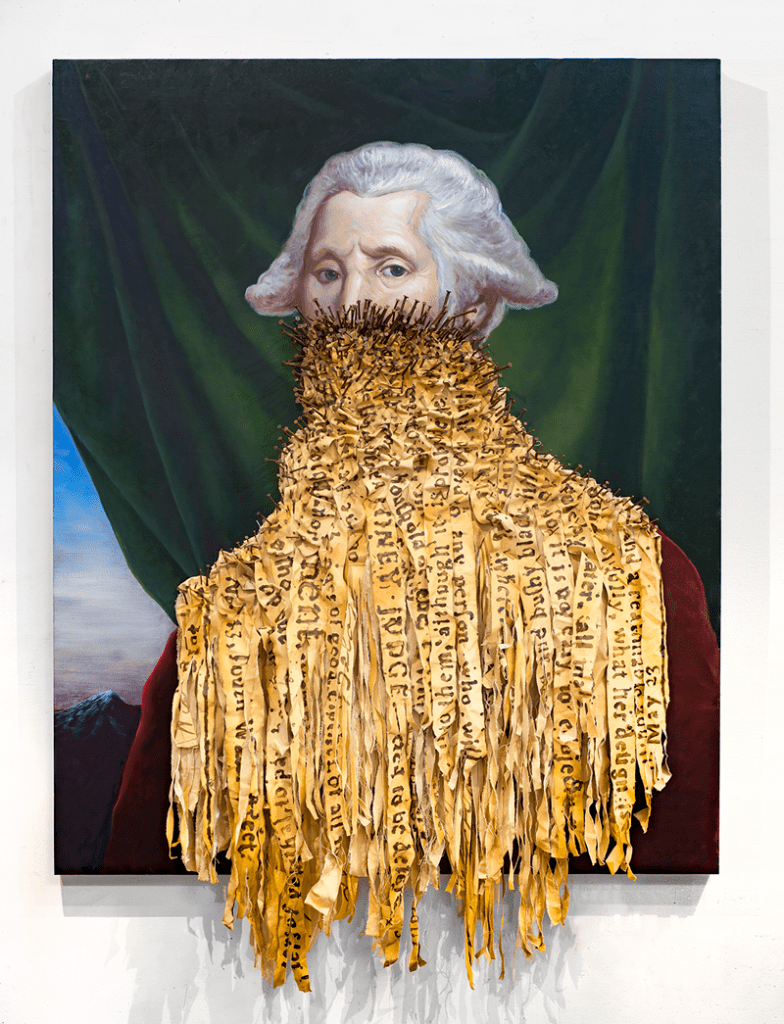
In this interview with Bomb Magazine, Titus Kaphar explains that he wants to bring attention to Black historical figures who are left out of discussions of American history. In one of Kaphar’s pieces named Absconded from the Household of the President of the United States (2016), there are multiple rusted nails tacked into a portrait of George Washington. The nails are all holding onto shredded pieces of paper with names of all the enslaved people that Washington owned. This piece calls out the fact that Americans credit George Washington for what he did for the country as the first U.S. President, while ignoring that the United States was built off the backs of enslaved people.
Titus Kaphar. Absconded from the Household of the President of the United States, 2016. Oil, canvas, and rusted nails on canvas; 60″ x 48″. Building a Legacy: Chrysler Collects for the Future, Norfolk, VA. Image by Kaphar Studio. Photo by Jeremy Lawson Studio.
Imperialist countries like the United States often like to mask the shame of its past. George Washington and multiple other Founding Fathers owned slaves. This is proved by states like Texas that are now trying to suppress the teaching of slavery and other horrific events in American history. I remember that I didn’t learn that the early presidents and other famous American figures owned slaves until I was in high school. Art like Titus’ is important because it shows how white-washed American history is, and how historical BIPOC figures are overlooked.
Sources
Titus Kaphar. Absconded from the Household of the President of the United States. 2016. Oil, canvas, and rusted nails on canvas, 60″ x 48″. Chrysler Museum of Art, Norfolk, VA.
The exhibition titled Our tears are sweet, our laughter venomous: Fourteen Iranian-American Artists was displayed in the Art Gallery at Eastern Connecticut State University from August 23rd to October 8th, 2021. The goal of this exhibition was to challenge the stereotypical portrayal of Iran that the media portrays. I believe the artwork in this exhibition achieved this goal by delving into deeper topics and issues like women’s rights and body image.
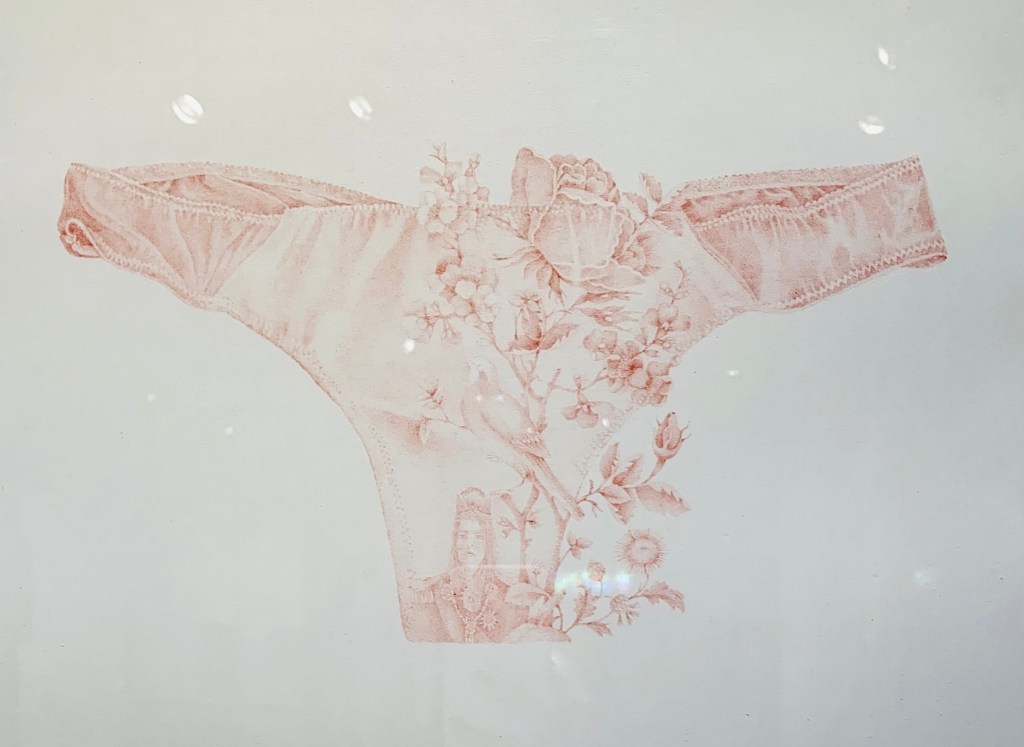
Azita Moradkhani. The Shah (Victorious Secrets), 2019. Colored pencils; 19 x 24 in. Eastern Connecticut State University’s Art Gallery, Willimantic, CT. Photo by Olivia Wronka.
The first piece that I observed upon entering the gallery was The Shah (Victorious Secrets) by Azita Moradkhani. My initial reaction when I saw this piece was that it was bland. Once I got closer I could see all the beautiful fine detail. Even viewing it close-up the color is extremely light and delicate. However, I think this lightness contributes to the fact that lingerie is a delicate piece of clothing. I was attracted to this artwork for its beautiful fine detail. I enjoy the fact that it is somewhat hard to make out, especially from a distance. Once you get closer, it is then that the peace reveals itself. I was also attracted to the pastel pink color and my eye was drawn to the vertical midline of the work where all the various elements are placed.
I believe this work has to do with female femininity and body expression. According to the booklet the artist was inspired by her experience walking into a Victoria’s Secret for the first time. This work brings me feelings of peace and femininity. The lingerie, floral elements, and bird all bring out these feelings for me. The delicate shading gives an excepting atmosphere which makes me feel like I should embrace my femininity and come to peace with my body’s imperfections. Imperfections are normal and natural. Overall, this work reminds me that I should love myself and my feminine characteristics even if it is seen as a weakness by society.
Sources
Wintner, Julia. Our Tears Are Sweet, Our Laughter Venomous: Fourteen Iranian-American Artists. Willimantic, CT: The Art Gallery Curatorial Programs, 2021.
Magdalena Carmen Frida Kahlo y Calderón known in the art world as just Frida Kahlo was a Mexican painter whose work primarily focuses on themes of identity, death, and personal life experience. Kahlo’s Self-Portrait with Cropped Hair and double self portrait The Two Fridas capture her struggle with identity. Kahlo’s colorful self-portraits and surrealist paintings challenged the gender and identity norms of the Western world.
Frida Kahlo. Self-Portrait with Cropped Hair, 1940. Oil on canvas; 40 x 27.9 cm. MoMA Collection, New York City, NY. Image by MoMA.
Kahlo disagreed with the Western concepts of gender from an early age. Directly challenging gender norms, Self-Portrait with Cropped Hair (1940) shows the artist in a men’s suit with a traditionally male haircut. She is seated in a chair in the center of the frame making eye contact with the viewer. She is holding scissors in one hand and a lock of hair in the other and it appears that she has just cut her own hair. There are locks of hair scattered throughout the foreground and middle ground of the painting. At the time of this painting, women traditionally presented with long hair and wearing a dress or skirt. In Mexico a women’s long hair was a sign of beauty and womanhood.
She exhibits herself in this painting from an androgynous angle sporting mens attier and a short hair cut. By cutting her hair, Kahlo stripps herself of the idealistic portrayal of what a woman should look like. Due to the artist’s medical issues and injuries, Kahlo was unable to bear children and suffered multiple miscarriages. Carrying a child and raising a family was something that was expected of women at that time while the men worked to support the family financially. This burdened Kahlo and created personal conflict with her identity as a woman. This painting was created following the artist’s divorce to her husband in 1939. During this time Kahlo swore she would sell her art inorder to be financially independent from any man. Therefore, this painting where she appears more masculine can also represent her becoming her own husband, and show that women do not need to rely on a man to be independent. This painting broke boundaries of both feminine beauty and expectations.
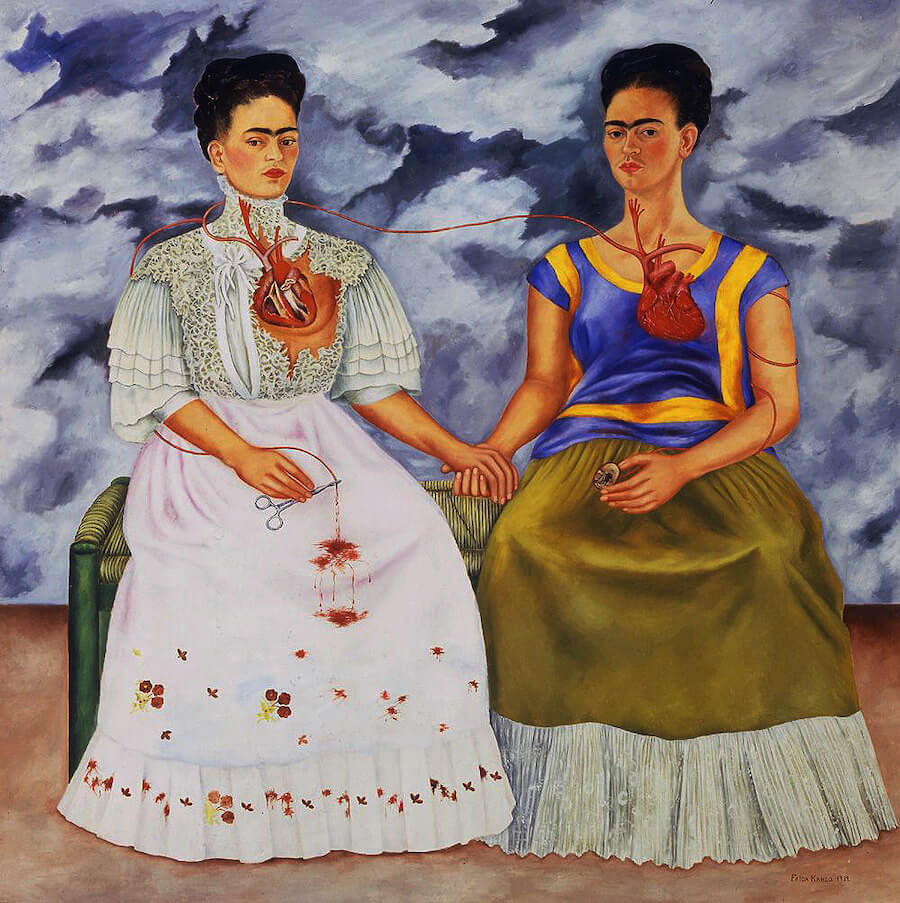
Frida Kahlo. The Two Fridas, 1939. Oil on canvas; 173.5 x 173 cm. Museo de Arte Moderno, Mexico City, Mexico. Image by Museo de Arte Moderno.
Not only did Kahlo document her ambiguity and experimentation with her identity as a woman, she also expressed her mixed heritage. In her painting The Two Fridas (1939) the artist depicts two sides of herself. On the left is Kahlo in a white European style dress in connection to her German heritage from her fathers side. And on the right she is depicted wearing a traditional Mexican skirt and blouse to represent her Mexican and Spanish heritage from her mothers side. The two figures are seated on a bench holding hands against a dark cloudy background. Their hearts are exposed and appear to be connected by a vein.
Kahlo moved to the United States in 1930 during the time of the Great Depression. This was an uncertain time for immigrants coming from Mexico and discrimination against spanish-speaking individuals grew as unemployment rates rose. This painting shows how the artist’s two very different sides are connected. Kahlo was proud of her Mexican and Spanish heritage and she symbolizes this in the attire worn by her on the right. She shows that although she had immigrated from Mexico, She would not cut herself off from her Mexican heritage. America was thought to have been a “melting pot” where inorder to avoid discrimination a person had to abandon their culture to fit into the societal norms of the U.S. This painting fights this idea that a person had to fully conform to the identity of their location.
The work of Frida Kahlo fights both gender constructs and the discrimination faced by immigrants. Her work stems from Kahlo’s own personal experiences and reality as a woman of both European and Mexican descent. Her work continues to be an inspiration by challenging the gender and identity norms of the Western world.
Sources
Bakewell, Liza. “Frida Kahlo: A Contemporary Feminist Reading.” Frontiers: A Journal of Women Studies 13, no. 3 (1993): 165–89. https://doi.org/10.2307/3346753.
3D printing can be dated back to 1860, however, 3D printing as we know it today has only been around since the mid 1980’s. Since 2007, the price of 3D printers has continued to go down and these machines have become more and more affordable. This new affordability has given way to a new widespread and popular art form. 3D printing is now used in many different industries to create a variety of things. Those who focus on utilizing this technology to create artwork push the limits of creative possibility within contemporary art by combining technology and art.
3D printing can also be known as digital manufacturing or fabrication. Using software such as Morphi or Autodesk 123d Design, the creator first designs a digital 3D model of their form. Those who don’t know how to utilize these software programs can go to websites like thingiverse.com where they can find previously designed digital files which can be downloaded and sent to the 3D printer. The machine then creates 3D objects through an additive process of layering a material from bottom to top. Materials can include polymer plastics, metal, and ceramics among others. Those working with this technology to design prints can create practical items which can be used. For example, one could create a battery cover for a remote where the original has gone missing. On the other hand, designers can engineer creative works meant for display purposes. Today, 3D printing is used in areas such as the medical, aerospace, and automotive industries. However, because this technology allows the creator to print virtually anything, it is also a new popular tool used in contemporary art. In the art world, this technology can be seen used in sculpture, fashion, jewelry making, and architecture among other artistic uses.
More and more contemporary art forms utilize technology in one way or another. 3D printing has naturally found its way into the sculptural art of contemporary artists such as Joshua Harker. Joshua Harker, one of the most recognized artists in the field of 3D printed sculpture is considered to be a “pioneer and visionary” in this medium and is credited as the “first to break the design & manufacturing threshold of possibility.”
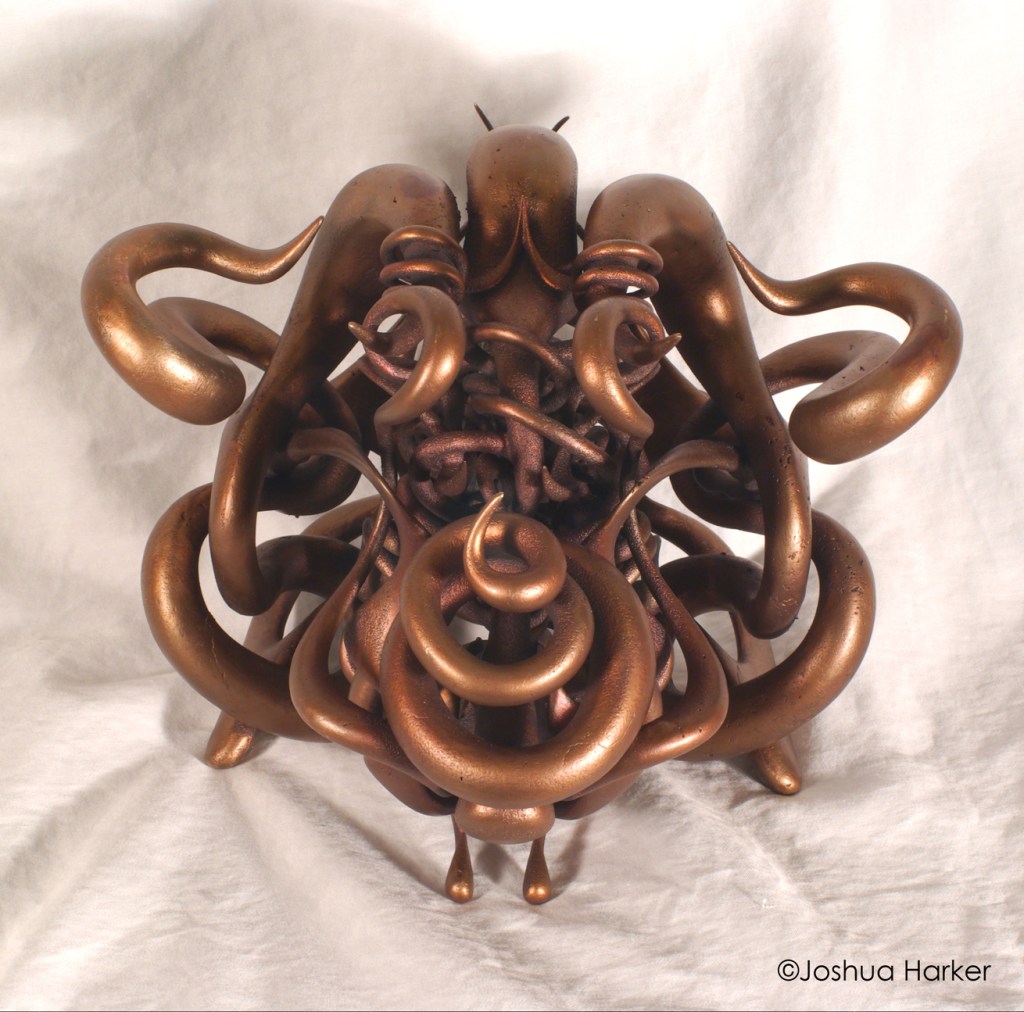
Joshua Harker. Dynamic Transcendental Migration, 2013. 3D Print. Photo by Joshua Harker.
His series of 3D printed sculptures titled Tangles are a mesmerizing collection of alien-like intricate and complex tangles. The tangles appear to be made of intertwined snake-like strands which are thicker in the middle and taper off to points at the end to form these serpentine creations. Each sculpture is printed with cast bronze to bridge traditional techniques of bronze sculpture making with this technologically advanced technique.
Artists who utilize this technology must change the way they think in terms of construction. Unlike other sculptural mediums, this requires the designer to think of a sculpture on a minuscule layer by layer basis (layers are typically 0.2 millimeters thick). Creating a design which successfully translates from design file to physical 3D form can be difficult depending on the complexity of the piece. Another reason why artists like Joshua Harker are so highly regarded. These abstract pieces would not be possible to create without the use of 3D technology. Therefore, the “practical impossibilities of their existence” has been considered a critical milestone or turning point in 3D printed art and contemporary sculpture. With the introduction of 3D printers artists like Harker have been able to expand their artists capabilities in areas such as sculpture and bring forth new innovative designs that would otherwise not exist.
This new ability to create works of art that could not have previously been crafted has been pivotal within contemporary art. 3D printing technology allows for endless creative possibilities and extends the realm of possibility within art. As technology improves and advances to provide artists with new mediums and tools, art is pushed to new limits and widens the possibility of creation. The creation of new technology in art will not stop here and contemporary art will continue to change as it has with 3D printing.
N. Shahrubudin, T.C. Lee, and R. Ramlan. “An Overview on 3D Printing Technology: Technological, Materials, and Applications.” Procedia Manufacturing 35 (August 14, 2019): 1286–96. https://doi.org/10.1016/j.promfg.2019.06.089.
Since the late 1800s, aquascaping has become a progressively popular form of art among those in the aquarium-keeping hobby. No longer do serious hobbyists simply lay some sand or gravel at the bottom of a tank, place a few decorative ornaments, and call it a day. These aquarists have cultivated a community of artists that create natural ecosystems as living works of art within the confines of a glass aquarium. Aquascaping is the art of methodically arranging aquatic plants, rocks, wood, and substrate, in a specific stylistic manner. Simply said it is the art of underwater gardening, but creating any type of aquascape requires the artist to have abundant scientific knowledge. Without proper water parameters and knowledge of various plant and aquatic species, the aquascape will quickly decompose. Because of the innate relationship aquascaping has with art and science, it can communicate and spark conservation efforts among serious aquarists. Therefore, by creating aesthetically pleasing underwater gardens as works of living art, aquarists create a relationship between art and science while increasing conservation ethics. This all starts with an artist choosing what style of aquascape they want to create. There are various styles that guide the design process and different styles come with different goals that the artist strives to achieve.
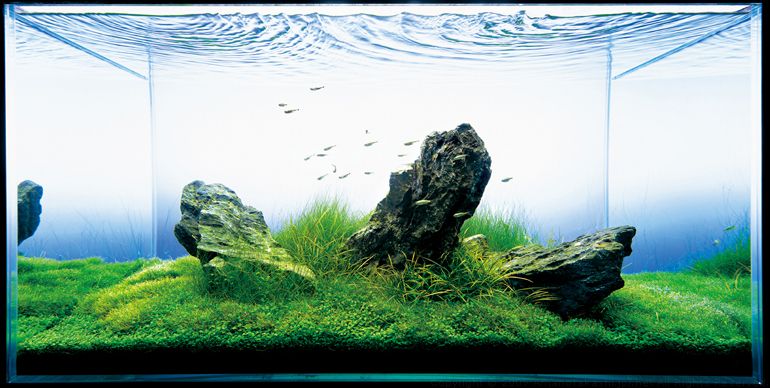
Three of the most prominent styles are iwagumi, the nature aquarium, and biotope. Iwagumi translates from Japanese to mean “rock formation” and tends to be the most visually minimalistic style. Unlike other styles, the main goal of an iwagumi aquascape isn’t necessarily to emulate a real-looking environment, but rather to create a perfectly balanced arrangement of stones. This harmonious style is heavily based on mathematics and is achieved by following the golden ratio or the rule of thirds. The golden ratio is a unique mathematical proportion often found in nature that has been theorized to be the most aesthetically pleasing to the eye. According to the golden ratio, a stone should have a length roughly one-point-six times its width. The rule of thirds helps the artist in organizing the arrangement by dividing the composition into thirds both vertically and horizontally. Stones should be placed along the hypothetical lines or points where the lines intersect. Iwagumi aquascapes always utilize an odd number of stones to avoid symmetry and place importance on the scale of each stone in relation to the other. This style was developed by Takashi Amano, a well-known photographer, and aquarist. Amano always took fine details into great consideration when building his aquascapes and once said that “to know Mother Nature, is to love her smallest creations.” His appreciation for nature and cultural background lead him to create the iwagumi style.
Takashi Amano. Untitled, 2009. Aquascape. Photo by Takashi Amano.
Amano’s untitled iwagumi piece from 2009 features an arrangement of three senmigawa stones planted on a bed of low-laying aquatic plants known as carpeting. The primary stone in the center of the composition is called Oyaishi. This stone is always the largest and acts as the focal point of the piece. Often times it is also placed slightly tilted in the direction of water flow to mimic the position of natural river rocks. To the left of Oyaishi is Fukuishi, the second largest stone and often resembles Oyaishi in color and texture. This stone is used to balance the primary stone and create tension in the composition. Lastly, on the right side of Oyaishi is Soeishi, the smallest of the three stones and is used to accentuate the strength of the primary stone. This arrangement satisfies the golden ratio and pays tribute to traditional Japanese concepts of culture and simplicity as seen in other types of Japanese gardening like zen rock arrangements. The carpet of Amano’s piece is made up of echinodorus tenellus, located on either side of Oyaishi between the outer two stones, and hemianthus callitrichoides in the surrounding scape. Although this style is visually minimalistic and may appear to be simple to recreate, to do so successfully is very difficult requiring extensive knowledge of related mathematics.
To maintain such an aquascape is even more difficult, the artist must also understand the scientific factors. The aquatic plants most commonly used in this style of aquascape are heavy root feeders, meaning they grow intricate root systems that require additional fertilizer in the substrate. The artist must choose a substrate that can account for this need such as aquarium soil which is rich in nutrients or use the water column method by adding additional liquid plant fertilizer. The biggest issue most aquarists who attempt this style face is algae formation. To battle this, aquarists must be cautious in their choice of water filtration, lighting, and tank nutrients. Too much light or excessive nutrients and the algae will rapidly grow. A proper water filtration system is also key to balancing water parameters and avoiding such algae growth. The delicate balance of math and science makes an iwagumi aquascape both difficult to create and maintain.
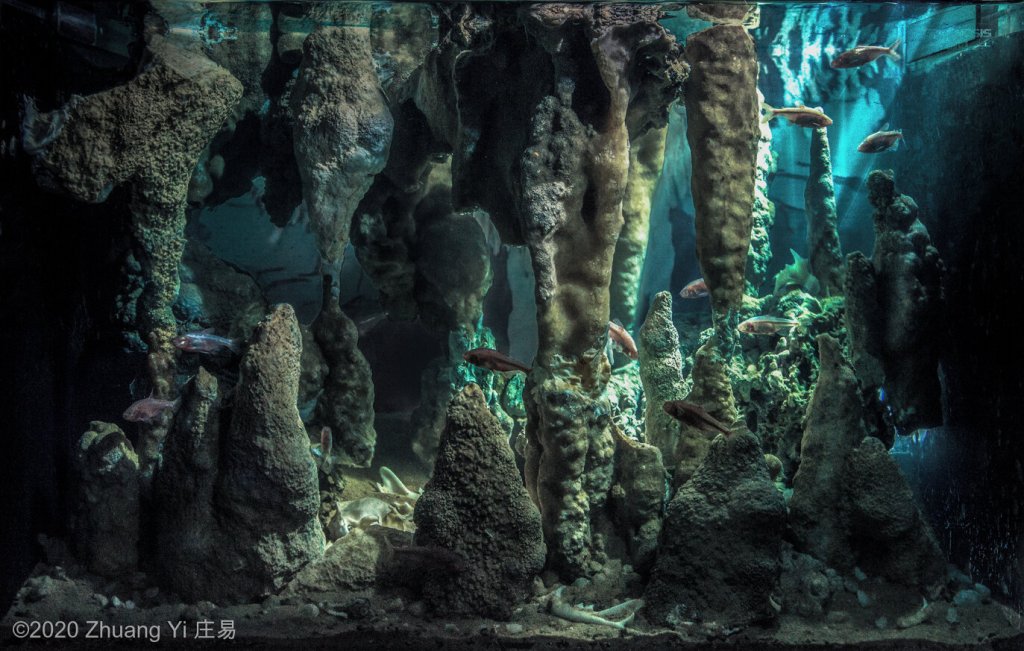
Zhuang Yi. Underwater Caves in the Peninsula of Yucatan, Mexico, 2020. Aquascape; 60 x 40 x 40 cm. Photo by Zhuang Yi.
Unlike iwagumi, the goal of a biotope aquascape is to perfectly emulate a natural environment both visually and physically on a scientific level. For a successful biotope, accuracy is key. Elements include creating authentic water conditions and choosing aquatic plants and hardscapes native to the environment being recreated. Aquarist Zhuang Yi utilizes this style in his piece promptly titled UnderwaterCaves in the Peninsula of Yucatan, Mexico. This aquascape imitates the environment found in the underwater caves in the peninsula of Yucatan, Mexico. The scape includes an assortment of stalactites that enter the composition from the top and bottom with water that appears to have a blue tint. The artist also added a possum skull which he placed on top of the substrate between stalactites and added blind cavefish to inhabit the scape. The artist’s inspiration for this piece stems from the fish which naturally inhabit this type of environment. He says, “The first time I saw blind fish, I was deeply attracted, so I looked up a lot of information and decided to restore the Maya underground cave in Mexico’s Yucatan Peninsula. There are a lot of mammal bones in the cave, so they stay in the water for years, and I used a possum skull in the water to simulate them.” In 2020, this aquascape won first place in the 96L Biotope Aquascape category of the Aquatic Gardeners Association International Aquascaping Contest. However, one judge pointed out that the piece, “suffers from a lack of biodiversity. Cenote ecosystems are special because in part of the community of organisms that live there. Including only one species of fish is not a complete biotope.” The judge who made this observation, Ted Judy, carries forty-plus years of experience keeping aquariums, and his comment proves just how serious accuracy is to this style of aquascape. In order to ensure the artist captures the environment accurately, many times they visit the location or a similar environment to fully understand its natural composition. Prior to the creation of this piece Yi visited many local caves to get a true “feel” for the stalactites in the environment. However, it is unclear whether or not the artist utilized real stalactites for his aquascape or if they are man-made replicas.
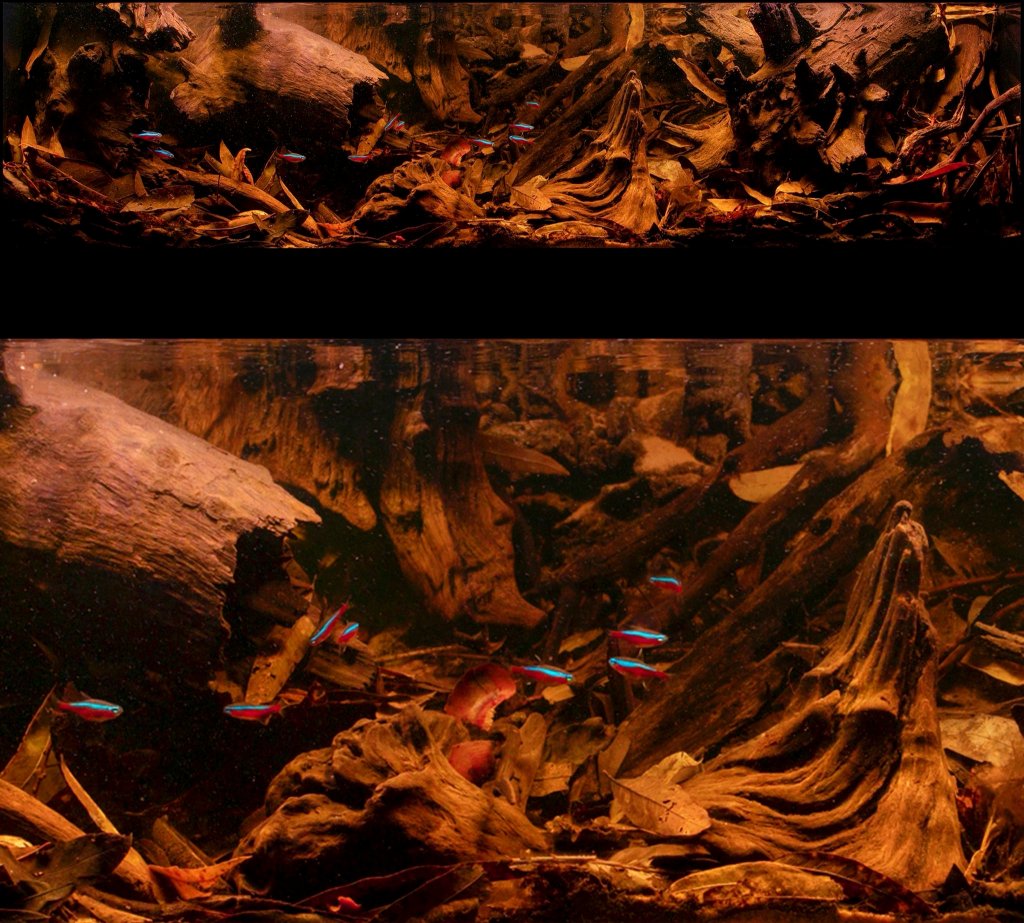
Alex Wenchel. Flooded Forest Tributary of the Rio Negro, 2021. Aquascape. Photo by Alex Wenchel.
Alex Wenchel’s Flooded Forest Tributary of the Rio Negro, which won first place in the 2021 90L Biotope category of the Aquatic Gardeners Association International Aquascaping Contest, is another exceptional example of a biotope aquascape. This biotope represents a flooded forest floor which the artist witnessed while on a trip to see the small tributaries of the Rio Negro River, the largest remaining tributary of the Amazon River. It utilizes materials such as “fallen” logs, leaf litter from a willow oak, and blended almond leaves among other botanicals. This piece displays the process of decay encapsulated by clear amber water. The amber water gives this piece warmth and the several “fallen” logs and stumps create various shadows within the scape. Aquarists like Wenchel who utilize shadow in their composition achieve a dramatic effect that can create a feeling of suspense, mystery, or moroseness. The shadows of Wenchel’s biotope are fitting with the theme of decay which resonates with the gloomy feelings one may feel while viewing this piece.
Although Wenchel’s piece explores the theme of death and decay, it still required the artist to carefully consider the science behind his tank’s water parameters. He shares that, “While the water is a crystal clear amber, a layer of mulm coats everything, and the slightest disturbance will fill the water with flecks of brownish grey.” Mulum is the layer of debris formed by the decomposition process of organic materials. This layer of mulum sits on top of all of the elements found within Wenchel’s piece and even the slightest touch or blow will send particles floating, damaging the appearance of the crystal clear water. Both the clear amber water and mulum are elements of Wenchel’s composition and he manages to have both in the same space without disturbance, but there is more to consider when it comes to mulum. Because mulum is a waste compound it can create harmful levels of nitrogen which can harm any live aquatic animals in the tank. This piece harbors cardinal tetras as inhabitants, meaning it’s important to keep nitrates low for the health of these fish. To prevent the adverse effects of mulum, the artist must have enough biological filtration such as beneficial bacteria to break down the nitrogen waste. The artist also recognizes that the size of his tank and quantity of fish will also have an effect on water parameters. The artist chose to include only ten tetras in his biotope due to the limited size of the tank. More fish means more waste being produced which must be accounted for. If too many fish are placed in a single tank it can have detrimental effects on the water parameters causing spikes in ammonia and nitrates, preventing the fish from being able to survive. Wenchel’s careful attention to such scientific aspects within his tank is an indication that his biotope is a success. His biotope meets the goal of creating a truly thriving ecosystem that can support live aquatic animals and process organic waste without affecting water quality.
Unlike the biotope style, the nature aquarium style does not strive to accurately represent an underwater ecosystem. The basis of this style is recreating terrestrial landscapes such as mountains, valleys, and deserts among other environments one would normally see above water. These styles of aquascapes tend to have many different species of plants and elements to convincingly create a realistic environment. The nature aquarium style also tends to be the one that receives the most attention from viewers due to its whimsical traits and is a popular focus of many aquascaping competitions.
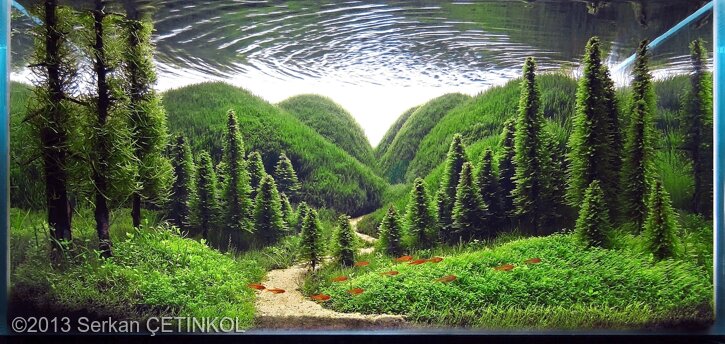
Serkan ÇETİNKOL. Whisper of the Pines, 2013. Aquascape; 75 x 50 x 40 cm. Photo by Serkan ÇETİNKOL.
Whisper of the Pines by Serkan ÇETİNKOL shows just how incredible this style truly is. This aquascape resembles a mountain valley with pine trees, hiking paths, and mountains. The artist uses a concave shape layout which places the height at the sides and a central lower point in the center to guide the viewer’s eye to the path created by the artist with sand. The path weaves its way from the foreground all the way into the background until it is no longer visible. This leads the viewer’s eye to the focal point and creates a sense of depth within the composition. The ability to create a sense of depth is a sought-after element utilized by advanced aquarists. However, to create such an aquascape requires the artist to have considerable knowledge of aquatic plant species to create a realistic-looking mountain valley. The plants and materials used in this piece include taxiphyllum barbieri, vesicularia dubyana, taxiphyllum sp. flame, utricularia graminifolia, glossostigma elationides, hemianthus callitrichoides, ammania sp. bonsai, eleocharis parvula, leptodictyum riparium, and various sands. ÇETİNKOL’s knowledge in botany led to his choices in plants to be a success in creating a sustainable environment within the tank.
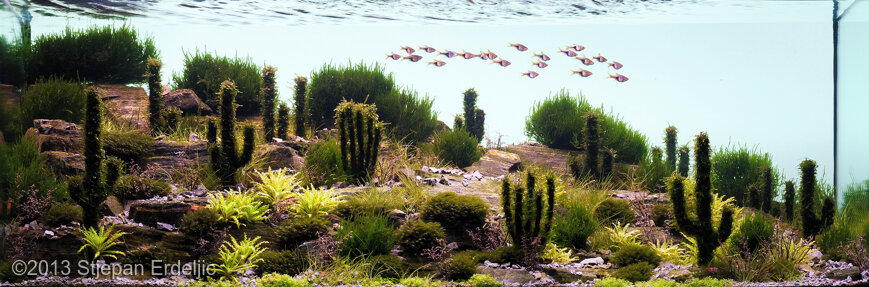
Stjepan Erdeljic. Wild West, 2013. Aquascape; 100 x 40 x 40 cm. Photo by Stjepan Erdeljic.
A similar aquascape titled Wild West by Stjepan Erdeljic although vastly different in theme of terrestrial landscape, shares its requirement of deep botanical knowledge. The plants and materials used in this piece include java moss, flame moss, fissiddens fontanus, HC cuba, elocharis parvula, gravel sand, stones, and “DIY cactus material.” Aquarists who utilize a variety of aquatic plants to densely fill their composition must also be aware of the nitrogen cycle. Aquatic plants effectively use nitrogen and can incredibly diminish the degrees of nitrate in a balanced aquarium. Meaning that these aquascapes benefit from the presence of aquatic wildlife to naturally continue on the nitrogen cycle. Erdeljic’s nature aquarium resembles a scene such as those found in the Arizona deserts. To compose this aquascape Erdeljic opted for a triangle shaped layout which creates a gradual slope from left to right. This composition gives the aquascape realistic variation in landscape elevation, verisimilar to that which would be seen in a real desert. The tiny yet realistic-looking cacti found scattered across the desert-scape are formed by shaping and grooming aquatic plants into a cactus-like shape. This addition makes the theme of the aquascape immediately recognizable to the viewer and adds to the success of this piece. Both Erdeljic and ÇETİNKOL achieve success in creating miniature underwater versions of our world above water in tandem with botanical science.
Not only do these aquascapes create visually captivating works of art and explore elements of science, but according to Elizabeth A. Marchio (a researcher from Texas A&M University), they also work to communicate conservation ethics. Conservation ethic is the moral way of thinking and preservation zeroed in on shielding species from elimination, restoring natural habitats, upgrading environment benefits, and protecting diversity among biological elements. In the study which Marchio conducted, she found that “(1) caring for a home aquarium communicates science latently, (2) over time, latent science communication becomes activated, and (3) long-term aquarium keeping leads to a personal response in science, as well as conservation.” Marchio shares that aquarists new to the hobby, and those with a relaxed direction, know nothing about protection suggestions and tend to participate in unwanted behavior. Such conduct includes buying species that become excessively enormous for tank captivity, buying creatures without first exploring their requirements or needs, overloading an aquarium, and so on. Public web forums have consistent and enthusiastic discussions, regarding these matters. Unlike novice aquarists, experienced aquarists comprehend the significance of granting a preservation ethic to new aquarists. Marchio says that “It seems it is up to the aquarium community to “police” the consumption and behavior of other aquarists.” The individual meaning of science and preservation realities is affected by “cultural, social, and political conditions in which they are produced and/or promoted.” Further, it is basic to include all aquarists in logical correspondence to contextualize and outline their collaborations with the captive ecosystem and its inhabitants. Marchio believes that gatherings of individuals interested in the aquarium keeping hobby, like clubs and meetings, are ideal spots to work on a science and preservation ethic. Zhuang Yi’s aquascape Underwater Caves in the Peninsula of Yucatan, Mexico (fig 2) is an important example of how aquascaping sparks conversation about conservation efforts. As mentioned previously, it is unclear whether or not the artist used real stalactites to create his biotope. If the artist did in fact utilize real stalactites which he harvested from a natural cave would mean having destroyed a structure which took over a thousand years to form. If everyone harvested pieces of underwater caves, the natural habitat would go extinct creating a detrimental effect on the local ecosystem. This makes it typically illegal to touch or harvest such things as stalacites from caves. The judges reviewing his work expressed their concern over the idea of using real stalacites and informed Yi of the potential implications his behavior had on conservation.
From mathematically intricate aquascapes, to those that accurately recreate underwater environments, and those which mirror the world above water, each utilizes elements of art and design concurrent with scientific processes. These artists continue to push the boundaries of what is possible to create within constricted and initially sterile glass aquariums. This continuation of innovation in design has popularized aquascape competitions around the world and intrigued many in the art form. The community formed around the art and hobby of aquarium keeping has communicated scientific knowledge and morals of conservation among those who are experienced and new to the art. Such conversation and practices of conservation will lead to a better practice of aquascaping.
Marchio, Elizabeth A. “The Art of Aquarium Keeping Communicates Science and Conservation .” Frontiers in Communication 3 (2018): 1–17. https://doi.org/10.3389/fcomm.2018.00017.

 Issues in Contemporary Art