Artificial Intelligence or Intelligent Artifice?

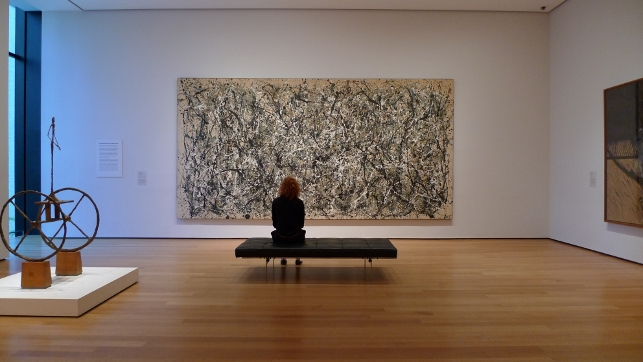
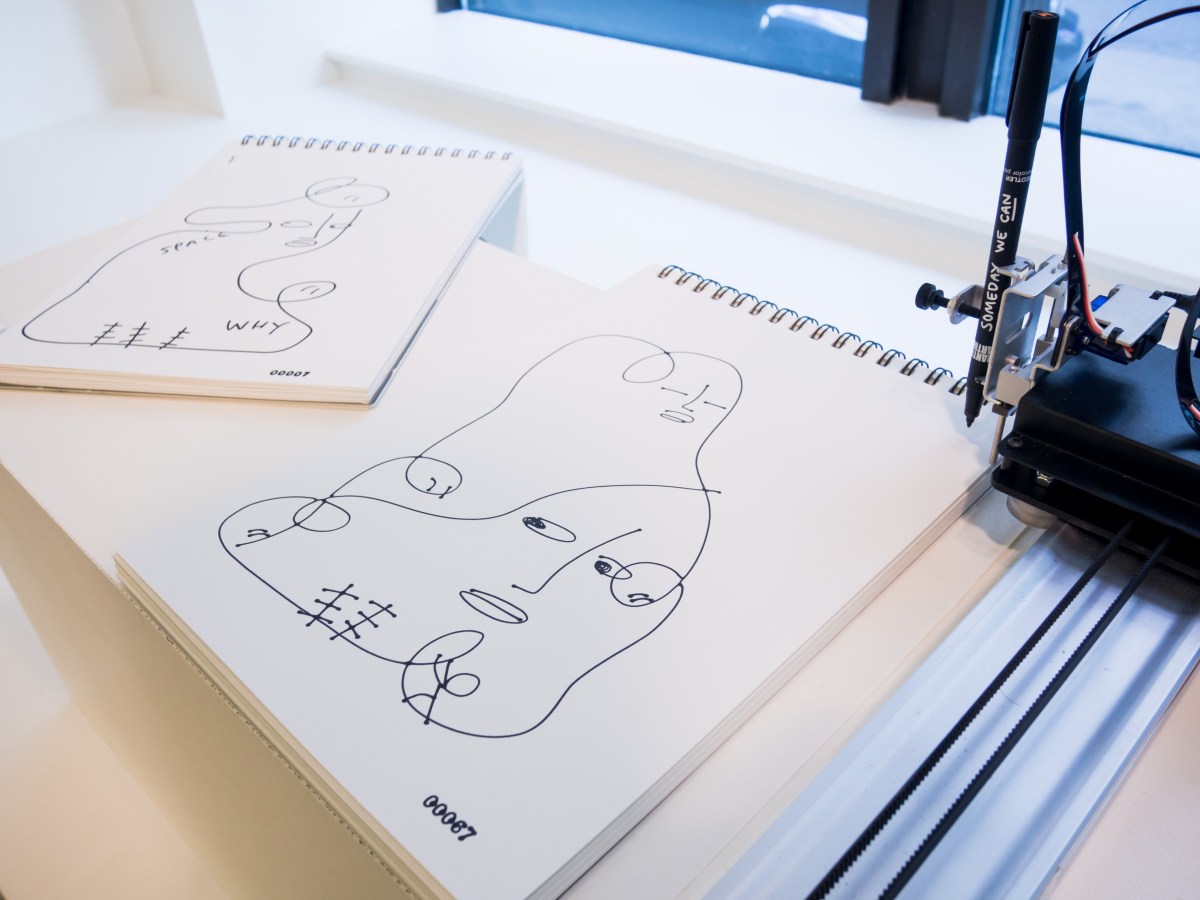
Artificial Intelligence is an emerging medium in the contemporary art world. Only recently has technology improved enough to allow the creation of algorithms capable of preforming complex tasks like generating an original image. AI art is pivotal within the history of contemporary art because it gives artists a new medium by which to create unique works, and a new framework through which they can explore and extrapolate upon on the role of the artist in the creation of a work. The Bauhaus idea of the artist as an engineer is invoked, as to code AI one must be intensely familiar with computer science and coding. It also allows artists to further explore ideas of randomness, iteration, and artistic authorship that the Abstract Expressionists and Surrealists experimented with before them. Continue reading →

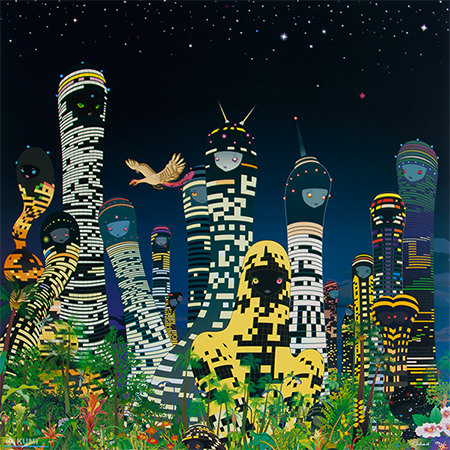
Chiho Aoshima – “Chiho in the City Glow”

Debates centering around the necessity of attending art school in the digital age have recently surged across all online spheres, but art school purists may’ve met their match in the provocative and inspired works of Economics major turned pop artist Chiho Aoshima. Aoshima taught herself how to illustrate digitally, and after having work featured in Takashi Murakami’s Tokyo Girls Bravo,was invited to work in his factory as part of the Kaikai Kiki Collective. Murakami, founder of the Japanese post-modern Superflat art movement, would act as a surrogate professor in her artistic endeavors.[1] Aoshima’s career is proof that ambition and a compelling artistic vision are all one needs to achieve success in the arts.

After finding her place among the well-known KaiKai Kiki Collective, Aoshima would go on to have works included in the Ackland Art Museum in Chapel Hill, the Museum of Contemporary Art in Chicago, the Carnegie Museum of Art in Pittsburgh, and the Seattle Art Museum.[2] This acclaimed work would inspire a collaboration with famed Japanese designer Issey Miyake on his 2003 Spring/Summer collection.[3] Other high-profile projects include a series of works which was featured in numerous ad-spaces throughout the Union Square subway station in New York, and a 2005 solo show in which she presented a 5-screen 7-minute animation piece along with her first sculptural piece.[4] While the transition from confused university student to successful artist may appear seamless on Aoshima’s resume, her unconventional path was, in reality, difficult to navigate.

Aoshima struggled considerably in her time as an Economics student, having been quoted as saying “When I was going to university, (Department of Economics) I was bored to death, even when I was hanging out with my friends. I was eager to create something but didn’t know what to create, every day time passed so slowly and I felt like I was going to die.Since I have had that experience, even in situations where I’m extremely busy and don’t have the time to sleep, I can still think to myself ‘it is better this way than to have nothing to do.”[5] Although she majored in economics, she wasn’t sure what she wanted to do and didn’t feel overly attached to her studies. Instead, she took on a number of part-time jobs to keep her mind busy. One, a job in the graphic design department of a company, required a basic knowledge of Adobe Illustrator which she would learn through her colleagues. From there, she taught herself how to create art with the program and fell in love with the medium.

Much of her thought process can be discerned through her charming use of words. When asked to describe her inspiration, she states, “My work feels like strands of my thoughts that have flown around the universe before coming back to materialize.”[6] It’s evident that she gives ample thought to every piece she creates, easily breathing life into them through her fanciful imagination and conviction of character. In an interview for TimeOut Tokyo, Aoshima further displays her thoughtful nature when asked what initially intrigued her about the relationship between mankind and nature, a common thread throughout her work. Aoshima responded that, “In a big city like Tokyo, it is difficult to get in touch with nature. But in cemeteries, you can see insects, cats and other animals running around amid wild trees and bushes. I like to think of them as oases in the middle of the concrete jungle.”[7] Clearly, Aoshima is far too introspective a person for these thoughts to be contained, and they have been beautifully realized through her art.

Aoshima’s work is sophisticated and intentional, never shying away from obscure or disturbing imagery, yet maintaining pleasantly balanced composition and use of color. Her work is true to the Superflat genre, which is often associated with criticism of post-war Japanese culture, including consumerism and the sexual fetishization of young girls.[8] In pieces like City Glow, Aoshima shows off an astute ability to marry the synthetic and natural world. Flora and fauna are set against a night skyline, the buildings warped to resemble young girls with eerily glowing eyes. She questions the ability of mankind, nature, and the spiritual world to coexist and imagines what our reality might resemble in a utopian future where these elements have collided.[9] In a number of other pieces, she takes to creating surreal and intriguing worlds inhabited by young girls. These young girls, while illustrated in a traditionally cute anime style, are in many cases unclothed and in compromising positions. All the while appearing unbothered and docile, the grotesque way these girls are sometimes presented calls into question their over-sexualization within popular culture and media and its disturbing implications. Aoshima’s work resembles traditional Japanese ukiyo-e art in its use of flat colors and bold, thick lines. Together with her use of bright colors and cartoonishly cute depictions of people and objects, Aoshima’s style itself contrasts with her often nightmarish subject matter.


Images Referenced

City Glow


Sources

  1. https://web.archive.org/web/20141114070909/https://www.blumandpoe.com/sites/default/files/press/Juxtapoz0106.pdf
  2. http://www.artnet.com/artists/chiho-aoshima/
  3. http://english.kaikaikiki.co.jp/artists/list/C6/
  4. http://english.kaikaikiki.co.jp/artists/list/C6/
  5. https://web.archive.org/web/20150504060230/http://magazine.saatchiart.com/culture/reports-from/los-angeles-reports-from/interview_chiho_aoshima
  6. http://english.kaikaikiki.co.jp/artists/list/C6/
  7. https://www.timeout.com/tokyo/art/interview-chiho-aoshima
  8. http://www.artnet.com/Magazine/features/drohojowska-philp/drohojowska-philp1-18-01.asp
  9. http://www.seattleartmuseum.org/chiho

Exploring Automatism

Surrealism is an art movement that took Europe by storm in the 1920s. The intriguing yet controversial subject matter would influence art styles to come. One art movement that greatly influenced by Surrealism was Abstract Expressionism, a movement that was founded twenty years after Surrealism. Abstract Expressionism was an American art movement that focused on applying automatic drawing and painting as a form of expression. Although both art movements have vastly different appearances, the fundamental core of both are identical. Continue reading →

Purification

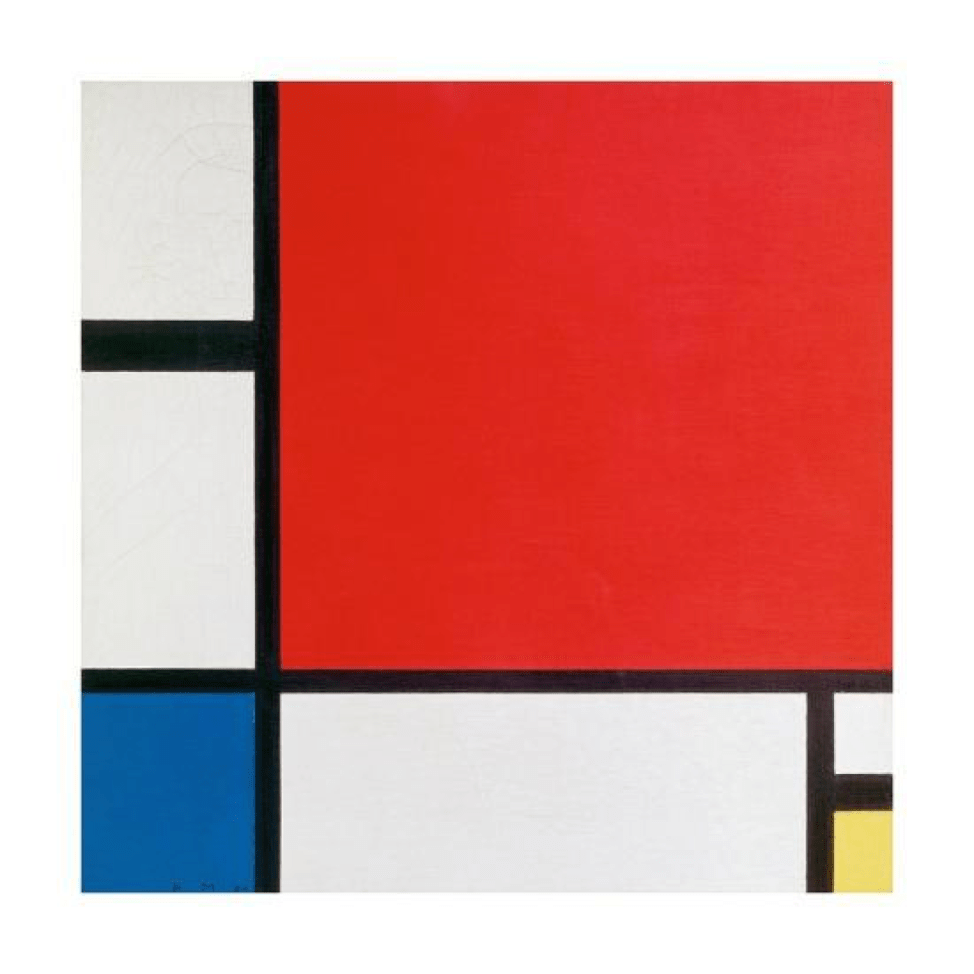
De Stijl remerges almost half a century later in the Minimalist art movement, stripped from its fundamental depths and classic red, blue and yellow palate. Instead, Minimalism takes on the classic shapes and lines to redefine the purest abstraction. The attempt to remove all recognizable aspects in our life is displayed through Minimalism’s clarity, much like De Stijl’s harmony: “I wish to approach truth as closely as is possible, and therefore I abstract everything until I arrive at the fundamental quality of objects,” Piet Mondrian once said. Continue reading →

James Turrell at the MASS MoCA – Existential Crisis with a Queue

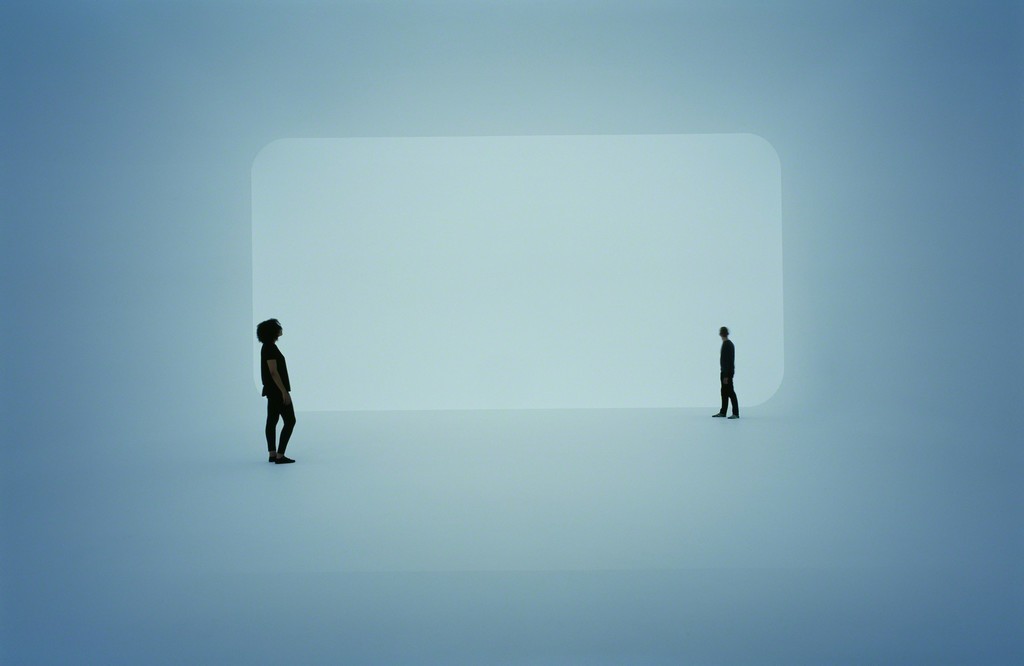
James Turrell’s Into the Light exhibition at MASS MoCA is a must-see exhibition. The artwork on display is jaw-dropping both visually and intellectually. James Turrell doesn’t just deconstruct light, but the very nature of seeing. While slightly hindered by the labyrinth-like venue, the mind-numbing wait to see certain works, and the lack of educational value, Into the Light is an extraordinary exhibition that must not be missed. Continue reading →

Dada vs. Neo-Dada – Contextualizing Contemporary Art

The Dada art movement or “Dadaism” began around 1914 in Europe. The movement was itself created in reaction to World War 1, as artists began to question the society that had allowed the atrocities of the war to occur (Dada 2019, par. 1). They placed most of the blame upon conformity and traditional values in both art and society, and therefore sought to completely reject traditional approaches to art. In this way Dada could be considered an art movement which embraced “anti-art” (Dada 2019, par. 3), and was framed as a critique on society. It accomplished this through emphasis upon the message conveyed by the art rather than just it’s appearance or façade. A major art concept popularized by Dada artists in the early 20th-century was the readymade: an “ordinary article of life” stripped of its traditional uses and significance and presented so as to create a “new thought for that object” (Ray and Duchamp 1917). The most famed example of the readymade is Marcel Duchamp’s Fountain. Duchamp submitted a signed urinal to an art exhibit in New York City and was promptly denied inclusion in the exhibition. Fountain became a huge symbol for the Dada art movement as a whole. By effectively removing the urinal’s usefulness, the purpose of the object became entirely aesthetic and Marcel believed it should therefore be considered art. This brought up a common thread throughout the Dada art movement: that the artist themselves defined what should be considered art. The act of choosing and labeling a “readymade” object for presentation as art was just as much an act of creation as a painting or handmade object would be. Fountain epitomized Dada’s rejection of conventional art practice, and many found it to be debase and meaningless as a result. Nonetheless, it has had an immense impact on art throughout the 1900’s and into the modern day.

Decades later, the 1950’s saw a resurgence of the Dadaism style in what was coined “Neo-Dada”. It began and ended in America alongside the Pop Art movement, meaning Neo-Dada drew from both Dada and Pop Art. Pop Art, in many ways exemplifying commercialism and conformity, was a stark contrast to the core principles of Dada, which offered criticism of these same principles. Some former Dada artists didn’t see Neo-Dada as an homage to Dada, but rather a derivative – a less impactful copy. While Dadaism was a rejection of traditional artistic form and practice, Neo-Dadaism was a rejection of art altogether. It leaned on absurdity and often seemed to have no meaning or message at all. Although some pieces might’ve appeared absurd or random upon first glance, at the heart of Dada artwork was a message which rejected societal norms and the boundaries set for what could be considered art. To some, Neo-Dadaism was absurd art for the purpose of absurdity, stripped of the underlying message behind its predecessor.

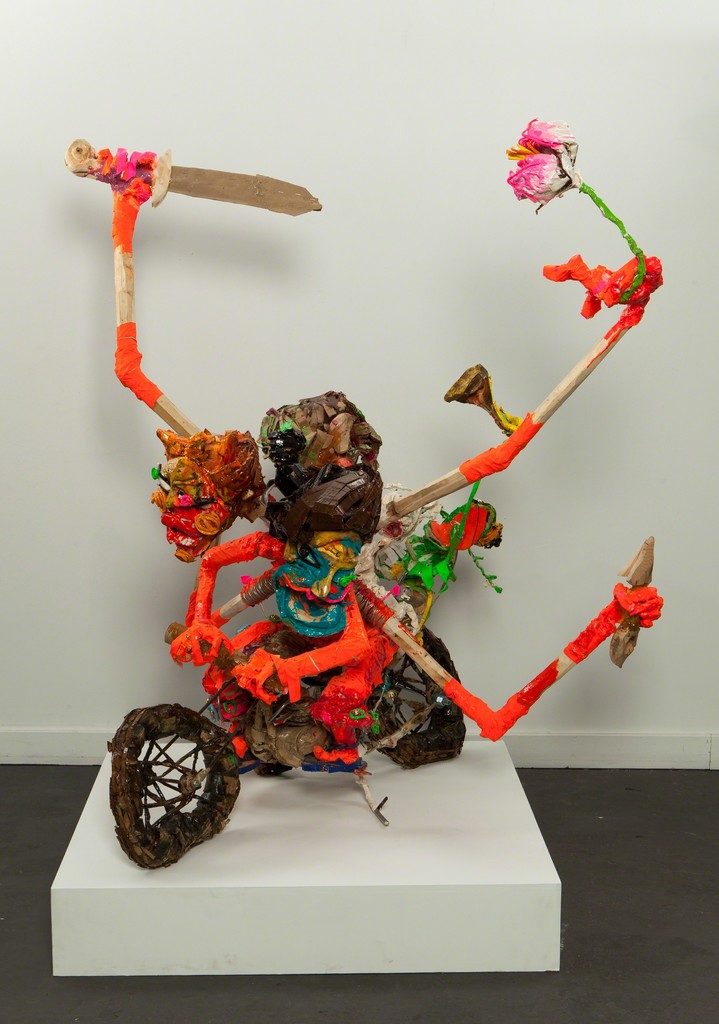
Neo-Dadaists, on the other hand, believed their art to have meaning through the viewer’s interpretation (Neo Dada 2019, par. 5). They accepted that art could have multiple meanings or no meaning at all, and placed more emphasis upon anti-art and anti-aesthetic than Dada had. Their work juxtaposed absurd imagery with modern materials and Pop Art to effectively question their relationship or lack thereof (Chilvers and Glaves-Smith 2009). Neo-Dadaism expanded upon the somewhat paradoxical nature of Dada. One such example is Ushio Shinohara’s “Ashura” (“Ushio Shinohara” 2019), a sculpture made from found objects. The found objects are assembled so as to depict a cartoonish man with several extra appendages: one holding a sword, another a flower, two more gripping the handlebars of the rusted-looking motorbike he sits atop. Segments of the piece are garishly painted in the same bright colors one might see in an Andy Warhol piece, while others retain their naturally dingy appearance. These found objects (often literally discarded trash) earned much of Shinohara’s work the label “junk art” (Lansroth 2015, par. 6), much like Duchamp’s repurposed urinal may’ve been regarded by some in its day. It is the inherent contrast between these aesthetically derelict found objects and the neon colors that accompany them which add another layer to fundamental Dadaism and create something entirely new.


Images Referenced

Fountain
Ashura


Sources

Chilvers, Ian and John Glaves-Smith. A Dictionary of Modern and Contemporary Art. Oxford University Press (2009), p. 503.

“Dada Movement Overview.” The Art Story. Accessed February 12, 2019. https://www.theartstory.org/movement/dada/.

Lansroth, Bob. “10 Neo Dada Art Pieces That Influenced and Shaped This Groundbreaking Art Movement.” Widewalls, October 3, 2015. https://www.widewalls.ch/neo-dada-artworks/.

“Neo-Dada Movement Overview.” The Art Story. Accessed February 12, 2019. https://www.theartstory.org/movement-neo-dada.htm.

Ray, Man and Marcel Duchamp. “The Richard Mutt Case.” Edited by Marcel Duchamp. The Blind Man, May 1917.

“Ushio Shinohara | Ashura (2014) | Available for Sale | Artsy.” 11 Artworks, Bio & Shows on Artsy. Artsy. Accessed February 12, 2019. https://www.artsy.net/artwork/ushio-shinohara-ashura.
Peter Pellettiere – “An Exploration into Vegetation”

When an organism looks “alien” to us, what qualities does it have? You might imagine the lush, extra-terrestrial rainforest of James Cameron’s Avatar, or even the monstrous human-eating plant from Little Shop of Horrors.It may come as a surprise, then, to learn that often those tasked with imagining convincing alien plant specimens look first to earth-dwelling species. At the Slater Memorial Museum in Norwich, Connecticut, sculptor Peter Pellettiere is memorialized through a collection of his works which explore this same relationship between the Earthly and the otherworldly.

The Slater Memorial Museum is best known for its vast collection of antique plaster casts of ancient statues. When one exits the area where they are exhibited and enters the mezzanine where Pellettiere’s creations dwell, they might feel they’ve entered another world. As the room contrasts with the rest of the museum, exemplified by the emptiness of this particular exhibit and the echoing of ones feet, there is a substantial change in subject matter. The series of “floraform plaster sculptures”[1], all-white and situated on the cold stone floor of a small, glass-walled room, at first appear unfamiliar. The oversized plant specimens, each displayed upon an unadorned, off-white pedestal, give the room and its contents a sort of celestial sterility. The pieces are detailed with such care and specificity that they feel almost like objects of worship, and despite their apparent artificiality, that they might begin to breath at any moment.

Was it Pellettiere’s intention to create this atmosphere of uncanniness? The museum’s placard states that the series is “based upon his percept that all sculpture should bring together form and human concern; that it should thoughtfully convey the human condition.”[2] Indeed, while they first evoke images of the botanical, several of the pieces easily relate to the inner workings of the human body. One, clearly labeled as ‘Impatiens Bud’, appeared first to me as a simplification of the human brain and spinal cord. Another, labeled ‘Narcissus Bud (Double)’ is a bulb with offshoots that call to mind the valves of the human heart. Perhaps it is this mix of similarity and dissimilarity that evokes the label “alien” in many cases. I’m reminded of “the uncanny valley”, a term used to describe the strange revulsion many get when things appear human, but aren’t quite right.[3] Though most often used in relation to Artificial Intelligence, I feel it can most certainly relate to Pellettiere’s study into plant and human anatomy.

Pellettiere’s sculptures are in fact scientifically accurate. He took concise measurements of each natural form before scaling them up in size. They were then directly modeled in water-based clay over wire armatures.[4] I find that while these forms are in many ways familiar, buds and bulbs of common plants such as poppies and dogwood, they are presented so as to give an unfamiliar perspective. At a much larger size, we are able to see small details of each organism which are imperceptible in their natural state of being. Pellettiere also appears methodical in the way he chooses to crop the individual pieces. Only in the few examples of bulbs are we able to see an organism in its entirety. The buds, cropped just where they begin on the stem or slightly before it, resemble anatomical illustrations or models of human bodily structures. These techniques help to blur the line between humanoid and plant structure, allowing us to ponder what makes the two so different in our perception.

I’m unsure if Peter Pellettiere’s exhibit answers every question it conjures, but that may very well be by design. The botanical specimens so faithfully suggest human form that they feel neither plant nor human, at least to me. I feel that anybody remotely intrigued and not wholly disturbed by questions of the existential nature would find this collection a valuable and thought-provoking look at the often over-looked nature of life on and potentially beyond Earth.


Sources

  1. Zoe, Vivian, and Leigh Thomas. “New Micro-Exhibition in the “Bubble”.” The Muse, Summer 2013, 2.
  2. Ibid.
  3. “Uncanny Valley.” Wikipedia. February 20, 2019. Accessed March 04, 2019.
  4. Ibid.