Adrian Margaret Smith Piper was born on September 20th, 1948 in New York, New York to mixed race parents, and she identifies as a Black woman. She is a conceptual artist who does performance pieces, with most of her art being confrontational critiques on society. She was inspired by the injustices she experienced and witnessed to use herself as a form of expression. In 1971 she wrote, “I can no longer see discrete forms or objects in art as viable reflections or expressions of what seems to me to be going on in this society. They refer back to conditions of separateness, order, exclusivity, and the stability of easily accepted functional identities that no longer exist.” In two of her pieces, Self Portrait Exaggerating my Negroid Features (1981) and Self Portrait of a Nice White Lady (1995), Piper aims to deconstruct viewers’ perceptions of race and identity.
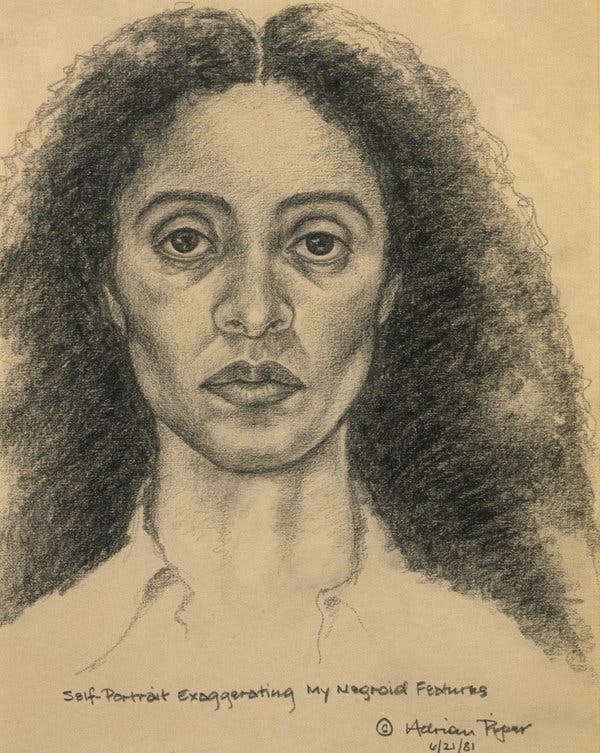
Pencil on paper; 10″ x 8″. Collection of Eileen Harris Norton, Los Angeles, CA. Image by Arthur.
Her piece, Self Portrait Exaggerating my Negroid Features (1981) features a self-portrait of Piper with pronounced facial features like a wide nose, afro-textured hair, and full lips, which are features that she does not naturally have. For her whole life, Piper was mistaken for being many different races and ethnicities other than Black because of her light skin and smaller facial features. Although this may not be her intention with the portrait, another way to examine this piece is perhaps Piper is taking a stand against the types of faces that are usually depicted in Western art art. Western beauty standards are very Eurocentric; European features like pale skin, long hair, and a small nose are praised. These beauty standards translate into art, and Western artists throughout history have depicted beautiful women as those with these specific features. These characteristics are often associated with femininity, elegance, and softness. The most common Black/non-White features like wide noses, darker skin, and curly/textured hair are not given this same exposure and are even demonized in the Western world. Piper could be giving power back to non-White features by depicting herself this way.
In Self Portrait of a Nice White Lady, Piper challenges the concept of race. In this picture, there is a photograph of Piper with a straight face and a speech bubble that says “Whut choo Lookin At MOFO” in front of a burgundy background. Due to racial biases, the concept of a White woman, specifically a “nice White lady” is automatically associated with positive attributes like friendliness, femininity, intelligence, and so on. The Studio Museum writes, “The image refutes its title by presenting Piper as herself, a Black woman, who cannot be reduced to being simply “nice.” The work’s text—“Whut choo lookin at, mofo?”—is a call to pay attention and confront how stereotypes inform the way we read people.”
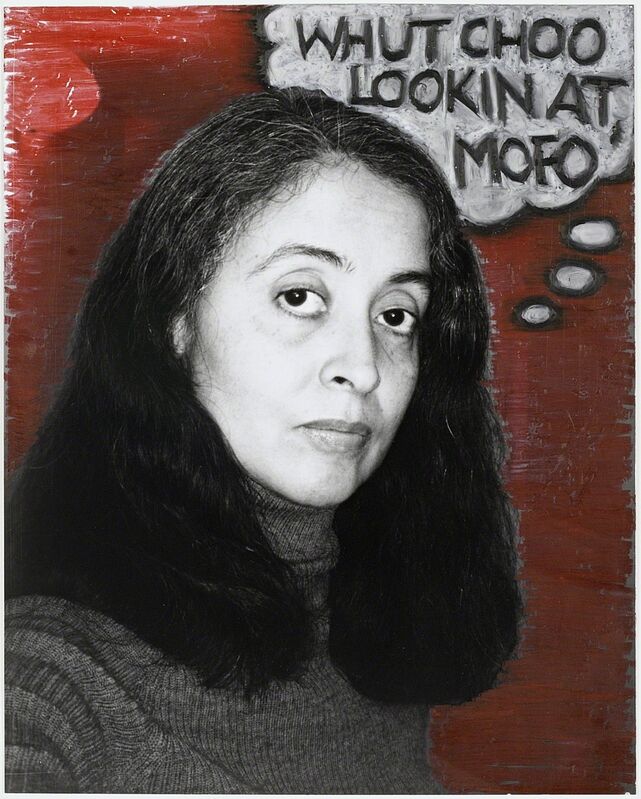
The fact that the nice White lady is talking in African American Vernacular English (AAVE) could be jarring, considering that AAVE is often seen as an “unintelligent” and “aggressive” dialect, traits that are not associated with White women. In this work, Piper is directly challenging the viewer’s perception of what it means to be a White woman by having her say the exact opposite of what many people may believe a nice White lady would say.
Although Piper’s work is successful in challenging Western art, it is important to note that her being a light-skin, White passing Black woman makes it easier for her art to be valued. She has been allowed in spaces that her dark skin counterparts have not been. Race is phenotypic as much as it is genotypic. Just because someone is racially Black does not mean that they will experience all of the plights of being a Black person if society does not perceive them that way. In Self Portrait Exaggerating my Negroid Features, Piper even had to extremely emphasize her facial features to show that she is Black. In her 1986 piece, Calling Card (I am black), Piper had to point out that she was Black when people would say racist things around her because they assumed she was another race. On the other hand, Piper never denies her Blackness, and if anything, uses her privilege as a White passing Black person to call attention to important topics.
Sources
Arthur. “Adrian Piper – Self Portrait Exaggerating My Negroid Features, 1981.” Arthur. Accessed November 11, 2021. https://arthur.io/art/adrian-piper/self-portrait-exaggerating-my-negroid-features.
Encyclopedia Britannica. “Adrian Piper.” Encyclopædia Britannica. Encyclopædia Britannica, inc. Accessed November 2021. https://www.britannica.com/biography/Adrian-Piper.
National Gallery of Art. “Calling Card (INational Gallery of Art Am Black).” nga.gov. Accessed November 2021. https://www.nga.gov/collection/art-object-page.203123.html.
Steinhauer, Jillian. “Adrian Piper’s Uncomfortable Art,”The New Republic, May 30, 2018. https://newrepublic.com/article/148298/outside-comfort-zone-adrian-piper
Studio Museum. “Self-Portrait as a Nice White Lady.” The Studio Museum in Harlem, December 3, 2020. https://studiomuseum.org/node/60854.
 Issues in Contemporary Art