Frida Kahlo, birth name Magdalena Carmen Frida Kahlo y Calderón was born in Coyoacán, Mexico City, Mexico on July 6, 1907, to her parents Wilhelm Kahlo and Matilde Calderon y Gonzalez. She married famed Mexican painter Diego Rivera two times, once from 1929-1940, then married again later that same year until Kahlo’s death. Most of her paintings consist of self-portraits, and her art is considered surrealism, specifically magical realism.
Throughout her life, Kahlo has suffered a multitude of illnesses and accidents. In her youth she caught polio, and it is debated whether she had a birth defect that affected her spine and legs. Her chronic pain led to her being bedridden for a great deal of her life, leading her to use her free time to paint her portraits. In 1953, her leg was amputated. One of the most influential events that impacted her art was a bus crash. Kahlo was involved in a bus accident on September 17, 1925. At the age of 18, she and her boyfriend at the time, Alejandro Gómez Arias were on a public bus on their way home when it suddenly crashed into an electric car. Her pelvic bone had been fractured and her uterus and abdomen were punctured. Additionally, her spine had been broken in three places, her right leg in 11 places, her shoulder was dislocated, her collar bone was broken, and doctors later discovered that three additional vertebrae had been broken as well. Her health caused her much distress, and in 1953 she stated, “I am not sick. I am broken. But I am happy to be alive as long as I can paint.” While recovering, she used her time painting and turned her pain into art, also painting on her body cast. Describing her journey finding comfort in art, Wes Kelley writes, “This body altering event led to a life of surgeries, recoveries, and pain. She became an alcoholic, an adulterer (like her husband), and a masterful painter. Her horrible physical condition became the inspiration for her morbid and macabre paintings. Kahlo’s pain created works focusing on the death, decay, and brokenness of the human body.”
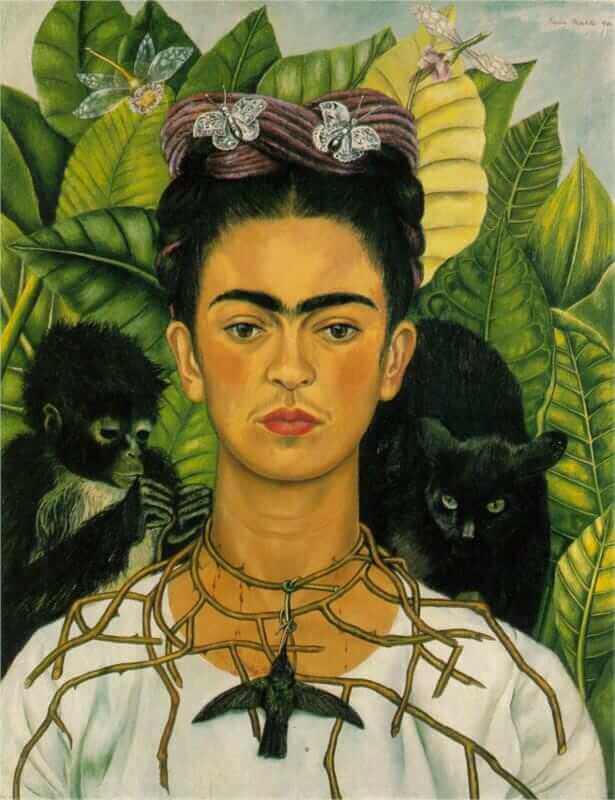
Most of Kahlo’s works are portraits of her surrounded by a beautiful, tropical landscape. Perhaps her being confined to a bed while sick inspired her to feel close to nature. For example, one of her most famous portraits, Self Portrait with Thorn Necklace and Hummingbird (1940), depicts Kahlo wearing a thorn necklace with a hummingbird attached to it. The necklace is so tight and sharp around her neck that it is drawing blood. On her left shoulder there is a black monkey, and there is a black cat, perhaps a panther, on her right. The background features many green leaves, suggesting that she is in a rainforest. Her stoic look in the painting may symbolize all the pain that she has endured, and how she has kept a brave face through it all.
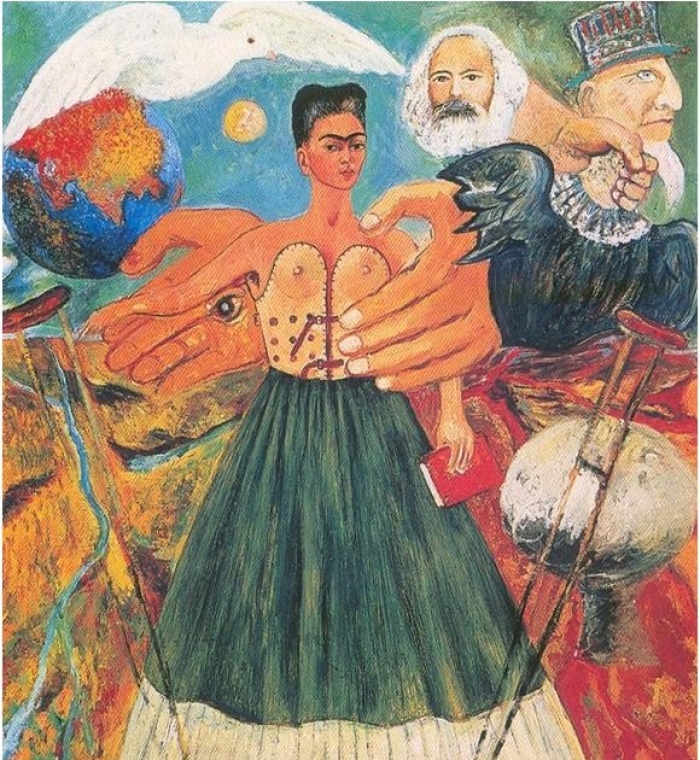
Besides her poor health, Kahlo’s politics also influenced her art. Kahlo was a Marxist, joining the Young Communist League and the Mexican Communist Party while at school. She was born just three years before the Mexican Revolution. In her later years as a painter, she would want to show her political side more. For example, she has a piece called Marxism Will Give Health to the Sick (1954). In the self-portrait, Kahlo is standing in the middle of the canvas with her left arm stretched out to her side, and her right arm at her side with her holding a red book, which is She is wearing a long green skirt and a corset or upper body cast with straps. There are crutches at her side, indicating that she is unwell. In the right-hand corner of the painting, there is the head of Karl Marx attached to a hand, which is gripping onto a bald eagle with the head of Uncle Sam. There are two hands outstretched toward her. These may represent the hands of Marxism coming to save Kahlo from the oppression of imperialism and capitalism.
Women are taught early on that body hair is “un-ladylike,” and because of this, many of them shave. Kahlo, however, heavily rejected society’s ideas of traditional femininity and what a woman “should” be. In her diary she once wrote, “I used to think I was the strangest person in the world but then I thought there are so many people in the world, there must be someone just like me who feels bizarre and flawed in the same ways I do. I would imagine her, and imagine that she must be out there thinking of me, too.” She was never afraid to stand out and break conventions, which is what makes her an important feminist figure today. She proudly sported a unibrow and mustache. She also did not shave her legs or underarms either. In all of her portraits, she makes her unibrow and mustache prominent.
Kahlo died a week after her 47th birthday on July 13, 1954 in her home village from a pulmonary embolism. Like most artists, Frida Kahlo did not get the full recognition for her art that she deserved until she died. Today, she remains an influential artist who used her misfortunes to guide her art.
Sources
Almeida, Laura. “Quotes from Frida Kahlo.” Denver Art Museum. Last modified December 28, 2020. https://www.denverartmuseum.org/en/blog/quotes-frida-kahlo
Kahlo, Frida. “Marxism Will Give Health to the Sick – by Frida Kahlo.” Accessed December 13, 2021. https://www.fridakahlo.org/marxism-will-give-health-to-the-sick.jsp.
Kahlo, Frida. “Self-Portrait with Thorn Necklace and Hummingbird, 1940.” Accessed December 13, 2021.
https://www.fridakahlo.org/self-portrait-with-thorn-necklace-and-hummingbird.jsp.
Kelley, Wes. “The Painful Life of Frida Kahlo: How Injury Led to Inspiration.” Medium. Medium, May 18, 2020. https://medium.com/@wnkelley13/the-painful-life-of-frida-kahlo-how-injury-led-to-inspiration-839210d3b58.
LibQuotes. “Frida Kahlo Quote.” Lib Quotes. Accessed December 13, 2021.
https://libquotes.com/frida-kahlo/quote/lbd2f7e
Maranzani, Barbara. “How a Horrific Bus Accident Changed Frida Kahlo’s Life.” Biography.com. A&E Networks Television, June 17, 2020. https://www.biography.com/news/frida-kahlo-bus-accident. The Art Story. “Frida Kahlo Biography, Life & Quotes.” The Art Story. Accessed on December 13, 2021 https://www.theartstory.org/artist/kahlo-frida/life-and-legacy/.
The Art Story. “Frida Kahlo Biography, Life & Quotes.” The Art Story. Accessed on December 13, 2021 https://www.theartstory.org/artist/kahlo-frida/life-and-legacy/.

 Issues in Contemporary Art