The idea of self-expression can be defined the expression of one’s feelings, thoughts, or ideas. Often these thoughts are expressed through one’s creative side such as dance, writing, and even in their art. Art is frequently thought of to express yourself in a way that speaks to you. Photography is an opportunity to communicate without words with infinite possibilities for expression. This can allow an artist to tell you anything and everything without having to tell you the story behind it instead the viewer can look within and try to find a better understanding of what the artist is trying to tell us without having to say anything.
Portraits have been around for over 5,000 years in a time before photography, these portraits were painted, sculpted, or drawn portrait and the only way to record the appearance and capture the likeness of someone. But even then, portraits have always been more than just a record. They have been used to show the power, importance, virtue, beauty, wealth, taste, learning or other qualities of the sitter.[1] In modern photography, self-portraits are sometimes used for self-expression. In today’s time most self-portraits are portrayed as photographs less then painting as most of us in modern time carry around a camera everywhere and can capture anything with a second’s notice. People today with their embedded cameras, have made self-portraits one of the most popular photographic genre. But the idea of self-portraits still shares the same goal no matter the medium that is used to create them. These self-portraits are meant to show the viewers, the under the skin look on who they are by expression themselves in a way in which the viewers gain insight on who the artist is. Self-portraits can come in all shapes and size that use self-expression to tell us a story that betters our understand on the story the artist is trying to portray.
In my exhibition Who am I: The Art of Self-Expression? I wanted to focus solely on self-portrait produced by women in the medium of photography. The idea that we can capture something of so much meaning in a second is something that modern technology has really expanded on for us. Over this semester, readings focused on many different topics but one of the most eye opening one was the lecture on feminist art. I wanted to incorporate the art that are produced by women and let them tell their stories using self-expression for my exhibition Christina Otero takes her creative self portraits to a fun, vibrant level. She uses her artistic abilities to push her photographs to the edge between paintings. Otero said that make up in Americas Next Top Model inspired her to start photography, dreaming that one day she would be able to have elaborate photo shoots like the ones featured in the show.[2] She used her photography and elaborate make up to elevate the simplistic nature of a face to a new category. A self-portrait is a portrait is one of the most relevant self-analysis exercises that an artist can do to help.
The expression captured in these photos can help convey the idea intended by the artist. Self-expression can mean many different things to every person you ask. In Otero’s case, she uses her life to create her work while drawing from everything including readings from her favorite authors, quotes that spoke to her, and even metaphors. Christina started her career as an illustrator, she was most drawn to different facial expressions and even female anatomy. She would use her own face and body as subjects for her drawings while incorporating hyperrealism to give the drawing a photographic feeling. With this technique, she shifted her career to become a photographer he specializes in artistic self portraits. In this process of exploration, Christina found that throughout her search that she was her best muse. [3] Otero created a series called Tutti Frutti, she chooses to focus on the bold vibrant colors of fresh fruit and incorporates fruit not only a prop but also as the inspiration for the make up design that she illustrates on her face for each photo. All photos in the series feature focus on the neck up, centering on her face, she incorporates different facial expressions as well as different posing and head positions to create a whimsical and striking collection of self portraits.
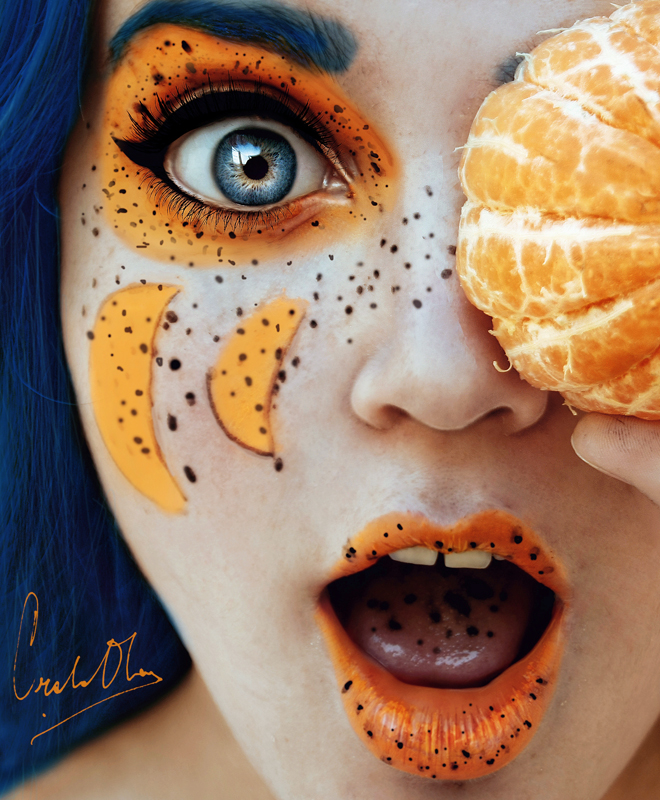
One of her most popular pieces Mandaria comes from her Tutti Frutti series. [4] This self-portrait features the fruit, tangerine. The tangerine is used as a peeled prop cover up Otero’s right eye and is also featured by using orange make up on her eye and lips with a slice on her face. Her facial expression is relaxed with an open mouth. With the orange make up accenting all facial features she also used black dots as well over these spots, resembling freckles, she also paints these on her tongue so that these dots can be seen with the expression she displays. The vibrant orange of a tangerine contrasts the best against blue when we think about color theory, Otero uses blue eyes, and royal blue hair and eyebrows to really accent against the orange. The idea that she takes such a creative approach on self-expression in her photos was something that really stuck out to me. The idea of using everyday items such a food to create something new is fascinating to me.
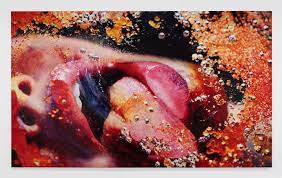
The idea of this relates to one of my favorite contemporary photographer Marilyn Minter. Marilyn Minter is an American Contemporary visual artist, she is best known for her sensual take on paintings, photographs, and videos where she explores the emotions around beauty and the feminine body in American culture. Minter wanted her work to make the viewer question the overly commercialization of sex and the body.[5] While Minter doesn’t focus on self-portraits, she uses expression with her models to tell us a story that feminists have been challenging for years. Marilyn Minter: Pretty/Dirty is the first retrospective of her work that focuses the aesthetics of high-fashion editorials, often depicting female bodies adorned with jewels, dirt, saliva, and higher end accessories, mixing in the idea of sexuality and food. [6]
One of Minters most talked about photographs is Orange Crush. This piece is nine feet tall, fifteen feet wide and painted in glossy enamels on an extremely large billboard-size metal panel. This large then life display takes up the entire display area and draws the viewers in. Displayed is a faceless woman with her lips open and tongue licking the glass, the mouth is trying to lick up all the brightly colored orange cake that has been smeared across the glass. Minter really shows us her unique method of photography with this piece, I think her entire collection really embodies the idea of over sexualization that many contemporary feminist artists have been influenced by. The self-expression that she puts into her work when it comes to props and posing to speak up against the problems females face is something that I believe would help solidify the exhibition pieces even if its not a self-portrait.
Feminist art is an art movement that really sparked conversation for the equality of women. Artists used the ideas that women shouldn’t be objectified and point out the flaws in our system with their work. Art historian Linda Nochlin was known for her views on feminism and how women should be seen in the same way as men in the art world. “Feminist art history is there to make trouble, to call into question, to ruffle feathers in the patriarchal dovecotes. It should not be mistaken for just another variant of or supplement to mainstream art history. At its strongest, feminist art history is a transgressive and anti-establishment practice, meant to call many of the major precepts of the discipline into question.” [7]
Nochlin’s words paved the way for Feminist photographer Cindy Sherman. For forty years, Cindy Sherman, known as the great chameleon of our time, has created more than 500 photographs. All these photos are photos she takes of herself, but Sherman doesn’t refer to them as self-portraits. She turns herself into a character to express her idea in each photo she takes, she is said to have created almost 500 different characters for herself in the forty years of photography. She has transformed herself into high-society women, bikers and horror babes, lonely-hearts and killer clowns. Each character she creates is a new persona she reflects into her work; she has even portrayed characters in reference to icons like Madonna. [8] Marilyn Minter gives credit to Sherman for being her inspiration into photography, she is quoted saying “you cannot take a photograph without the entire history of Cindy Sherman’s oeuvre behind it.”
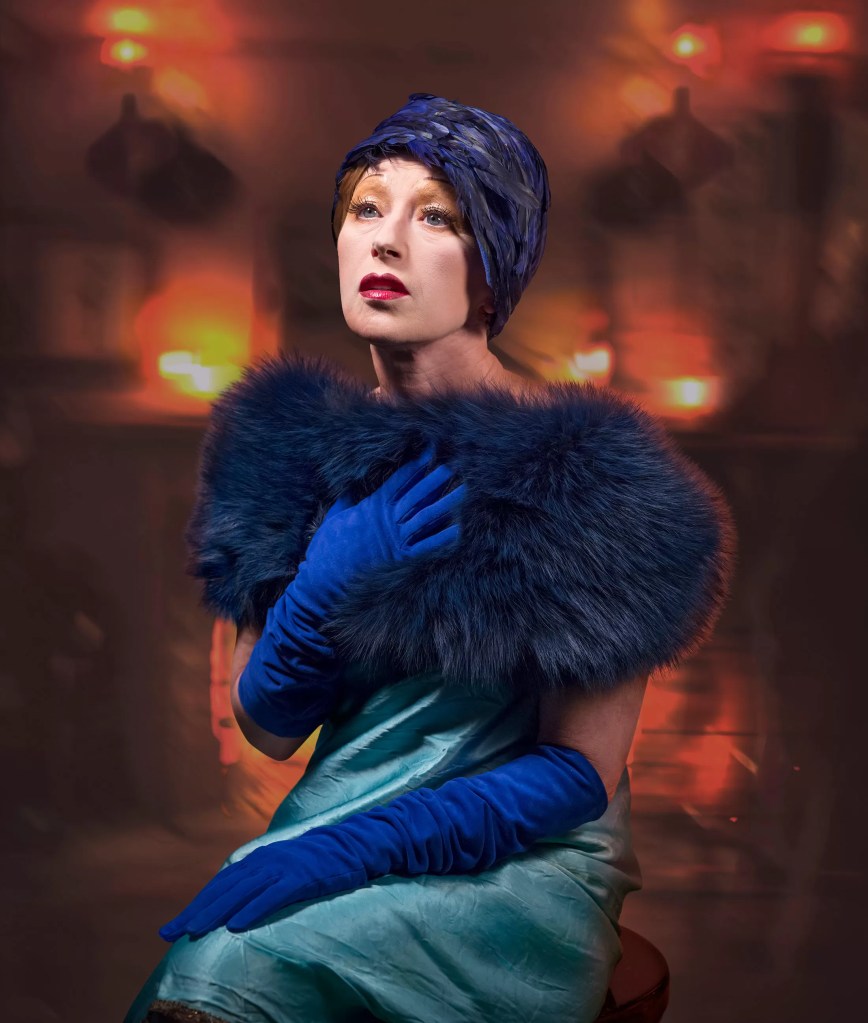
Cindy Sherman is a huge part of the foundation that started feminist art, without her work the idea of the male gaze wouldn’t be what it is today and something that most artist focus on when exploring feminist art. Sherman herself said that she doesn’t like to disclose the exact meaning behind her photographs as she prefers the frenzy of different interpretation people give.[9] Having one of Shermans photographs as a apart of this exhibition would help include the idea of where feminist art started. She was someone most of these newer artists followed for inspiration, someone who helped them understand that you can tell whatever you want in your photographs as she told every story she could think of from clowns to classy women. Untitled #574 would be the photograph I would include in my exhibition. Sherman depicts herself a high society woman in this photo, there is a red background with her in the foreground seated in a formal manner in a chair. She is clothed in all blue and turquoise clothing creating a vibrant contrast of colors. She wears a darker blue hat that is fitted to her head with a tiny bit of short orange hair exposed against her face. Her face is angled upward toward the light source but is very plain with make up that furthers the idea of a well-respected women. Her chest is covered in a blue fur shawl that covers her top torso, she places one hand over her chest, and her hands are adorned with royal blue gloves. These blue colors contrast beautifully against her silk turquoise dress. All these different textures and colors make for an interesting composition. Sherman has never expressed the meaning she felt for creating this image but by many sources, the consensus is she is playing the role or a put together high-society women and is posing for a portrait.[10]
Another turn of the century photographer is Francesca Woodman, best known for her haunting black and white photos. Her work was ignored by most of the art world during her life and she was referred to as tragic. Through her time, she fought with her depression, and unfortunately, she took her own life at the young age of twenty-two. Despite the rough start she had to the art world, after her death her photos became a present part of the world she longed for. Woodman’s work used conceptual and surrealism concepts to create her self-portraits. [11]
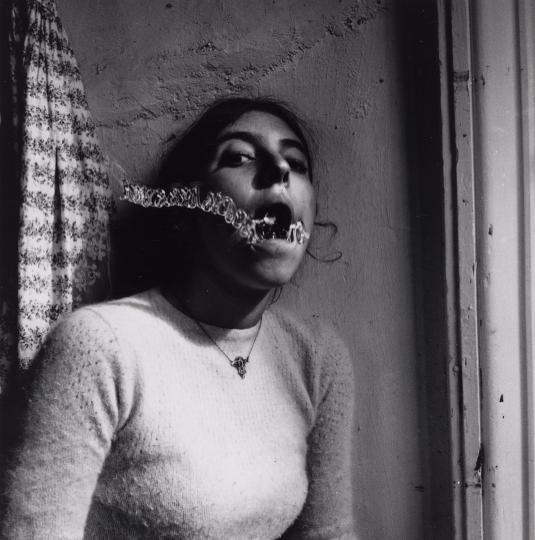
A Woodman self-portrait lets us have a large insight into the mind of someone who was struggling with life. I believe she used this tortured feeling that she had to express a tortured feeling in her work. The photo that I want to have as part of my exhibition is Self-portrait talking to Vince. the overall feeling of the photo is distressed, very dark, it really tells us the story of Francesca life. Considering she isn’t here to explain her work the world looked to her family and friends for explanations. They have said that they feel like her art was telling us how much she was struggling.[12] Depicted in this specific black and white portrait is Woodman sitting with her head tiled up and mouth forced open, in her mouth there is a clear material which seems to be gagging her mouth. The overall photo is dark with little to focus on besides her mouth. It is an extremely tortured look she is giving the viewer; it shows us how she felt during that time, and how she wanted to express the struggle she was dealing with during 1977. Woodman isn’t the only artist that uses her feelings to portray an image in her work.
Much like Francesca Woodsman, photographer Jennifer Kiaba uses her life to tell us the story of her life through self-expression in her self-portraits. Kaiba’s story started at a young age, this is her explanation of herself expression.
“Self-portraiture, for me, is a tool for self-exploration. I use it to peer into my psyche, and to begin to unravel the inner workings there,” she says. “I was born into one of the most notorious cults of the ‘70s and ‘80s in the United States – the Unification Church. That experience warped my perspective on what it meant to be a woman and what my inherent value was. Since extricating myself from the group in my late teens, it has been a long road to healing and rewiring my mind in an attempt to undo the damage of the cult.”[13]
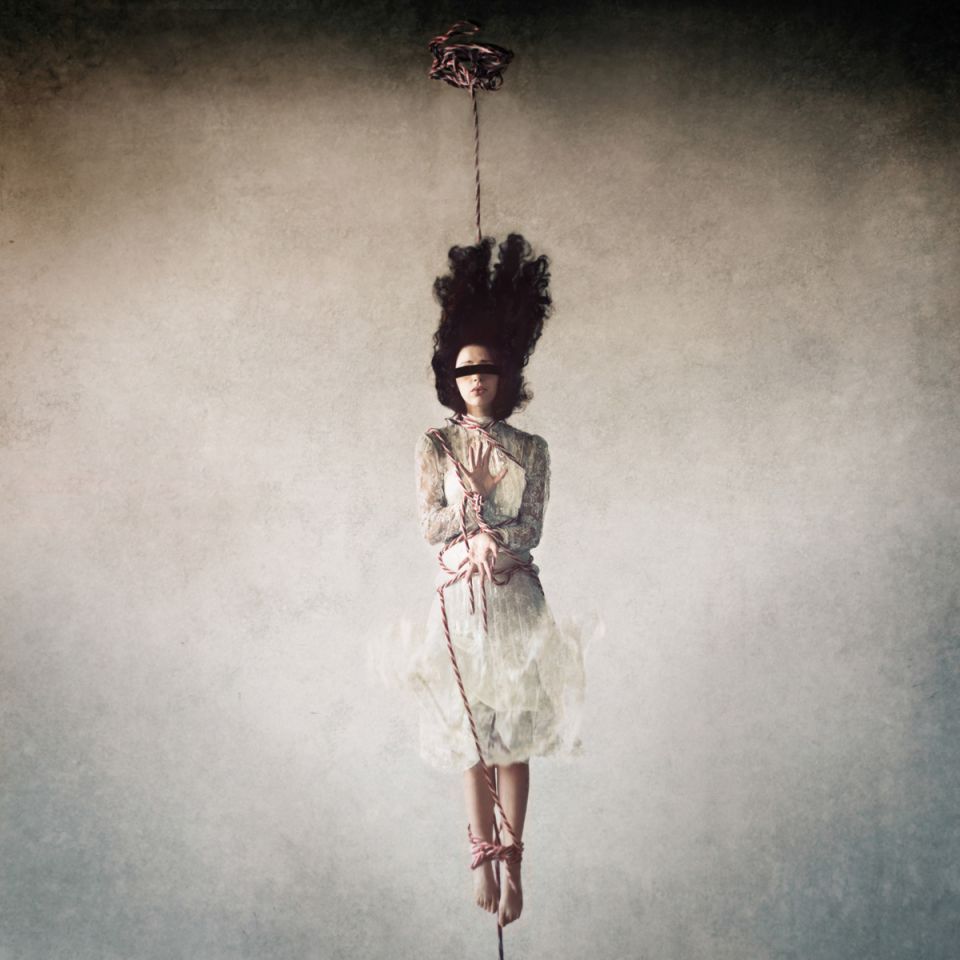
Kiaba is very open about her experience and hard upbringing and talking to many people out there who are struggling. She began doing photography to bring clarity into her life so that she could heal from the trauma she suffered. The self-portrait from her collection I want to include is Hold Your Peace, from the series, Burdens of a White Dress. This series helps Kiaba use self-expression to explain the feeling she had while growing up in a cult and the experiences she had to go through. Specifically, this talks about how within the cult she was forced into marriage and this series helped her express her feeling from that forceful experience she had to endure. She described this photo as her way of exploring the issues of forced marriage. Within this photo, Jenn photographs herself in a white dress with her hands, body, and eyes all bound. She uses tight body language to express the discomfort she felt and the rope to explain the torture she had to go through. Kiaba really taught us that self-expression is the technique that she uses to understand how she truly feels about her life. [14]
All these portraits have different meaning hidden below the surface embracing the artists self-expression. Throughout each of their lives there was always something they wanted to share, whether it be illustrated skill, depression, a flaw in society or even the way you grew up. Each of these female artists show a different side to self-expression, giving us a better idea of who they are and the message they’re trying to portray.[15] The idea of artist expression is a phenomenal experience because as the viewer we can all come up with different interpretations of the message we think the artist is telling. Self-expression is subjective without an explanation for its creator but either way it truly gives us a deeper connection to the artist and what they believe in.
Sources
“16-Year-Old Photographer’s Jaw-Dropping Self-Portraits (Photos).” HuffPost. HuffPost, June 29, 2012. https://www.huffpost.com/entry/cristina-otero-16-year-ol_n_1625715.
Bengal, Rebecca. “What We See Now When We Look at Francesca Woodman’s Photographs.” Vogue. Vogue, January 26, 2016. https://www.vogue.com/article/francesca-woodman-photographs.
Burnett, Craig. “The Complex Characters of Artist Cindy Sherman’s Non-Self Portraits.” MONTECRISTO. Accessed December 10, 2021. https://montecristomagazine.com/magazine/volume-12/cindy-sherman.
Candide McDonald | 24 October 2018. “Look at Me: The Art of Self-Expression.” Capture magazine. Accessed December 10, 2021. https://www.capturemag.com.au/advice/look-at-me-the-art-of-self-expression.
“Cindy Sherman: Moma.” The Museum of Modern Art. Accessed December 10, 2021. https://www.moma.org/artists/5392.
Knight, Christopher. “Marilyn Minter’s ‘Pretty/Dirty’ Show Allures and Repulses All at the Same Time.” chicagotribune.com, April 23, 2016. https://www.chicagotribune.com/la-et-cm-marilyn-minter-review-20160422-column.html.
Luis, Angel Jiménez de. “What Is Self-Portraiture and How to Master It: Blog.” Domestika. DOMESTIKA, November 3, 2020. https://www.domestika.org/en/blog/4352-what-is-self-portraiture-and-how-to-master-it.
“Marilyn Minter: Pretty/Dirty,” Brooklyn Museum: Marilyn Minter: Pretty/Dirty, accessed December 10, 2021, https://www.brooklynmuseum.org/exhibitions/marilyn_minter_pretty_dirty.
Samuelson, Kate. “Are Selfies Art? New Saatchi Gallery Exhibition Says Yes.” Time. Time, March 31, 2017. https://time.com/4718143/selfie-exhibition-saatchi-gallery-london/.
Sehgal, Parul. “The Ugly Beauty of Cindy Sherman’s Instagram Selfies.” The New York Times. The New York Times, October 5, 2018. https://www.nytimes.com/interactive/2018/10/05/magazine/instagram-cindy-sherman-ugly-beauty.html.
Stewart, Jessica. “10 Famous Photographers Whose Self-Portraits Are Much More than Just a Selfie.” My Modern Met, July 13, 2021. https://mymodernmet.com/famous-self-portrait-photographers/.
Tate. “Portrait – Art Term.” Tate. Accessed December 10, 2021, https://www.tate.org.uk/art/art-terms/p/portrait.
[1] Tate. “Portrait – Art Term.” Tate. Accessed December 10, 2021
[2] 16-Year-Old Photographer’s Jaw-Dropping Self-Portraits (Photos).” HuffPost. HuffPost, June 29, 2012. https://www.huffpost.com/entry/cristina-otero-16-year-ol_n_1625715.
[3] Luis, Angel Jiménez de. “What Is Self-Portraiture and How to Master It: Blog.” Domestika. DOMESTIKA, November 3, 2020. https://www.domestika.org/en/blog/4352-what-is-self-portraiture-and-how-to-master-it.
[4] 16-Year-Old Photographer’s Jaw-Dropping Self-Portraits (Photos).” HuffPost. HuffPost, June 29, 2012. https://www.huffpost.com/entry/cristina-otero-16-year-ol_n_1625715.
[5] Knight, Christopher. “Marilyn Minter’s ‘Pretty/Dirty’ Show Allures and Repulses All at the Same Time.” chicagotribune.com, April 23, 2016. https://www.chicagotribune.com/la-et-cm-marilyn-minter-review-20160422-column.html.
[6] “Marilyn Minter: Pretty/Dirty,” Brooklyn Museum: Marilyn Minter: Pretty/Dirty, accessed December 10, 2021, https://www.brooklynmuseum.org/exhibitions/marilyn_minter_pretty_dirty.
[7] Women, Art, and Power and Other Essays, Linda Nochlin
[8] Parul Sehgal, “The Ugly Beauty of Cindy Sherman’s Instagram Selfies,” The New York Times (The New York Times, October 5, 2018), https://www.nytimes.com/interactive/2018/10/05/magazine/instagram-cindy-sherman-ugly-beauty.html.
[9] Craig Burnett, “The Complex Characters of Artist Cindy Sherman’s Non-Self Portraits,” MONTECRISTO, accessed December 10, 2021, https://montecristomagazine.com/magazine/volume-12/cindy-sherman.
[10] “Cindy Sherman: Moma,” The Museum of Modern Art, accessed December 10, 2021, https://www.moma.org/artists/5392.
[11] Stewart, Jessica. “10 Famous Photographers Whose Self-Portraits Are Much More than Just Selfie.” My Modern Met, July 13, 2021. https://mymodernmet.com/famous-self-portrait-photographers/.
[12] Bengal, Rebecca. “What We See Now When We Look at Francesca Woodman’s Photographs.” Vogue. Vogue, January 26, 2016. https://www.vogue.com/article/francesca-woodman-photographs.
[13] Candide McDonald | 24 October 2018. “Look at Me: The Art of Self-Expression.” Capture magazine. Accessed December 10, 2021. https://www.capturemag.com.au/advice/look-at-me-the-art-of-self-expression.
[14] Candide McDonald | 24 October 2018. “Look at Me: The Art of Self-Expression.” Capture magazine. Accessed December 10, 2021. https://www.capturemag.com.au/advice/look-at-me-the-art-of-self-expression.
[15] Samuelson, Kate. “Are Selfies Art? New Saatchi Gallery Exhibition Says Yes.” Time. Time, March 31, 2017. https://time.com/4718143/selfie-exhibition-saatchi-gallery-london/.
 Issues in Contemporary Art