3D printing can be dated back to 1860, however, 3D printing as we know it today has only been around since the mid 1980’s. Since 2007, the price of 3D printers has continued to go down and these machines have become more and more affordable. This new affordability has given way to a new widespread and popular art form. 3D printing is now used in many different industries to create a variety of things. Those who focus on utilizing this technology to create artwork push the limits of creative possibility within contemporary art by combining technology and art.
3D printing can also be known as digital manufacturing or fabrication. Using software such as Morphi or Autodesk 123d Design, the creator first designs a digital 3D model of their form. Those who don’t know how to utilize these software programs can go to websites like thingiverse.com where they can find previously designed digital files which can be downloaded and sent to the 3D printer. The machine then creates 3D objects through an additive process of layering a material from bottom to top. Materials can include polymer plastics, metal, and ceramics among others. Those working with this technology to design prints can create practical items which can be used. For example, one could create a battery cover for a remote where the original has gone missing. On the other hand, designers can engineer creative works meant for display purposes. Today, 3D printing is used in areas such as the medical, aerospace, and automotive industries. However, because this technology allows the creator to print virtually anything, it is also a new popular tool used in contemporary art. In the art world, this technology can be seen used in sculpture, fashion, jewelry making, and architecture among other artistic uses.
More and more contemporary art forms utilize technology in one way or another. 3D printing has naturally found its way into the sculptural art of contemporary artists such as Joshua Harker. Joshua Harker, one of the most recognized artists in the field of 3D printed sculpture is considered to be a “pioneer and visionary” in this medium and is credited as the “first to break the design & manufacturing threshold of possibility.”
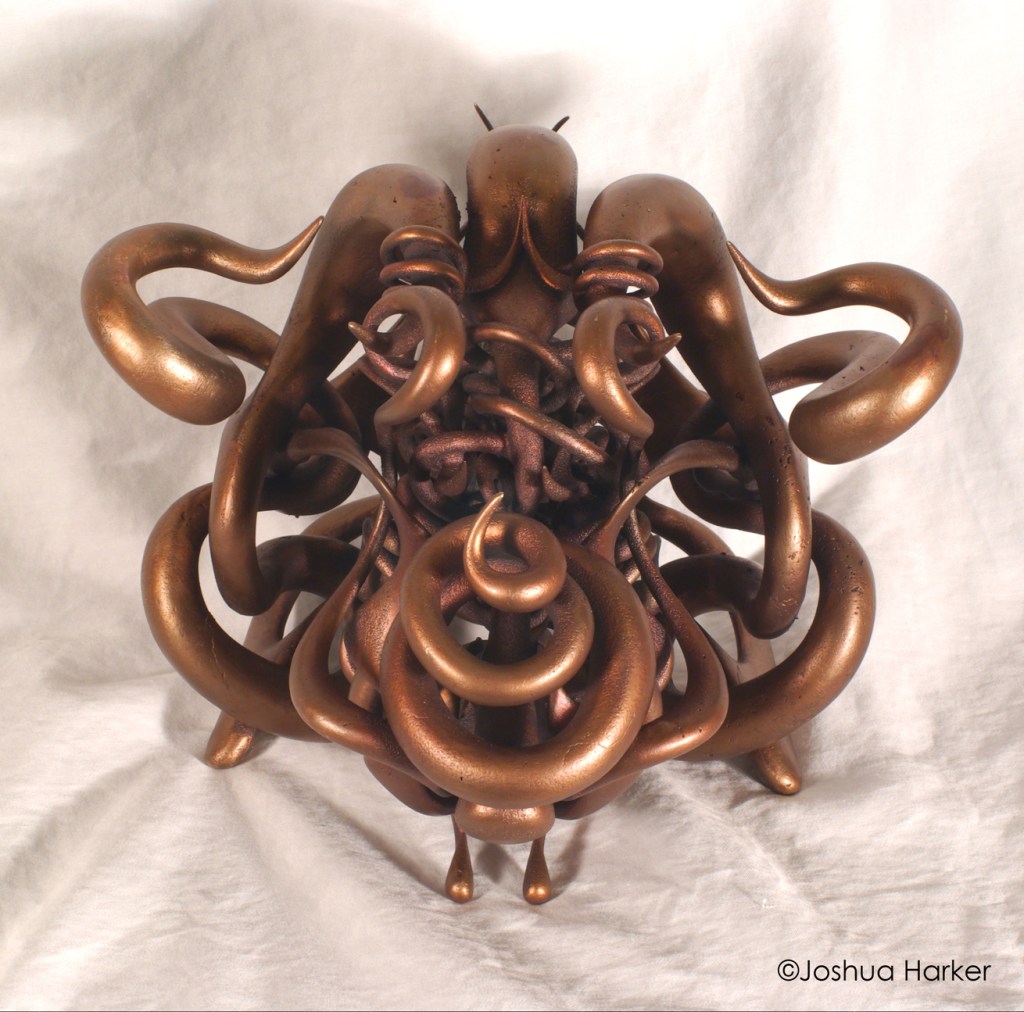
His series of 3D printed sculptures titled Tangles are a mesmerizing collection of alien-like intricate and complex tangles. The tangles appear to be made of intertwined snake-like strands which are thicker in the middle and taper off to points at the end to form these serpentine creations. Each sculpture is printed with cast bronze to bridge traditional techniques of bronze sculpture making with this technologically advanced technique.
Artists who utilize this technology must change the way they think in terms of construction. Unlike other sculptural mediums, this requires the designer to think of a sculpture on a minuscule layer by layer basis (layers are typically 0.2 millimeters thick). Creating a design which successfully translates from design file to physical 3D form can be difficult depending on the complexity of the piece. Another reason why artists like Joshua Harker are so highly regarded. These abstract pieces would not be possible to create without the use of 3D technology. Therefore, the “practical impossibilities of their existence” has been considered a critical milestone or turning point in 3D printed art and contemporary sculpture. With the introduction of 3D printers artists like Harker have been able to expand their artists capabilities in areas such as sculpture and bring forth new innovative designs that would otherwise not exist.
This new ability to create works of art that could not have previously been crafted has been pivotal within contemporary art. 3D printing technology allows for endless creative possibilities and extends the realm of possibility within art. As technology improves and advances to provide artists with new mediums and tools, art is pushed to new limits and widens the possibility of creation. The creation of new technology in art will not stop here and contemporary art will continue to change as it has with 3D printing.
Sources
“About.” Joshua Harker, April 18, 2021. https://www.joshharker.com/about/.
N. Shahrubudin, T.C. Lee, and R. Ramlan. “An Overview on 3D Printing Technology: Technological, Materials, and Applications.” Procedia Manufacturing 35 (August 14, 2019): 1286–96. https://doi.org/10.1016/j.promfg.2019.06.089.
Smith, Shaunna. “3D Printing: Where Art and Technology Collide .” TRENDS , 2014, 16–23. https://www.taea.org/taea/Docs/2014/TRENDS-2014.pdf#page=17.
“Tangle Sculpture Series.” Joshua Harker, February 11, 2018. https://www.joshharker.com/art/tangles/.
 Issues in Contemporary Art