In the beginning of the twentieth century art was moving more towards mind tantalizing ways then we had previously seen before. Surrealism is the art movement that started in the 1920s and the main concept is for you to look beyond what your eyes are seeing and use your subconscious mind to understand what you’re looking at. Expressionism dates to 1910 with the idea of the artists understanding and not necessarily reality itself but more so the meaning, the expression behind the object or experience. Both requiring the viewer to look further then what meets the eye, surrealism and expressionism are two very different art movements allow us to explore our subconscious mind to reveal deeper meanings.
These two art movements came about in very different ways. But I feel as though they have such a strong connection in the art world as final pieces. “Although both Surrealism and Expressionism are troubled with the perception of the unconscious behavior, surrealism is conventional in introduction while the later one is over-romantic.”[1] Robert Hobbs was known for exploring the idea of expressionism and surrealism in the hope to understand their methods and help us become aware of their different techniques. But just because two things are done in different ways doesn’t mean they cannot be similar. I think it in fact makes them have even more in common as a complete art piece.
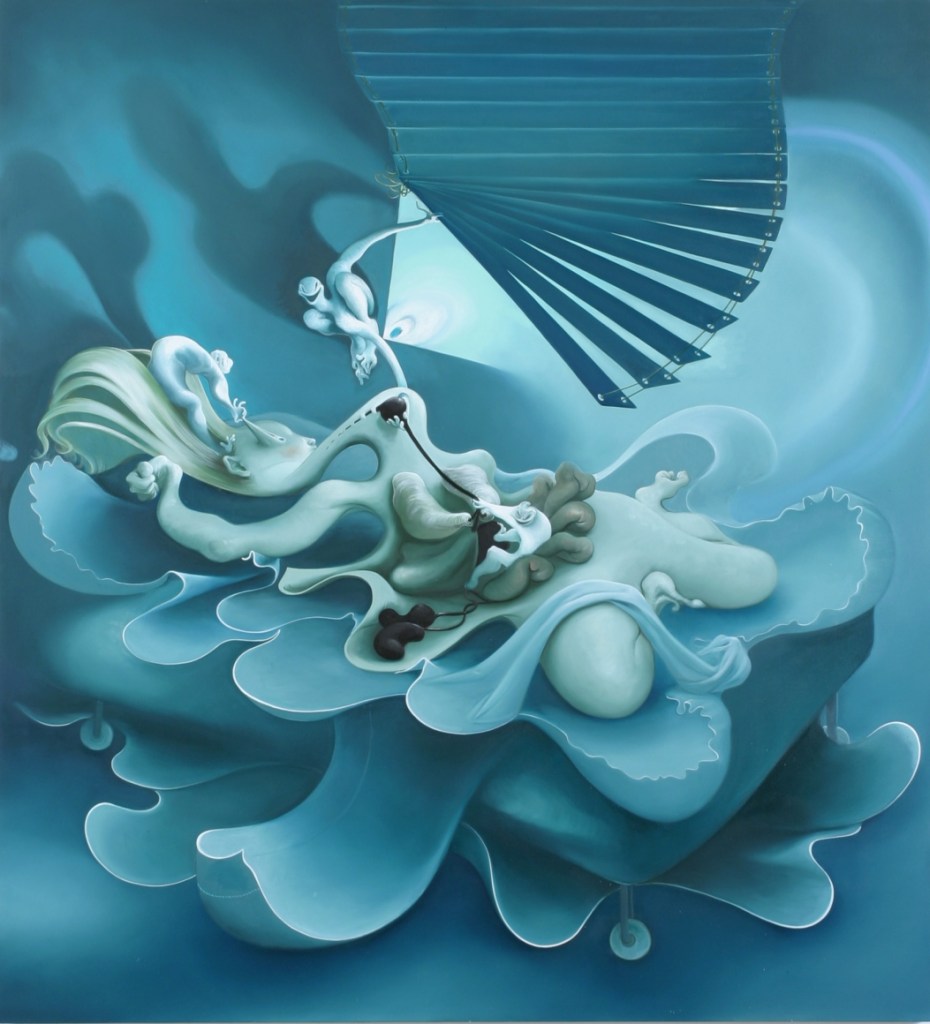
For example, I took a further look at Inka Essenhigh, In Bed. This piece depicted the Surrealism art style, we see a blue tinted representation of a women lying in bed. The woman appears to be stretched out in a way of resembling an octopus with extremities extended out cascading through the canvas. This woman lays over a large bed with the sheets draping alongside her tentacles creates a sea-like feeling. As we begin to look even further, we notice what appears to be window with blinds, that lurk down over the women creating a lurking demon like effect. This depiction instantly reminds the onlooker of a nightmare scene, from the muted blue tones to the unrealistic and eerie aspects to the whole. The entire image requires us to look closely and really use our minds to feel and see everything the artist is trying to tell us in the canvas. This instantly compares to Käthe Kollwitz Death Grabbing at a Group of Children (Tod greift in eine Kinderschar) from the series Death (Tod). In a completely different medium and style, we see here a child in pain; he looks to be screaming and a dark figure coming above that is taking him. From the title we can infer that this figure is death, here to take the child. This again, is a dark piece that with a little subconscious thought we can understand the entire meaning of the piece. The lithograph medium helps us understand the depth and darkness surrounding the underlying meaning of this piece.
When comparing these two styles we can see a line connecting the subconscious mind among surrealism and expressionism to one another. While they have their differences, the overall depicted art from these movements both display a deeper psychological response that the viewer uncovers.
Bibliography
Hobbs, Robert C. “Early Abstract Expressionism and Surrealism.” Art Journal 45, no. 4 (1985): 299–302. https://doi.org/10.2307/776801.
Park West Gallery. “What Is Surrealism? How Art Illustrates the Unconscious.” Park West Gallery. Park West Gallery, January 7, 2021. https://www.parkwestgallery.com/what-is-surrealism-art/.
Polcari, Stephen. “Abstract Expressionism: ‘New and Improved.’” Art Journal 47, no. 3 (1988): 174–80. http://www.jstor.org/stable/777043.
Taylor & Francis. “Early Abstract Expressionism and Surrealism.” https://www.tandfonline.com/doi/abs/10.1080/00043249.1985.10792314?tab=permissions&scroll=top.
Inka Essenhigh. In Bed, 2005. Oil on canvas. (A&T 29)
Käthe Kollwitz. Death Grabbing at a Group of Children (Tod greift in eine Kinderschar) from the series Death (Tod), 1934. Lithograph. Museum of Modern Art Collection.
[1] Hobbs, Robert C. “Early Abstract Expressionism and Surrealism.” Art Journal 45, no. 4 (1985): 299–302.
 Issues in Contemporary Art