One of the best, most powerful ways to amplify black voices is through the visual arts. Whether invoking an emotional response to its audience through portraying their struggles, celebrating culture, or simply celebrating fine art, this exhibition aims to empower black voices in all ways, through all types of art. By displaying both of these types of art it is a means to balance struggle with celebration, seriousness with playfulness, or just admiration of talent. Also by displaying both sides of the coin out of respect it shows black people’s strength for what pulls them through difficult times, rather than only pitying those of color. Yet the weight for which the struggles they carry should not be ignored, and should make the privileged viewers uncomfortable. Another strong reason to have this exhibition is because of the lack of black artists displayed in galleries and museums being underrepresented. The same goes for black art critics, black art dealers, and black museum trustees. A good reason for why one would want to come to this exhibition would not only be to enjoy the extraordinary artwork but also the recorded number of attendees at the exhibition is considered for the value of an art piece and when the number is higher it supports the black artists. Also viewers can follow the artist on social media giving more value to their work, something curators also look for.
The first artist to introduce would be a versatile pioneer of black art, Faith Ringgold. She has won countless awards including a National Endowment for the Arts Award, a Guggenheim Fellowship for painting and an NAACP Image Award. Faith Ringgold, born Faith Will Jones, was born on October 8, 1930, in Harlem, a time where she’d be greatly exposed to the Harlem Renaissance. She graduated with a B.S. in fine art and education in 1955 from The City of New York and soon after also received a M.A in art. Protesting in the 60s and 70s against art institutions that had not included people of color, her artwork’s narrative during that time period changes from angry and disheartened when it comes to living in America as a person of color to portraying black females in all their glory in later decades. Later in her career she’d published award winning children’s books during the 80s and 90s written and illustrated by her. They educate youth upon the pivotal as well as inspiring times during black history, Aunt Harriet’s Underground Railroad, and My Dream of Martin Luther King just to name a couple. Woman on a Bridge #1 of 5: Tar Beach, (1988, Acrylic paint, canvas, printed fabric, ink, and thread, 74 5/8 x 68 1/2 inches) would be included since the book to go along with the piece, titled Tar Beach, won the Caldecott medal which goes out to the most distinguished American picture book for children for its preceding year. Pictured within the artwork are all people of color – a family sitting with visitors on a city building’s rooftop at night with a food table, potted plants, and a clothesline with laundry hooked. In the background there are the skyscrapers of Harlem lit at night along with the George Washington Bridge also lit. The is a little girl and a boy laying down on a blanket looking into the sky. Interestingly, the little girl in the nightgown is pictured twice because she also appears flying in the background too.
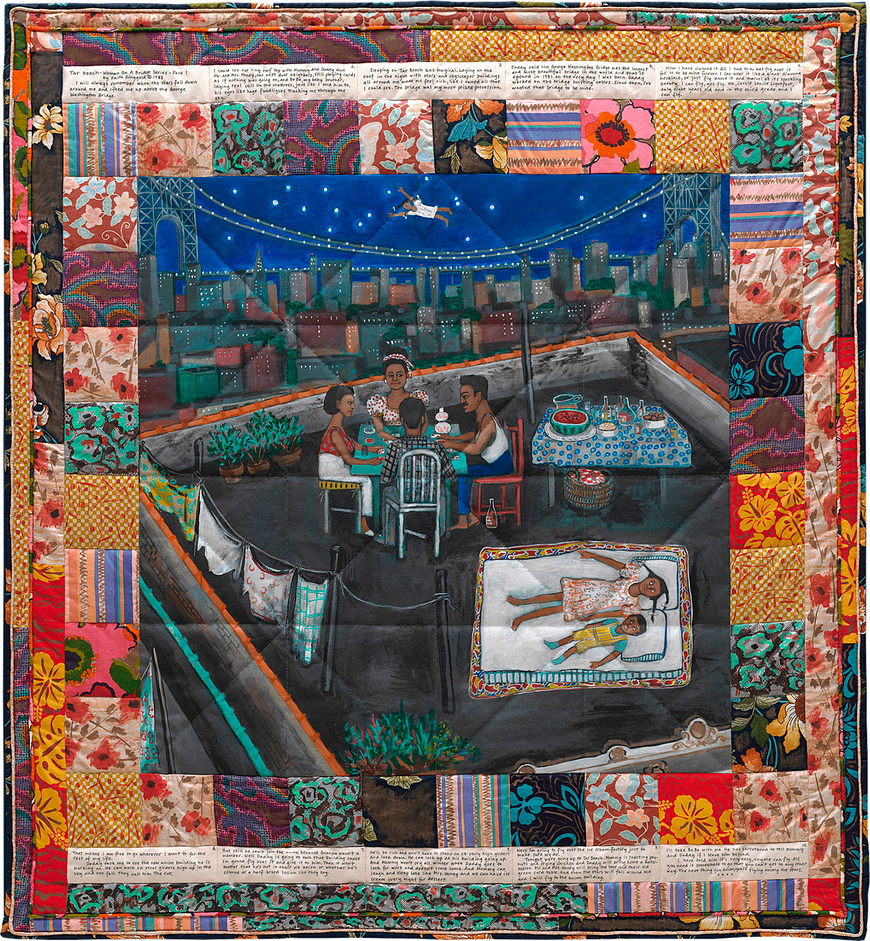
Faith Ringgold. Woman on a Bridge #1 of 5: Tar Beach, 1988. Acrylic paint, canvas, printed fabric, ink, and thread; 74 5/8 x 68 1/2 inches. Solomon R. Guggenheim Museum collection, New York, New York. Image by Guggenheim Museum.
The story behind Tar Beach spoke upon feeling free. A little girl named Cassie Louise Lightfoot living in Harlem imagines herself flying over the George Washington Bridge. She dreams of ways her beloved family members can also feel free, addressing the financial hardships her parents have dealt with while also speaking highly of them. The little girl is determined to take over the city and make a better life for her family, dreaming of what could be. This emphasizes the power of dreaming and that in Ringgold’s case – dreams do come true.
Her style is characterized by the bright and bold two dimensional artwork style from the Harlem Renaissance and also references Cubism as well as Fauvism, specifically Picasso and Matisse. Like the staple in most of her works, she used an illustrative quilt border in Tar Beach. Ringgold is best known for her quilted artwork for which the patterns take inspiration from multiple elements. Tibetian thangka paintings are one of them. Another is how quilts resonate and honor her mother who took an interest in fashion design, sold dresses in Harlem as well as taught Faith how to sew. Quilt Making also speaks upon the craft behind women’s work within the community in both American and African culture. Quilts are also a reference for what was used to help slaves escape through the underground railroad. The combination of painting and quiltmaking combined is quite innovative. First she paints on fine woven cotton duck canvas fabric. Then she attaches colorful squares of upholstery fabric along the boards, some of which she’d also paint on.
Who’s Bad? (1988, Acrylic on canvas with pieced fabric border, 79 1/2 x 92 1/2 in.) would be included because of its fun lightheartedness with Michael Jackson centered, yet speaks upon race also. The Michael Jackson figure appeals to a large audience because of his popularity. For that, this work could even be considered as pop art since he is a widely recognized figure. This adds to Ringgold’s versatility, attributing her work to many aspects of black culture, back then and during more recent times. Within the piece painted there are repeated writings of the names Martin Luther King Jr. and Malcom X in a vandalized style. In the background there are a bunch black men of all ages and differing personas, based on their fashion apparel, shown together dancing. With this as well as including the following piece mentioned, the viewer can see that because of her history with textiles and fashion she uses apparel to create each individual figure’s persona that reflects the times. In this case it’s the 80s. It speaks upon how no matter how one may identify themself or how society sees them as a black man Michael Jackson’s exceptional talent brings the black community together for a good time. United, this promotes black power. Her work again captures the style of art depicted during the Harlem renaissance as well as Cubist and Fauvist elements. Again the artist references her staple quilted border.
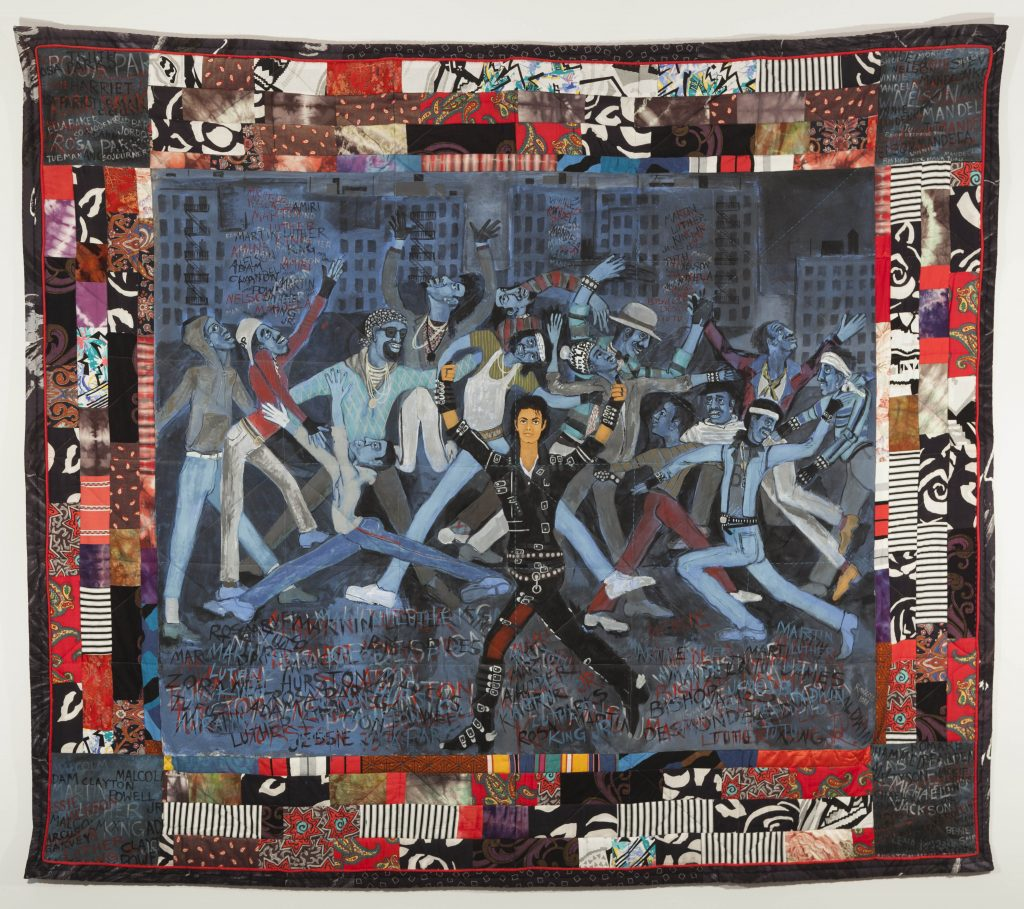
Faith Ringgold. Who’s Bad?, 1988. Acrylic on canvas with pieced fabric border; 79 1/2 x 92 1/2 in. Image by https://www.faithringgold.com/portfolio/whos-bad/.
Another great piece of Faith Ringgold’s to include would be Groovin’ High, 1996 because it celebrates another vibrant time in black culture. “Groovin’ High was inspired by Ringgold’s memories of Sunday afternoon dances at the Savoy and her connection to her native Harlem neighborhood. The title references jazz composer and trumpeter Dizzy Gillespie’s 1945 bebop classic.” The founding of bebop is unique to black culture being founded by Charlie Parker and Dizzy Gillespie. It typically comprises the necessary trumpet and saxophone with a rhythm section (this includes a piano, bass, and drums). The piece similar to Who’s Bad depicts roughly a dozen and a half people, again of all ages, of which are a gathering of black people dancing. Groovin’ High is culturally educational as well as fun and engaging. Again the style resonates the same as mentioned in the earlier pieces, using bold colors with two dimensional figures. Also appearing again she shows her eye for fashion trends, something that she must’ve adopted from her mother, because it shows what people wore taking place in the 40s/50s. The fact that she shows this within both Who’s Bad? As well as Groovin’ High is another captivating trademark since they’re two different eras. To add, again they both also show the power of music and its ability to bring people together.
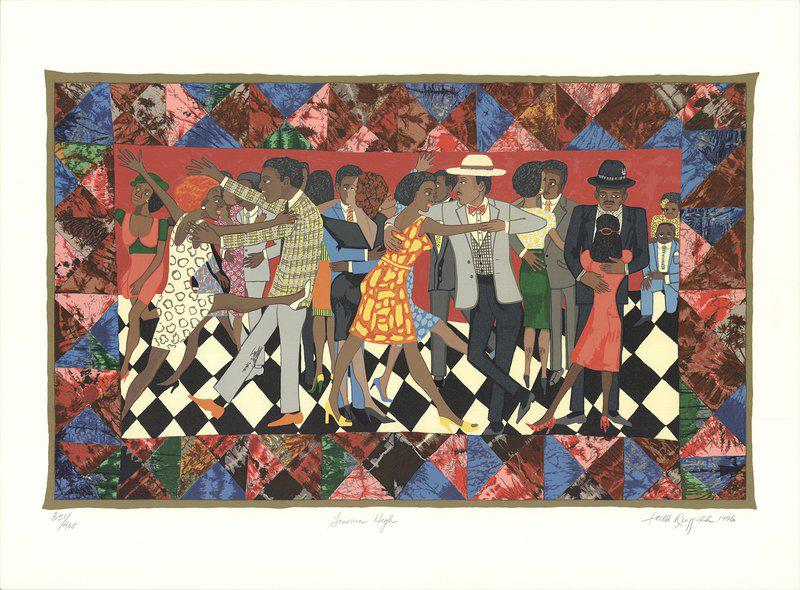
Faith Ringgold. Groovin’ High, 1996. Silkscreen; 32 ½ x 44 in. Image by https://www.artsy.net/artwork/faith-ringgold-groovin-high-10.
To go with the theme of bringing people together would be the cozy southern shack house artworks of Beverly Buchanan. When anyone looks at them she hopes that they “strike a chord” with whoever that may be. Many people react saying the works remind them of home. She’s been widely recognized and has received rewards including National Endowment for the Arts Fellowship (1980), a Pollock-Krasner Foundation Award (1994), and a Lifetime Achievement Award from the Women’s Caucus for Art (2011). Her work is also displayed at the Metropolitan Museum of Art.
Beverly was born October 8, 1940 in Fuquay-Varina, NC. What influenced her work was how her father was the dean of the department of agriculture at South Carolina State College as well as an agricultural agent for the state to travel so he could teach the trade, with Beverly tagging along with him. Her father’s friend was a landscape architect and she would mimic her own handmade small three dimensional versions of buildings based on the knowledge he’d share. She was pressured by her parents and being black in the 60s to be successful by pursuing medical school, since she was already a health educator in New Jersey. She instead chose to be an artist. During the late 60s she was turned away from a gallery being directly told from them that they don’t show black art. In the same interview where she expresses that she also states how she’s been told even years preceding, “what great work for a woman”. And even for a third example of discrimination that same interview shares how in 1977 once her works were in a gallery in New York gaining success up north curators and dealers down south (Atlanta, GA) finally contacted her showing interest her work after the fact of seeing it beforehand and dismissing it.
Beverly claims her work’s style is strongly influenced by the abstract expressionist movement. She creates two dimensional and three dimensional works of a common theme, inspired by one to two, perhaps even three hundred year old shacks that are still standing from the old south in South Carolina. Her works are semi representational but her aims towards embodying the spirit of those who lived there and who built them, as she puts it.
A good piece of Beverly Buchanan’s to include would be Dublin, Georgia, Dublin, Georgia, 1992, Oil pastel on paper, 22 x 30 inches. The piece depicts two small log shacks, taller than they are wide, each with orange roofs, the right one pictured with a staircase, with a dark blue sky, low lit grass at the bottom, thus it being nighttime this achieves the look of a candle lit window. Similar to all her other works she presents a beautiful, bold, rich jewel toned use of color theory. The windows capture a glowing candle lit light, reflective of the times when the house was lived in. This adds, as mentioned earlier, the “cozy” “at home” feel. It’s almost as if these places were never left abandoned, perhaps Beverly gives them life again, which successfully ties along with her artist statement/intent of capturing the shack’s spirit. While scribbles in art are commonly discouraged, instead she owns that type of mark making throughout her work. A similar example for reference would be Macon Georgia, Oil pastel on paper, 22 5/8 x 30 inches 2003. The mark making gives an innocent, childlike, welcoming feel, which is how one wants to feel when walking into another’s home. The mark making also relates to the weathered chaos that the still standing building has been through a couple hundred years or so. Perfect lines wouldn’t make any sense for this type of subject and theme.
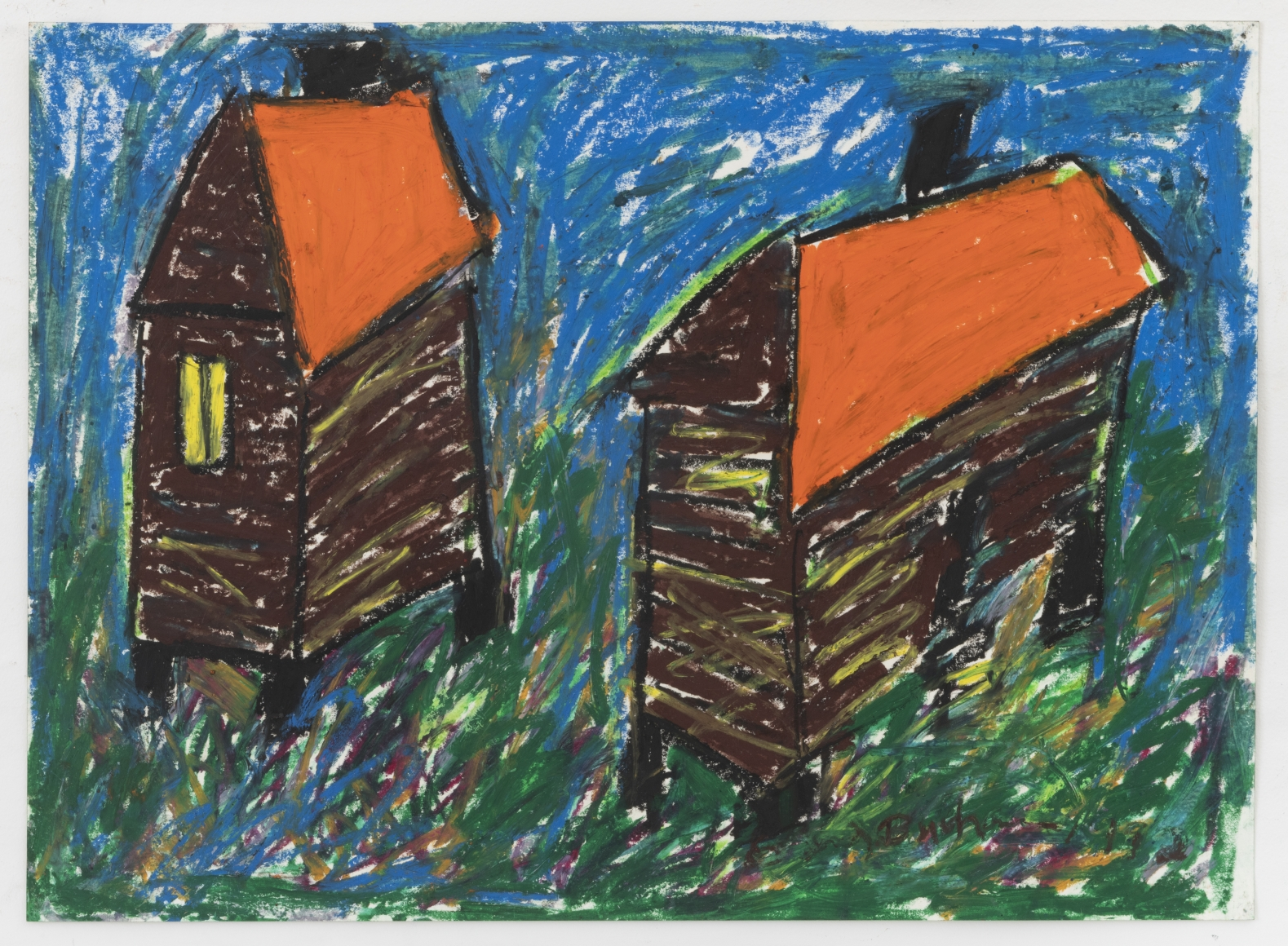
Beverly Buchanan. Dublin, Georgia, 1992. Oil pastel on paper; 22 x 30 inches. Andrew Edlin Gallery Collection, New York, New York. Image by Andrew Edlin Gallery.
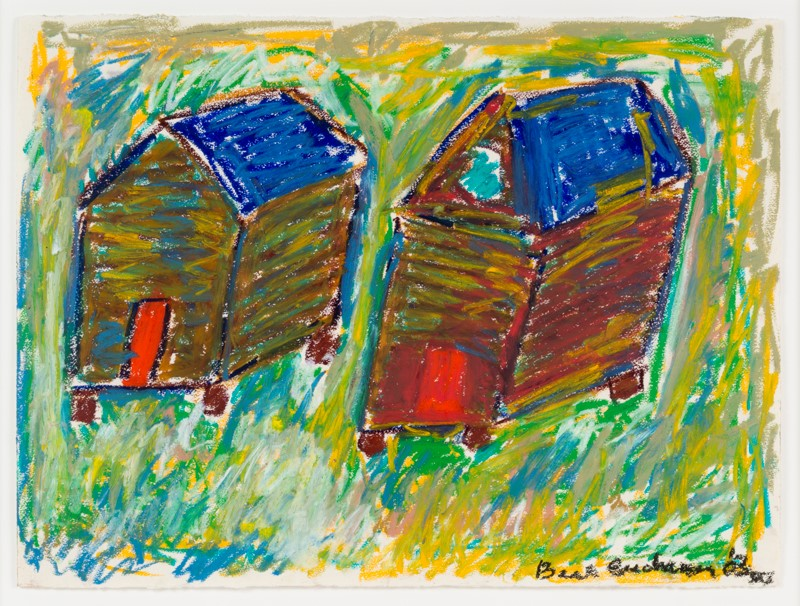
Beverly Buchanan. Macon, Georgia, 2003. Oil pastel on paper; 22 5/8 x 30 inches. The Johnson Gallery Collection, Spartanburg, SC. Image by The Johnson Gallery Collection.
While it is important to recognize the work of black artists who’ve paved the way, it’s equally just as important to recognize up and coming ones. Ariel Dannielle, 29, is a portrait painter with the theme of drawing the viewer into the intimate everyday life of a black woman in today’s world. From Atlanta, GA, she graduated from the University of West Georgia, where she received a Bachelor of Fine Arts. She has been mentioned in the New York Times and has been featured in the California African American Museum, featured in several galleries, and been a finalist in several competitions. Two of her pieces, Be Safe and We Adapt would be included in the exhibition. Be Safe began with the Black Lives Matter protests following the death of Alton Sterling in 2016 in Baton Rouge, Louisiana.
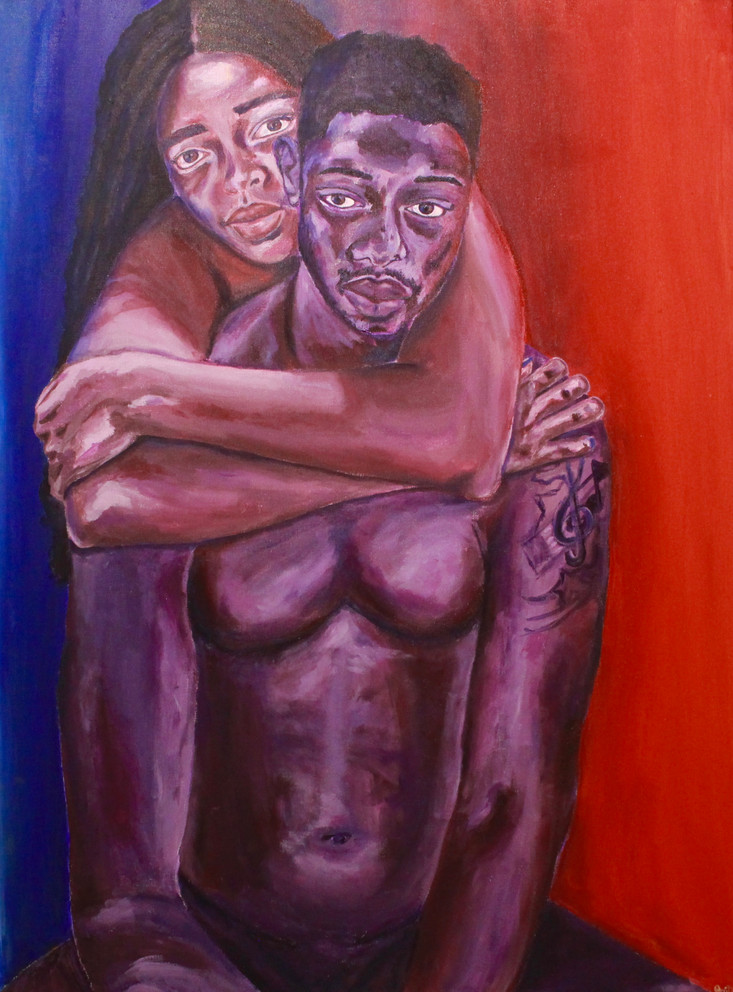
Ariel Dannielle. Be Safe, 2016. Acrylic on Canvas; 30x40in. Image by https://www.byaridannielle.com/paintings.
For context Sterling was selling CDs outside a store and a few days prior began carrying a gun due to recent CD vendor robberies surrounding the area. Two officers responded to a call about a man who was threatened with a gun by a man selling CDs, thus Serling’s red hoodie fit the description. Yet the store owner stands by Sterling stating he was not the one who instigated or in his time of knowing him was looking to cause trouble. Back during 2009 almost the exact same incident involving Sterling selling CDs with police arrival a different store owner also vouched for him saying the same thing. Once Sterling was on the ground officers tased him. Already tased he reaches into his pocket for what the jury claimed to be his gun. After seeing this the now ex officer Salamoni fatally shot him six times in close range. The Department of Justice did not file charges for this case however the officer who shot Sterling was fired two years later before the wrongful death suit began in 2021.
If Sterling wasn’t shot dead he could have had justice. Perhaps he didn’t address police confrontation properly by resisting and reaching but with the numerous other cases in the media since the Trayvon Martin case of police brutality directed towards people of color it’s no wonder he panicked. Police officers should be seen as trusted professionals but how can they be when they have their own track record? Having the black community fear them is only making the problem grow.
Ariel Dannielle’s Be Safe, 2016, 30x40in, Acrylic on Canvas is an emotional depiction of the fear behind walking outside as a black man with a target on his back due to police brutality towards people of color. With a blue and red backdrop with the exact same hues of police vehicle lights Dannielle paints herself embracing her male lover. Her expression is fearful and anxious with his being discouraged and hopeless. Along with her other works it is so up close and personal that it has the viewer feeling the emotion it’s intended to portray. Not only is the Black Lives Matter movement about police brutality but it’s also about generational social economic inequality amongst races. What comes with that is besides police brutality, communities of color fear violence from those in their own neighborhood. This piece is very personal and powerful.
On a lighter note, We Adapt (2020, Acrylic on Unstretched Canvas, 60 × 83 in) has to do with finding the joys within the COVID-19 pandemic that can be found by staying home. The artist pictures herself in her bedroom wearing a facemask in her bathrobe holding up a glass of wine. She looks very happy, comfortable and at home with her dog on the bed with the other hand throwing up the peace sign towards her Macbook. She owns her femininity by including her cheetah print pillow and salt rock lamp. And of course she included a bottle of Purell on the dresser.
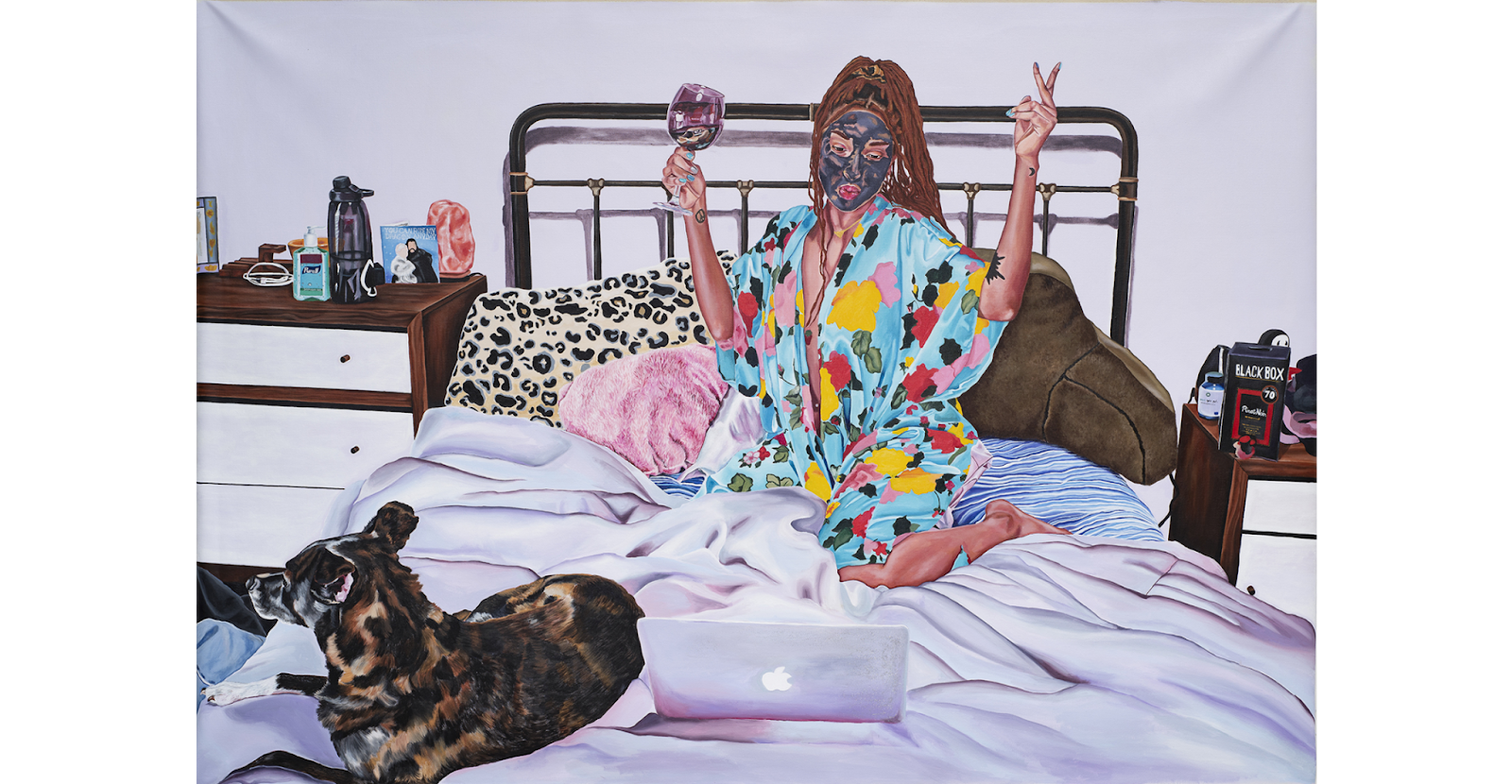
Ariel Dannielle. We Adapt, 2020. Acrylic on Unstretched Canvas; 60 × 83 in. Image by https://www.byaridannielle.com/paintings.
All these three pieces have to do with her artist statement of which challenges gender and racial stereotypes because if a white person was to gain insight into the world of a black woman this would be it. It is simply them trying to enjoy life and loving those around them. This is similar to all human nature that we can all relate to. Being human is something everyone has in common.
Sources
“ABOUT.” Website. July 28, 2021. https://www.byaridannielle.com/about.
“About Faith.” Faith Ringgold. Accessed July 28, 2021. https://www.faithringgold.com/about-faith/.
“Beverly Buchanan, Thornton Dial, and the Gee’s Bend Quiltmakers.” Andrew Edlin Gallery. Accessed July 28, 2021. https://www.edlingallery.com/exhibitions/beverly-buchanan-thornton-dial-and-the-gee-s-bend-quiltmakers?view=slider#4.
Craftinamerica2007. YouTube. May 10, 2012. Accessed December 15, 2021. https://www.youtube.com/watch?v=794M-mcOJY4.
“Faith Ringgold.” Mattatuck Museum. Accessed July 28, 2021. https://www.mattmuseum.org/mattatuck_carousel/faith-ringgold/.
“Faith Ringgold.” Biography.com. November 05, 2021. Accessed December 15, 2021. https://www.biography.com/artist/faith-ringgold.
Hanson, Reviewed By: Debra, and Debra Hanson. “Faith Ringgold: Paintings and Story Quilts, 1964–2017.” Panorama Journal of the Association of Historians of American Art. Accessed December 15, 2021. https://editions.lib.umn.edu/panorama/article/faith-ringgold/.
“Macon Georgia.” The Johnson Collection, LLC. Accessed December 15, 2021. https://thejohnsoncollection.org/beverly-buchanan-macon-georgia/.
Ufoutlier. YouTube. December 31, 2013. Accessed December 15, 2021. https://www.youtube.com/watch?v=GfBZm2QHzi4.
YouTube. June 15, 2020. Accessed December 15, 2021. https://www.youtube.com/watch?v=Ry5_Ns9jRNI.


 Issues in Contemporary Art