When the average viewer thinks of a portrait they usually think of paintings of the rich and powerful, or of well-dressed and made-up figures, usually for school photos or ones online profiles. Catherine Opie however, transformed the art of portraits, using them as a form of expression that not only investigates someone’s essence, but makes a point of addressing society itself.
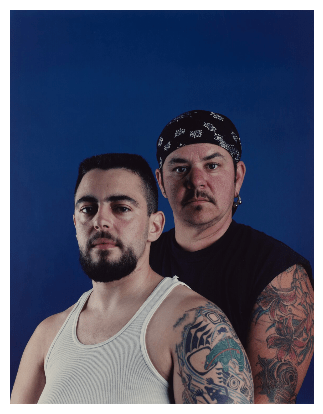
The most well known of her portraits are her photographs from the 90’s, documenting queer culture during the height of the AIDS pandemic.[1][2] Mike and Sky, 1993 features two men, one behind the other. They’re both strong looking men, with tattoos, and piercings and yet its clear the two have a relationship. Seeing just one of these men wouldn’t elicit the same reaction but together they create a powerful energy that would fiercely cause a reaction with the viewer at the time.
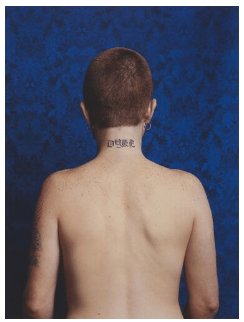
Dyke, is very similar, what could be a young man or woman facing away is immediately charged by the word Dyke tattooed on the back of her neck, which forces the viewer to have a reaction whether positive or negative.

Gina & April, 1998 shows two black women in an embrace in bed, caressing one another’s arms and heads, one with her eyes closed, the other looking on softly. Not only does this soft interaction counter racial stereotypes, showing the women as soft, it also counters common lesbian stereotypes, the women are fully dressed and unprovocative, not being manipulated by the fetishistic male gaze.
Unlike many artists, Opie did not cater to the rich or the male viewer, while some of her portraits are nude, they are not nude in a sexual way, but in a way that is vulnerable, just as most of her subjects are. There is no profound message, no glaring text or pointed titles, just queer people of all shapes and sizes existing and co-existing together. While the subject matter may not seem as important today, it was not nearly as commonplace back in the 90’s, nor was it out there for everyone to see. Opie changed that.[3]
[1] Dazed “How Catherine Opie Transformed the Image of Contemporary America.” 2021
[2] Wallentine “Catherine Opie on Her First Monograph, ‘A Map of My Mind.’” 2021
[3] Shapiro “Catherine Opie – Photographs by Catherine Opie: Book Review by Emily Shapiro.”
Sources
Dazed. “How Catherine Opie Transformed the Image of Contemporary America.” Dazed, July 6, 2021. https://www.dazeddigital.com/art-photography/article/53440/1/how-catherine-opie-transformed-the-image-of-contemporary-america.
Shapiro, Emily. LensCulture, Catherine Opie |. “Catherine Opie – Photographs by Catherine Opie: Book Review by Emily Shapiro.” LensCulture. Accessed October 26, 2021. https://www.lensculture.com/articles/catherine-opie-catherine-opie.
Wallentine, Anne. “Catherine Opie on Her First Monograph, ‘A Map of My Mind.’” Hyperallergic, July 26, 2021. https://hyperallergic.com/664912/catherine-opie-on-her-first-monograph/.
 Issues in Contemporary Art