Vladimir Kush: Awakening the Subconscious

An exceptional Surrealist painter and sculptor would be Russian-American artist Vladimir Kush. His artwork falls into the Surrealist category for its themes involving awakening the subconscious through juxtapositions, thus the merging of dreams with reality. He states how his works emphasize the use of metaphors. His works involve bright, upbeat, whimsical, creative, subjects rather than dark or destructive ones, invoking the viewer’s imagination and inner child. Because of this, according to his website, “The Cleveland Clinic Neurological Institute’s Lou Ruvo Center for Brain Health uses Vladimir Kush’s intellectual paintings with dementia and Alzheimer’s patients.” In 2011 the artist was awarded the painter of the year presented by Picasso’s granddaughter. Along with his subject matter it makes sense that the euphoric, imaginative, dream state types of subjects are primarily sold through his galleries in Laguna Beach, California, Las Vegas, Nevada and Maui, Hawaii as giclée prints, jewelry, handbags and face masks which are also sold on his website. These locations are on brand for the artist because the vibrant tourist destinations match the embodiment of his artworks.


Vladimir Kush was born in Russia, near the Moscow forest-park, Sokolniki. He began his artistic study and practice as early as age seven, then spending approximately a year at the Moscow Higher Art and Craft School. This time was short lived because he was drafted into the Russian Army. Six months into training, his unit commander encouraged him to use his artistic talent for propaganda posters. Perhaps his artworks to come after were a therapeutic escape from the harshness from training for the Cold War and also claims how during his time in Russia he could not travel due to government regulations thus resorting to the use of his imagination. After his service he finished his education with a degree from the Institute of Fine Arts. Thereafter he created portraits on Arabat Street in Russia to support his family. “In 1987 Vladimir began partaking in his first exhibitions organized by the Union of Artists. In 1990, at an exhibition in Coburg, Germany, almost all of his displayed paintings were sold. After the exhibition’s close, Vladimir flew to Los Angeles, CA, where 20 of his works would be exhibited.” Still working his way up he’d freelance portraits on the Santa Monica pier. His next destination as well as where he currently resides is in Hawaii.

Kush’s African Sonata (oil on canvas, 21 in × 24 in) depicts elephants with giant tubas for faces. With that being the primary focus also included barbary stag, a deer lookalike found in Africa pictured with a harp for antlers. Along the bed of water are Great Egrets also found in Africa which are similar to pelicans. The scene takes place on a desert with volcanoes in the background as well as various brass instruments, (french horn, cymbals) resembling the shape of long yellow grass. Pieces like this encourage viewers and especially children to never stop exploring, pursue interests that make you feel alive, and as well as along with all his works that everything is connected and no idea is too far fetched.
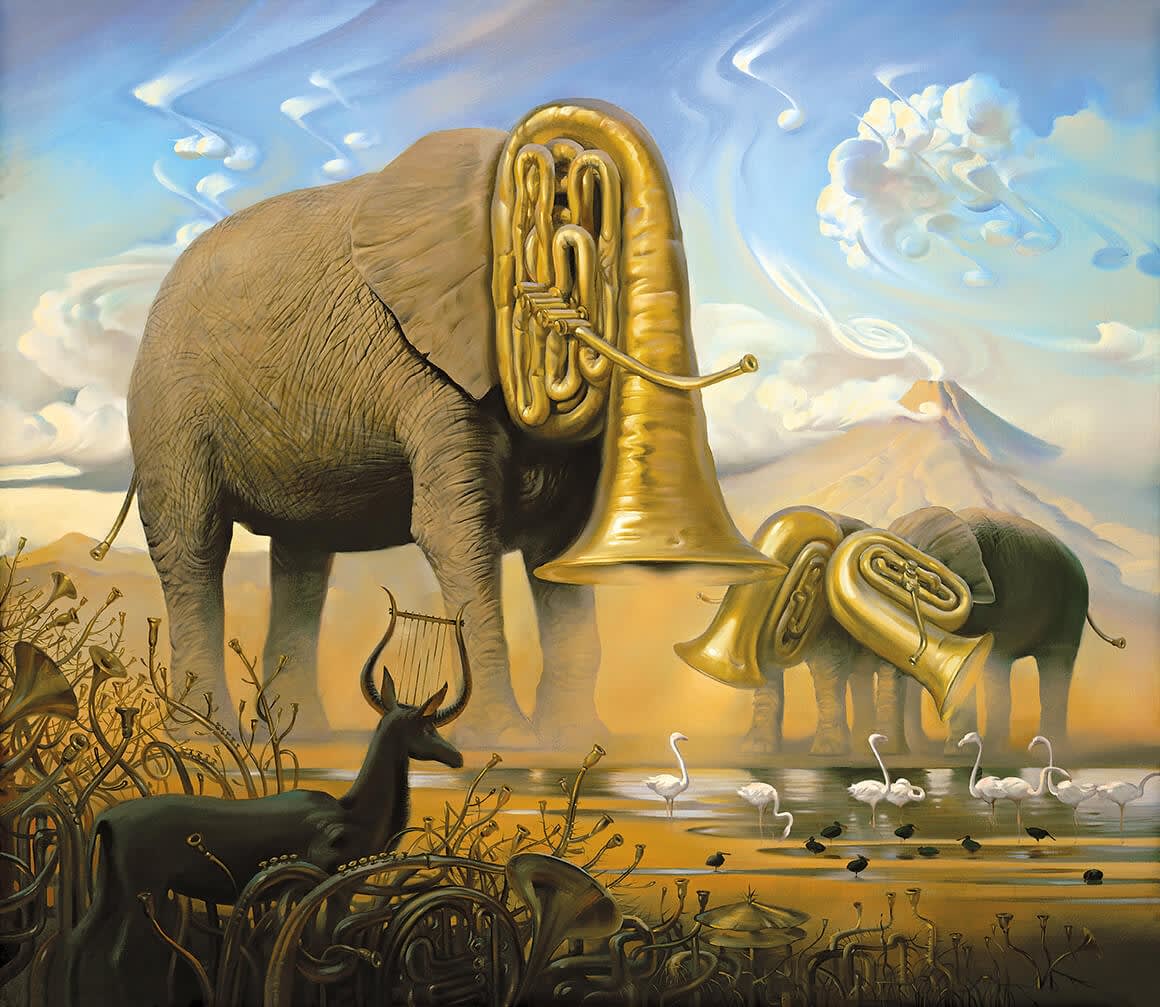

Vladamir Kush. African Sonata, n.d. Giclee on canvas; 21 x 24″. Jacob Gallery collection, Oakville, Ontario, CA. Image by Jacob Fine Art Gallery.


Along with the theme of Kush’s work many of them use a hazy yet sunny, dreamlike landscape as the background. One of his most well known works is Departure of the Winged Ship (circa 2000, oil on canvas, 39 in × 31 in), a staple within Surrealist art published in books and magazines. It is commonly mistaken as one of Dali’s works. It features a large wooden ship stylized to look like the ones from centuries ago and instead of using a cloth sail it is replaced by colorful vibrant butterflies resembling good luck. The top clouds are puffy yet are also illustrated to look curly giving them a whimsical effect. Artistically placed there are also two sets of wings apart from the sail that are on the bottom. Kush’s standard skinny humanoid figures wave goodbye with their fishing nets at the bottom right standing on top of the rocky shore. It’s said to
speak upon the exciting adventure behind a distant voyage.


What makes Vladimir Kush so appealing is the feel good themes of imagination that take the viewer out of the everyday mundane, which is something everyone regardless of background
enjoys. The power to wish and the power of imagination inspires the viewer within their own life and it’s difficult to feel otherwise when looking at his work. Like other surrealist pieces it’s
enjoyable for the viewer to make sense of the quirky juxtapositions and the meaning behind his metaphors. In other words, the unordinary makes the viewer stop and stare and can’t help but want to make sense out of it.
Dada and Surrealism

        At first glance, Dada and Surrealism can easily be mistaken for each other. This is because their styles and motivation behind the art is similar. Both of these movements are meant to make viewers of the art question logic. In her article on Dada and Surrealism, Alice Samusevich writes, “They sought to break down conventions in the arts in order to bring forth a new, improved culture…Surrealism was similar to the Dada movement because it was meant to defy the reason and logic in response to the seemingly unreasonable World War I.” However, if you look past the sometimes questionable, outlandish pieces both movements have to offer, you’ll find that their emergence, styles, and messages are different in a lot of ways. 

        Dada first emerged in Zurich, Switzerland 1914 as a result of the end of the first World War. As what happens with the end of most wars, countries have to rebuild and there is generally a more serious atmosphere. Many artists started to grow unhappy with the monotony of everyday life. Art historians at the MoMA explain, “For the disillusioned artists of the Dada movement, the war merely confirmed the degradation of social structures that led to such violence: corrupt and nationalist politics, repressive social values, and unquestioning conformity of culture and thought… Dada artists sought to expose accepted and often repressive conventions of order and logic, favoring strategies of chance, spontaneity, and irreverence.” Dada artists were often anti-establishment, left leaning individuals. They proudly rejected the meaning of traditional art and what they felt it stood for. Often, the art world and artists can be seen as pretentious, elitist, and so on. Dadaists, being against the bourgeoisie, rejected these ideas.

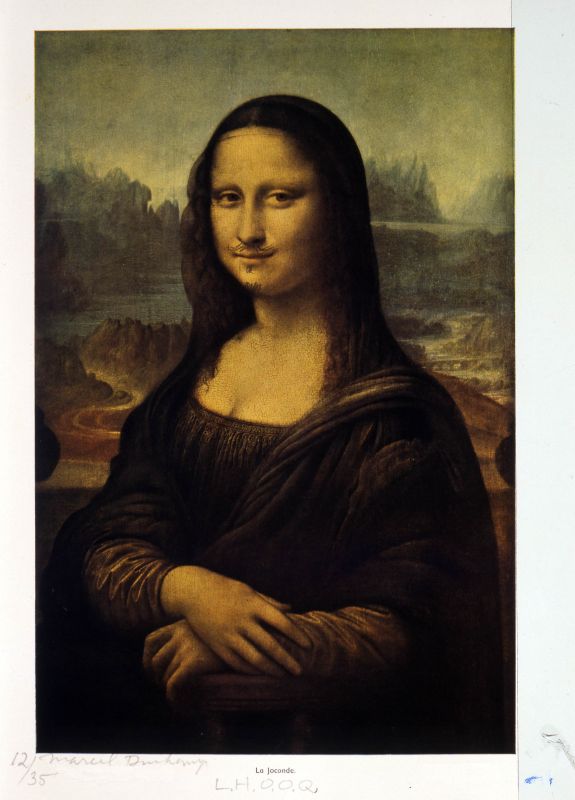
Marcel Duchamp. L.H.O.O.Q., 1919/1964 Rectified readymade. Pencil on reproduction; 30 x 23 cm. Collection of the Israel Museum, Jerusalem The Vera and Arturo Schwarz Collection of Dada and Surrealist Art. Image by Israel Museum. Photo by  Avshalom Avital.

        L.H.O.O.Q (1919) by leader of the Dada movement, Marcel Duchamp, depicts the Mona Lisa painting by Leonardo DaVinci with a handlebar mustache and goatee. This is known as a “readymade,” which gives new life and purpose to everyday objects. According to Dr. Charles Cramer and Dr. Kim Grant, “The readymade is divorced from its ordinary context and use value and re-presented in an art world context. This encourages us to encounter the object in a different way.” The piece is meant to be a comical critique of art in general. The Mona Lisa is one of the most iconic paintings in history, today it is worth about $850 million. By making a satirical piece of this piece, perhaps Duchamp was finding the humor in a painting that many people take so seriously. 

        As Dada art began to dwindle in popularity, Surrealism emerged in Paris in the early 1920s. Similar to Dada, Surrealism was also a response to the first World War. In his article on surrealism, art historian James Voorhies says, “The cerebral and irrational tenets of Surrealism find their ancestry in the clever and whimsical disregard for tradition fostered by Dadaism a decade earlier.” Surrealists wanted to introduce different ideas, and to inspire people to think beyond what they think they know about the world. 

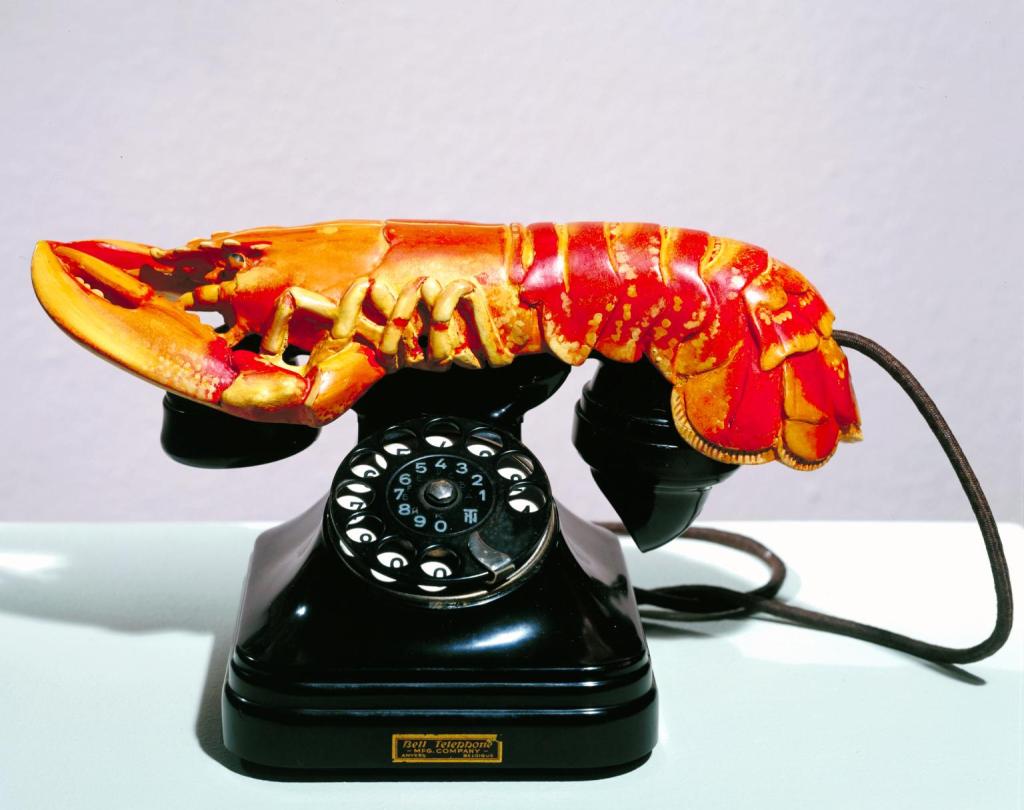
        Unlike Dadaists, Surrealists consider themselves to be real artists. On the other hand, Dadaists’ art is meant to mock the art world; it is anti-art. Surrealism emerged not to mock, but to make people question rational thought. Surrealists’ goal was to make thought provoking work that makes you see the world in a new perspective. Also, although Dada and Surrealism came about because of World War I, dada was a negative and critical expression of feelings, while surrealism was a more positive expression. In other words, Dadaists used their art as an outlet to critique, and surrealists used their art to simply question. One example of this style of art is Lobster on Telephone (1938), a sculpture by Edward James and Salvador Dalí. The title describes the appearance of the work perfectly; there is a plastic, red lobster on top of an black rotary phone. These are two vastly different things that the average person would not think would go together. When asked why he created the piece, Dalí said, “I do not understand why, when I ask for a grilled lobster in a restaurant, I am never served a cooked telephone.  I do not understand why champagne is always chilled and why on the other hand telephones, which are habitually so frightfully warm and disagreeably sticky to the touch, are not also put in silver buckets with crushed ice around them.” James and Dalí wanted viewers of the piece to question its purpose; was there even meant to be a purpose? Does all art have to have meaning or can it just exist for art’s sake?

Salvador Dalí. Lobster on a Telephone, 1938. Steel, plaster, rubber, resin and paper; 7″ x 13″ x 7″. Tate Modern, London, England. Image by Tate Britain. Photo by Salvador Dali, Gala-Salvador Dali Foundation/DACS, London 2020.

        Known for their humor and not taking themselves too seriously, Dadaism and Surrealism have many things in common and it is easy to see why they are often mistaken for each other. They also have many differences as well; Dada was more negative, meant to critique, and was anti-establishment. On the other hand, Surrealists were more positive, meant to inspire questions, and they were less involved in politics when it came to their art. Despite their similarities and differences, they are two powerful art movements that are still respected and discussed today.

Sources

Cramer, Dr. Charles, and Dr. Kim Grant. “Dada Readymades.” Khan Academy. Accessed on December 13, 2021. https://www.khanacademy.org/humanities/art-1010/dada-and-surrealism/dada2/a/dada-readymades.

Ducahmp, Marcel. Pencil on reproduction, 1919/1964. Israel Museum, Jerusalem. https://www.imj.org.il/en/collections/199796

MoMA. “World War I and Dada.” MoMALearning. Accessed on December 13, 2021. https://www.moma.org/learn/moma_learning/themes/dada/ 

Riggs, Terry. “Lobster Telephone.” Tate Britain. Last modified March 1998. https://www.tate.org.uk/art/artworks/dali-lobster-telephone-t03257 

Samusevich, Alice. “Dada and Surrealism.” Eportfolios@Macaulay. September 23, 2009. https://eportfolios.macaulay.cuny.edu/weinroth2009/2009/09/23/dada-and-surrealism/.  

Voorhies, James. “Surrealism.” Met Museum. Last modified October 2004. https://www.metmuseum.org/toah/hd/surr/hd_surr.htm