Dada and Surrealism

        At first glance, Dada and Surrealism can easily be mistaken for each other. This is because their styles and motivation behind the art is similar. Both of these movements are meant to make viewers of the art question logic. In her article on Dada and Surrealism, Alice Samusevich writes, “They sought to break down conventions in the arts in order to bring forth a new, improved culture…Surrealism was similar to the Dada movement because it was meant to defy the reason and logic in response to the seemingly unreasonable World War I.” However, if you look past the sometimes questionable, outlandish pieces both movements have to offer, you’ll find that their emergence, styles, and messages are different in a lot of ways. 

        Dada first emerged in Zurich, Switzerland 1914 as a result of the end of the first World War. As what happens with the end of most wars, countries have to rebuild and there is generally a more serious atmosphere. Many artists started to grow unhappy with the monotony of everyday life. Art historians at the MoMA explain, “For the disillusioned artists of the Dada movement, the war merely confirmed the degradation of social structures that led to such violence: corrupt and nationalist politics, repressive social values, and unquestioning conformity of culture and thought… Dada artists sought to expose accepted and often repressive conventions of order and logic, favoring strategies of chance, spontaneity, and irreverence.” Dada artists were often anti-establishment, left leaning individuals. They proudly rejected the meaning of traditional art and what they felt it stood for. Often, the art world and artists can be seen as pretentious, elitist, and so on. Dadaists, being against the bourgeoisie, rejected these ideas.
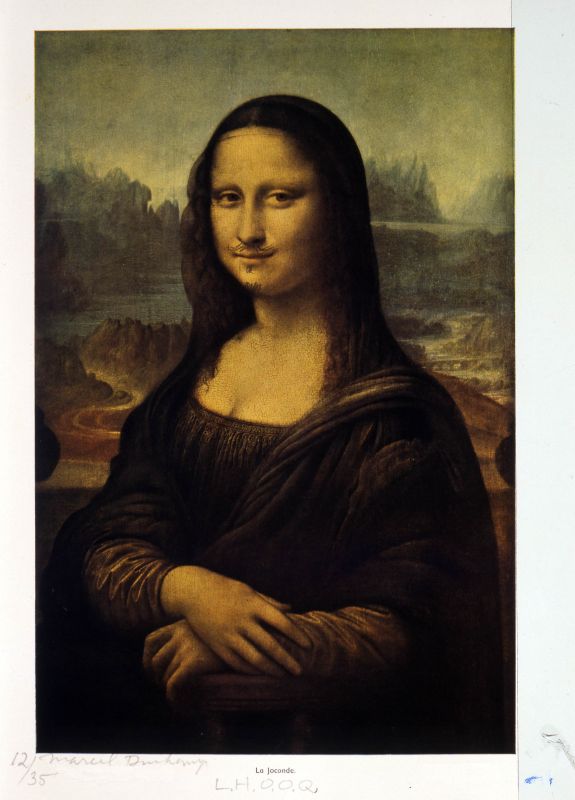
Marcel Duchamp. L.H.O.O.Q., 1919/1964 Rectified readymade. Pencil on reproduction; 30 x 23 cm. Collection of the Israel Museum, Jerusalem The Vera and Arturo Schwarz Collection of Dada and Surrealist Art. Image by Israel Museum. Photo by  Avshalom Avital.

        L.H.O.O.Q (1919) by leader of the Dada movement, Marcel Duchamp, depicts the Mona Lisa painting by Leonardo DaVinci with a handlebar mustache and goatee. This is known as a “readymade,” which gives new life and purpose to everyday objects. According to Dr. Charles Cramer and Dr. Kim Grant, “The readymade is divorced from its ordinary context and use value and re-presented in an art world context. This encourages us to encounter the object in a different way.” The piece is meant to be a comical critique of art in general. The Mona Lisa is one of the most iconic paintings in history, today it is worth about $850 million. By making a satirical piece of this piece, perhaps Duchamp was finding the humor in a painting that many people take so seriously. 

        As Dada art began to dwindle in popularity, Surrealism emerged in Paris in the early 1920s. Similar to Dada, Surrealism was also a response to the first World War. In his article on surrealism, art historian James Voorhies says, “The cerebral and irrational tenets of Surrealism find their ancestry in the clever and whimsical disregard for tradition fostered by Dadaism a decade earlier.” Surrealists wanted to introduce different ideas, and to inspire people to think beyond what they think they know about the world. 

        Unlike Dadaists, Surrealists consider themselves to be real artists. On the other hand, Dadaists’ art is meant to mock the art world; it is anti-art. Surrealism emerged not to mock, but to make people question rational thought. Surrealists’ goal was to make thought provoking work that makes you see the world in a new perspective. Also, although Dada and Surrealism came about because of World War I, dada was a negative and critical expression of feelings, while surrealism was a more positive expression. In other words, Dadaists used their art as an outlet to critique, and surrealists used their art to simply question. One example of this style of art is Lobster on Telephone (1938), a sculpture by Edward James and Salvador Dalí. The title describes the appearance of the work perfectly; there is a plastic, red lobster on top of an black rotary phone. These are two vastly different things that the average person would not think would go together. When asked why he created the piece, Dalí said, “I do not understand why, when I ask for a grilled lobster in a restaurant, I am never served a cooked telephone.  I do not understand why champagne is always chilled and why on the other hand telephones, which are habitually so frightfully warm and disagreeably sticky to the touch, are not also put in silver buckets with crushed ice around them.” James and Dalí wanted viewers of the piece to question its purpose; was there even meant to be a purpose? Does all art have to have meaning or can it just exist for art’s sake?
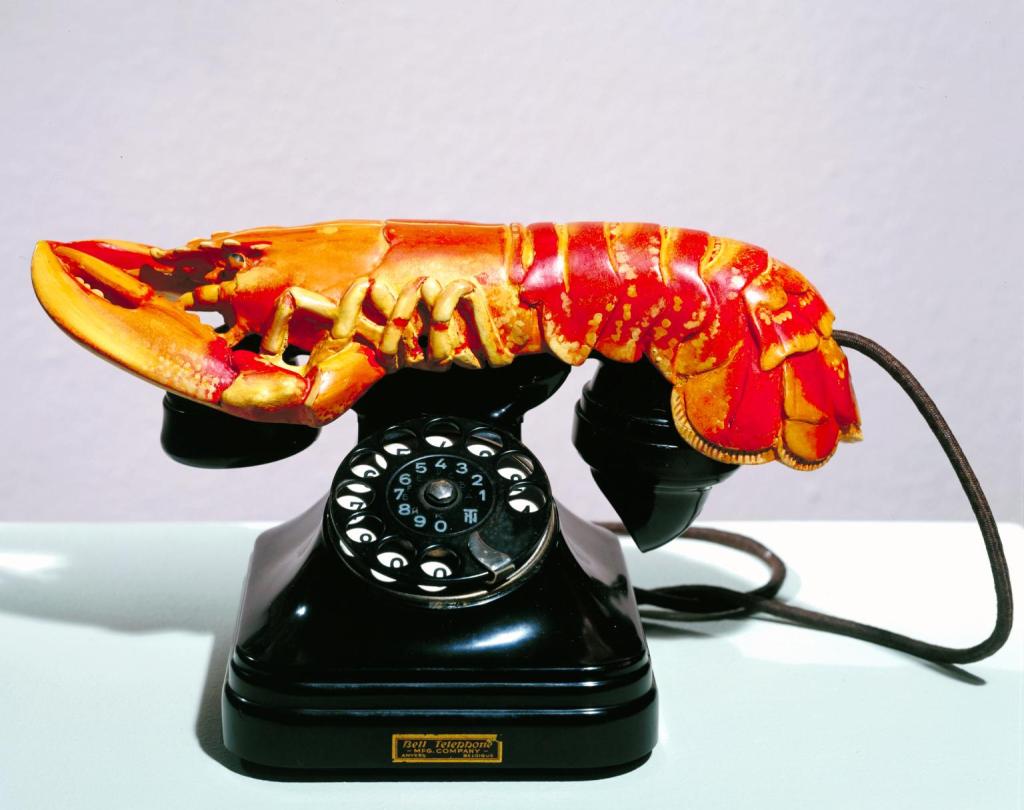
Salvador Dalí. Lobster on a Telephone, 1938. Steel, plaster, rubber, resin and paper; 7″ x 13″ x 7″. Tate Modern, London, England. Image by Tate Britain. Photo by Salvador Dali, Gala-Salvador Dali Foundation/DACS, London 2020.

        Known for their humor and not taking themselves too seriously, Dadaism and Surrealism have many things in common and it is easy to see why they are often mistaken for each other. They also have many differences as well; Dada was more negative, meant to critique, and was anti-establishment. On the other hand, Surrealists were more positive, meant to inspire questions, and they were less involved in politics when it came to their art. Despite their similarities and differences, they are two powerful art movements that are still respected and discussed today.

Sources

Cramer, Dr. Charles, and Dr. Kim Grant. “Dada Readymades.” Khan Academy. Accessed on December 13, 2021. https://www.khanacademy.org/humanities/art-1010/dada-and-surrealism/dada2/a/dada-readymades.

Ducahmp, Marcel. Pencil on reproduction, 1919/1964. Israel Museum, Jerusalem. https://www.imj.org.il/en/collections/199796

MoMA. “World War I and Dada.” MoMALearning. Accessed on December 13, 2021. https://www.moma.org/learn/moma_learning/themes/dada/ 

Riggs, Terry. “Lobster Telephone.” Tate Britain. Last modified March 1998. https://www.tate.org.uk/art/artworks/dali-lobster-telephone-t03257 

Samusevich, Alice. “Dada and Surrealism.” Eportfolios@Macaulay. September 23, 2009. https://eportfolios.macaulay.cuny.edu/weinroth2009/2009/09/23/dada-and-surrealism/.  

Voorhies, James. “Surrealism.” Met Museum. Last modified October 2004. https://www.metmuseum.org/toah/hd/surr/hd_surr.htm
The Exploration Between Surrealism and Expressionism

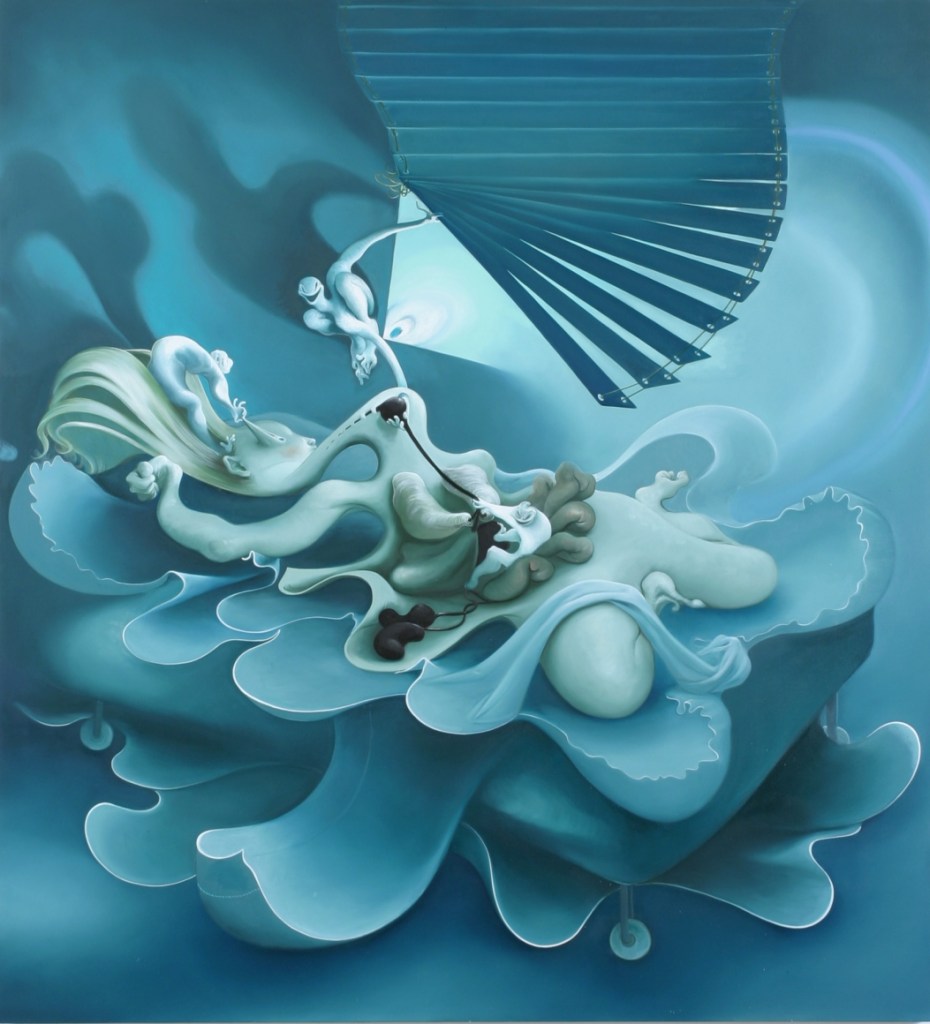
Inka Essenhigh, In Bed. 2005. Oil on Canvas; 68 X 62 inches. 303 Gallery, New York

In the beginning of the twentieth century art was moving more towards mind tantalizing ways then we had previously seen before. Surrealism is the art movement that started in the 1920s and the main concept is for you to look beyond what your eyes are seeing and use your subconscious mind to understand what you’re looking at. Expressionism dates to 1910 with the idea of the artists understanding and not necessarily reality itself but more so the meaning, the expression behind the object or experience. Both requiring the viewer to look further then what meets the eye, surrealism and expressionism are two very different art movements allow us to explore our subconscious mind to reveal deeper meanings.

These two art movements came about in very different ways. But I feel as though they have such a strong connection in the art world as final pieces. “Although both Surrealism and Expressionism are troubled with the perception of the unconscious behavior, surrealism is conventional in introduction while the later one is over-romantic.”[1] Robert Hobbs was known for  exploring the idea of expressionism and surrealism in the hope to understand their methods and help us become aware of their different techniques. But just because two things are done in different ways doesn’t mean they cannot be similar. I think it in fact makes them have even more in common as a complete art piece.

For example, I took a further look at Inka Essenhigh, In Bed. This piece depicted the Surrealism art style, we see a blue tinted representation of a women lying in bed. The woman appears to be stretched out in a way of resembling an octopus with extremities extended out cascading through the canvas. This woman lays over a large bed with the sheets draping alongside her tentacles creates a sea-like feeling. As we begin to look even further, we notice what appears to be window with blinds, that lurk down over the women creating a lurking demon like effect. This depiction instantly reminds the onlooker of a nightmare scene, from the muted blue tones to the unrealistic and eerie aspects to the whole. The entire image requires us to look closely and really use our minds to feel and see everything the artist is trying to tell us in the canvas. This instantly compares to Käthe Kollwitz Death Grabbing at a Group of Children (Tod greift in eine Kinderschar) from the series Death (Tod). In a completely different medium and style, we see here a child in pain; he looks to be screaming and a dark figure coming above that is taking him. From the title we can infer that this figure is death, here to take the child. This again, is a dark piece that with a little subconscious thought we can understand the entire meaning of the piece. The lithograph medium helps us understand the depth and darkness surrounding the underlying meaning of this piece.

When comparing these two styles we can see a line connecting the subconscious mind among surrealism and expressionism to one another. While they have their differences, the overall depicted art from these movements both display a deeper psychological response that the viewer uncovers.

Bibliography

Hobbs, Robert C. “Early Abstract Expressionism and Surrealism.” Art Journal 45, no. 4 (1985): 299–302. https://doi.org/10.2307/776801.

Park West Gallery. “What Is Surrealism? How Art Illustrates the Unconscious.” Park West Gallery. Park West Gallery, January 7, 2021. https://www.parkwestgallery.com/what-is-surrealism-art/.

Polcari, Stephen. “Abstract Expressionism: ‘New and Improved.’” Art Journal 47, no. 3 (1988): 174–80. http://www.jstor.org/stable/777043.

Taylor & Francis. “Early Abstract Expressionism and Surrealism.” https://www.tandfonline.com/doi/abs/10.1080/00043249.1985.10792314?tab=permissions&scroll=top.

Inka Essenhigh. In Bed, 2005. Oil on canvas. (A&T 29)

Käthe Kollwitz. Death Grabbing at a Group of Children (Tod greift in eine Kinderschar) from the series Death (Tod), 1934. Lithograph. Museum of Modern Art Collection.


[1] Hobbs, Robert C. “Early Abstract Expressionism and Surrealism.” Art Journal 45, no. 4 (1985): 299–302.

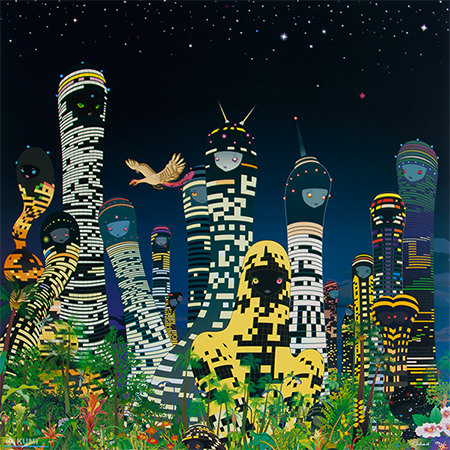
Chiho Aoshima – “Chiho in the City Glow”

Debates centering around the necessity of attending art school in the digital age have recently surged across all online spheres, but art school purists may’ve met their match in the provocative and inspired works of Economics major turned pop artist Chiho Aoshima. Aoshima taught herself how to illustrate digitally, and after having work featured in Takashi Murakami’s Tokyo Girls Bravo,was invited to work in his factory as part of the Kaikai Kiki Collective. Murakami, founder of the Japanese post-modern Superflat art movement, would act as a surrogate professor in her artistic endeavors.[1] Aoshima’s career is proof that ambition and a compelling artistic vision are all one needs to achieve success in the arts.

After finding her place among the well-known KaiKai Kiki Collective, Aoshima would go on to have works included in the Ackland Art Museum in Chapel Hill, the Museum of Contemporary Art in Chicago, the Carnegie Museum of Art in Pittsburgh, and the Seattle Art Museum.[2] This acclaimed work would inspire a collaboration with famed Japanese designer Issey Miyake on his 2003 Spring/Summer collection.[3] Other high-profile projects include a series of works which was featured in numerous ad-spaces throughout the Union Square subway station in New York, and a 2005 solo show in which she presented a 5-screen 7-minute animation piece along with her first sculptural piece.[4] While the transition from confused university student to successful artist may appear seamless on Aoshima’s resume, her unconventional path was, in reality, difficult to navigate.

Aoshima struggled considerably in her time as an Economics student, having been quoted as saying “When I was going to university, (Department of Economics) I was bored to death, even when I was hanging out with my friends. I was eager to create something but didn’t know what to create, every day time passed so slowly and I felt like I was going to die.Since I have had that experience, even in situations where I’m extremely busy and don’t have the time to sleep, I can still think to myself ‘it is better this way than to have nothing to do.”[5] Although she majored in economics, she wasn’t sure what she wanted to do and didn’t feel overly attached to her studies. Instead, she took on a number of part-time jobs to keep her mind busy. One, a job in the graphic design department of a company, required a basic knowledge of Adobe Illustrator which she would learn through her colleagues. From there, she taught herself how to create art with the program and fell in love with the medium.

Much of her thought process can be discerned through her charming use of words. When asked to describe her inspiration, she states, “My work feels like strands of my thoughts that have flown around the universe before coming back to materialize.”[6] It’s evident that she gives ample thought to every piece she creates, easily breathing life into them through her fanciful imagination and conviction of character. In an interview for TimeOut Tokyo, Aoshima further displays her thoughtful nature when asked what initially intrigued her about the relationship between mankind and nature, a common thread throughout her work. Aoshima responded that, “In a big city like Tokyo, it is difficult to get in touch with nature. But in cemeteries, you can see insects, cats and other animals running around amid wild trees and bushes. I like to think of them as oases in the middle of the concrete jungle.”[7] Clearly, Aoshima is far too introspective a person for these thoughts to be contained, and they have been beautifully realized through her art.

Aoshima’s work is sophisticated and intentional, never shying away from obscure or disturbing imagery, yet maintaining pleasantly balanced composition and use of color. Her work is true to the Superflat genre, which is often associated with criticism of post-war Japanese culture, including consumerism and the sexual fetishization of young girls.[8] In pieces like City Glow, Aoshima shows off an astute ability to marry the synthetic and natural world. Flora and fauna are set against a night skyline, the buildings warped to resemble young girls with eerily glowing eyes. She questions the ability of mankind, nature, and the spiritual world to coexist and imagines what our reality might resemble in a utopian future where these elements have collided.[9] In a number of other pieces, she takes to creating surreal and intriguing worlds inhabited by young girls. These young girls, while illustrated in a traditionally cute anime style, are in many cases unclothed and in compromising positions. All the while appearing unbothered and docile, the grotesque way these girls are sometimes presented calls into question their over-sexualization within popular culture and media and its disturbing implications. Aoshima’s work resembles traditional Japanese ukiyo-e art in its use of flat colors and bold, thick lines. Together with her use of bright colors and cartoonishly cute depictions of people and objects, Aoshima’s style itself contrasts with her often nightmarish subject matter.


Images Referenced

City Glow


Sources

  1. https://web.archive.org/web/20141114070909/https://www.blumandpoe.com/sites/default/files/press/Juxtapoz0106.pdf
  2. http://www.artnet.com/artists/chiho-aoshima/
  3. http://english.kaikaikiki.co.jp/artists/list/C6/
  4. http://english.kaikaikiki.co.jp/artists/list/C6/
  5. https://web.archive.org/web/20150504060230/http://magazine.saatchiart.com/culture/reports-from/los-angeles-reports-from/interview_chiho_aoshima
  6. http://english.kaikaikiki.co.jp/artists/list/C6/
  7. https://www.timeout.com/tokyo/art/interview-chiho-aoshima
  8. http://www.artnet.com/Magazine/features/drohojowska-philp/drohojowska-philp1-18-01.asp
  9. http://www.seattleartmuseum.org/chiho

Exploring Automatism

Surrealism is an art movement that took Europe by storm in the 1920s. The intriguing yet controversial subject matter would influence art styles to come. One art movement that greatly influenced by Surrealism was Abstract Expressionism, a movement that was founded twenty years after Surrealism. Abstract Expressionism was an American art movement that focused on applying automatic drawing and painting as a form of expression. Although both art movements have vastly different appearances, the fundamental core of both are identical. Continue reading →