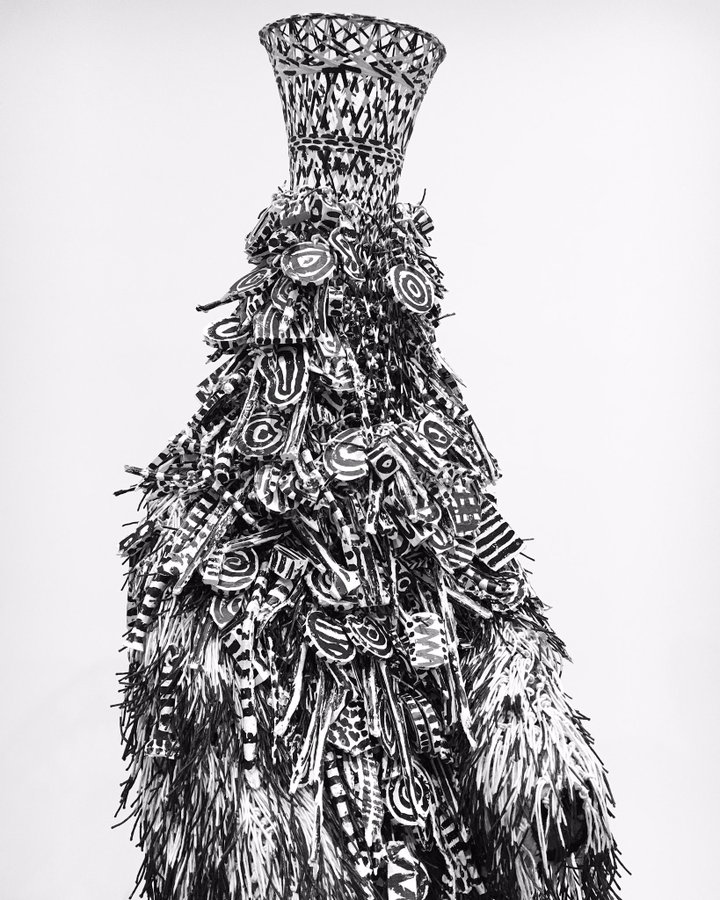
Walking into the Yale Art Gallery, Nick Cave’s Soundsuit (2006) is not a piece you would expect to see. Its tall stature is intimidating and a little frightening at first glance. The sculpture is very tall and almost looks like a monster that is covered head to toe in a mixture of wood, paint, and paper that looks like fringe on the arms and legs. It stands out amongst the other artworks in the room.
Nick Cave. Soundsuit, 2006. Paint, paper, cotton, wood, fabricated fiberglass; 90 × 27 × 19 in.”. American Art Gallery at Yale University Art Gallery, New Haven, CT. Photo by @ronnie_rysz.
Once reading the description of Cave’s process for the piece, it is clear that he intended for the sculpture to be unsettling. As a gay Black man, he knew that he would be seen as a threat in society. He says, “How do I exist in a place that sees me as a threat?” In response to this feeling, Cave wanted to create a piece that could be worn as protection or as a performance piece. Also, perhaps Cave wanted viewers to have a visual representation of what being a Black man in America feels like.
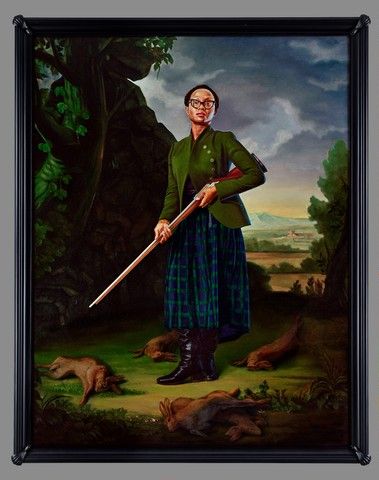
Kehinde Wiley, Portrait of Lynette Yiadom-Boakye, Jacob Morland of Capplethwaite 2017 Oil on canvas 120 5/16 × 93 5/16 in. (305.6 × 237 cm) Yale University Art Gallery and Yale Center for British Art, Purchased with a gift from Mary and Sean Kelly in honor of Courtney J. Martin and with the Janet and Simeon Braguin Fund and Friends of British Art Fund
Britain in the World: A Display of the Collections is an exhibition featured at the Yale Center for British art in New Haven, Connecticut. “This installation reveals how frequently the story of art in Britain focuses on a narrative of international exchange. This arrangement addresses the impact of immigration and travel on British art and culture across the centuries, and the role that the arts have played in propagating Britain’s imperial vision—exploring the ways in which the perception of the British Empire influenced how Britain’s saw themselves and others.” The overall them is very well reflected among each piece of art displayed in this collection. We see many different depictions as well as many different time periods displayed throughout this exhibition giving us a wider look into the theme of British culture and the travels they faced. When walking into the museum, this is the first exhibition you walk through, as you walk in you see billboard size artwork displayed up the wall with a larger than life feeling. It is a truly beautiful first sight and really a stupendous way to start an exhibit. However, the exhibition is split between two floors, and we have the large circular shaped grand room, but the rest of the floor is of a completely different exhibition giving a very unsettling and disconnected feeling. The rest of the Britain in the World Exhibition is up two floors higher, leaving us very disconnected overall. The fourth floor is very well lit with white walls the really contrast the artwork well; most of them have gold frames which helps the balance. One eye-catching feature is noticeable while on the top floor, you have an opening where you can look out to the center of the building and if you look down you see the rest of the exhibition two floors down. It is a very interesting lookout point that the viewer can use, but even with the two-floor layout I still find the space that is set in chronological order, to be arranged in very pleasing way. A few pieces of art that stuck out to me and made an impression on the overall theme of British culture included, a portrait of the artist Lynette Yiadom-Boakye by Kehinde Wiley and Theodor von Holst’s The Wish, 1840. These two painting are a part of the British in the World Exhibition and are both feature portraits of women but in a very different way. I think these two represent strong women, one dated back to the mid-nineteenth century and one in today’s time of the twenty-first century. Wiley’s painting is bold and vibrant, representing another artist in a strong way as a Scottish bunny hunter. However, Holst paints a darker vibe portrait of a women that appears to be a psychic, hence the title the wish. I found myself drawn to both pieces, overall, there is many unique and different styled pieces in the exhibition that might speak to you. In conclusion, I would have to rate British in the World Exhibition a four out of five. While the artwork was incredible filling with many different forms and style that touch on all art created by the British and their culture throughout their journeys The setup of the exhibition really leaves the chronological set up disjointed and confusing. It seems like two different exhibitions because of the layout instead of one big cohesive exhibition. I feel as if it would’ve been better to keep the exhibition on just one floor so we could fully divulge in the art instead of starting the exhibition, going into another that is completely different and then going back.
 Issues in Contemporary Art